It was suggested I post this as its own question.
To attempt rephrase it better, what was/were the first dedicated and sustained attempt(s) at improving military hardware (and/or tactics/strategy etc.) that we would recognize as such? That is to say, not including one-off reforms or the more general attempts at military intelligence/espionage, but more along the lines of a group of people were told 'here is our current pointy stick; go figure out how to make better pointy sticks.'
And as a side question, if the advent is associated with a no longer existent entity, what is the oldest continuous attempt at 'modern' military R&D?
The first documented instance (in Italy) when military engineering was specifically removed from the ad-hoc efforts of an officer or commander to the purview of a noncombatant specialist for a sustained period of time was in early 16th century Italy, when Leonardo Da Vinci was handed letters patent making him "General Engineer and Architect" of the Papal Armies by captain-general cesare Borgia. If you'd like a precise date, it happens to be August 18th, 1502. However, military engineering was so far in its infancy that Leonardo found himself falling back on art multiple times.
So how did Leonardo become the first military engineer? Well, let's go back twenty years: Lorenzo Medici, the behind the scenes ruler of the Republic of Florence, needed to get Ludovico Sforza of Milan in his good books: although Ludovico's teenage nephew Galeazzo Maria Visconti-Sforza was technically duke of Milan, Lodovico had managed to imprison the boy's mother, Bona of Savoy, in the castle of Abbiategrasso and have himself proclaimed regent.
Lorenzo's diplomatic modus operandi was to contrive, outside of the normal appointment of ambassadors, the employment of Florentine artists (normally painters) on projects commissioned by his allies. King Ferdinand of Naples, for example, had two Florentine painters working for him, while a group of painters had also been dispatched to Rome. This tactic got Lorenzo in everyone's good books, plus when he wrote to check up on how his dear artist friends were doing he could, by extension, find out what was going on in rival courts.
The Duchy of Milan had been a historic ally of Florence, but artistically didn't lag very far behind and Lorenzo Medici was more than a little unsure of where precisely he stood after Galeazzo Maria's death. Lorenzo's solution was to send Leonardo Da Vinci.
Leonardo had some success as a painter, but there's a weird four-year "blank period" immediately following his breakthrough successes in the 1470's in which there isn't a trace of his work. Following this period, his questionable work ethic gets worse; starting some works without finishing them, even taking commissions without even starting them.
Somehow, Leonardo entered the circle of Lorenzo de Medici. We know for sure he took up small-scale architectural drafting, but we don't know where he picked up Military Engineering. We can only hypothesize that his boredom with painting had (perhaps starting in his period off the grid) given way to more practical pursuits. Did Lorenzo know this? We don't know. What we do know is that in 1482 Leonardo da Vinci traveled to Milan with a golden lyre officially to take part in a music contest at the Milanese court, but unofficially to deliver a nine-paragraph letter to Lodovico Sforza.
The letter is preserved in its entirely in the Ambrosian Library in Milan. In it, Leonardo outlines his skills (quite literally, as he includes copious sketches); and defines himself not as a painter, but as a multi-talented engineer.
Leonardo's welcome was tepid, but he seemed determined to adapt quickly. While at first his rural Tuscan accent was a barrier to making headway in the Milanese court, even his personal writings would soon be peppered with Lombard-isms. He had been awkward and passè in the refined and lettered Florentine high society (he would bitterly describe himself a "man without letters" both figuratively and literally; his handwriting was so bad he asked a scribe to transcribe his letters to Lodovico) while in the Milanese court his military imagination was fueled by the veterans of Duke Galeazzo Maria's near constant campaigning and the uneasy peace over which his successor Lodovico presided. Milan had been bullying other cities in Italy for some two hundred years, this was the prefect environment for an aspiring military engineer. The ruling House of Sforza themselves were a cadet branch of the House of Visconti who had distinguished themselves as military commanders before Francesco Sforza came to the throne by marrying Duke Filippo Maria Visconti's only child and daughter, Bianca Maria.
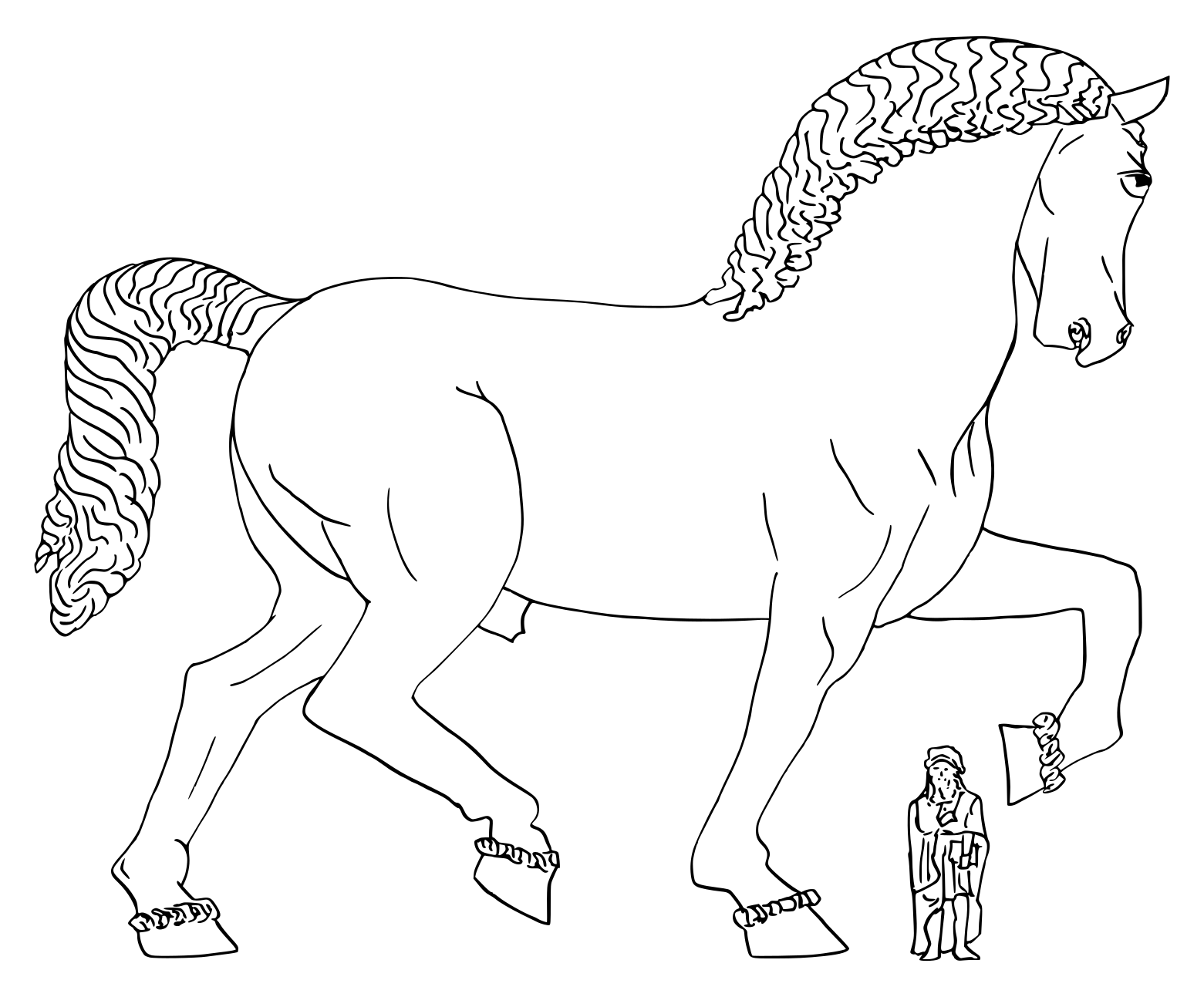
Leonardo's candid letters to Lodovico (which can often be summarized with, "Give me more commissions!") testify to how well he got on in the Milanese court. At first he had lodged with two fellow artists in a workshop near the Ticinese Gate, but by 1485 he had his own workshop with three apprentices, a servant and a housekeeper. Leonardo maintained himself by painting portraits, but was slowly entrusted with engineering commissions, first of which involved the city's canal system and was sent multiple times to Pavia to oversee stones being cut for the city's cathedral (where he also took the chance to read up on anatomy). He built an elaborate model of the Solar System for the wedding of little Gian Galeazzo Maria Sforza and Isabel of Naples, as well as plan an absolutely massive equestrian statue of Lodovico which was never built.
Although we can't know the extent to which Lodovico encouraged Leonardo's military drafting, Leonardo filled entire notebooks on his plans for war machines (the Codex Atlanticus, so called because it's nearly the size of an Atlas, has the greatest number of military contraptions, and it's digitized somewhere but I can't find it. The Codice Trivulziano also has a large section on military architecture).
Leonardo's interest makes sense given military doctrine in Italy at the time, as I wrote in a previous answer, shovels, brick and mortar were just as important as swords and pikes:
In addition, even when armies were within striking distance few actual pitched battles were fought; maneuver and positioning became exponentially more important, as captains tried to keep their companies intact. When two armies finally gave battle, the encounter was often short and relatively bloodless; as soon as one side worked out an advantage, the "loser" often attempted to swiftly withdraw in good order (often to the frustration of their employers; "They avoid defeat just as long as they avoid battle" wrote Macchiavelli). Sieges were more common, especially early in the century. Between the 13th and 15th centuries, the Milanese, Paduans, Veronese and Florentines were almost continuously involved in some kind low-level warfare, often bullying smaller surrounding towns into submitting in order to establish a ring of fortified burghs around their capital. Oftentimes, these sieges were perpetuated by the mercenaries themselves, who needed to be occupied lest they start pillaging; perpetuating a vicious cycle by which larger, richer cities were constantly hounding out weaker ones.
But Lodovico wouldn't give Leonardo his big break as an engineer. Leonardo would have to wait till 1499 when Louis XII of France pressed his claim on Milan. Leonardo first fled to Genoa with Lodovico's court (Genoa was a Milanese puppet-state at this point) before becoming somewhat itinerant around Italy, painting in Mantua, Venice and Florence. Somehow, he managed to come to be employed by Cesare Borgia, the most powerful vassal of the Papacy (and son of Pope Alexander VI). Here, he is finally employed as the first military engineer. Apart from examining enemy fortifications, in his letters patent (written by Cesare in a mix of Spanish and Italian) also entrusted to, "see, measure, and well examine our encampments, fortifications and states [...]" and to do what was needed to strengthen them. Leonardo also invented a new variety of gunpowder at this time.
After the deposition of Cesare Borgia in 1503, Leonardo moved back to Florence, where he took a bizzarre interest in birds (perhaps due to melancholy caused by his father's recent death). He was very briefly employed by the Florentine state as a military engineer and dispatched to the siege of Pisa, where he was entrusted with diverting the river Arno in an attempt to starve out the city. However, a miscalculation caused the project to fail and infuriated the Florentine commander. He would then dedicate himself to painting until around 1509 when the French military governor of Milan offered him a generous stipend to come back to Milan (he had sold many paintings to the French in the past and was well-regarded by them). Unfortunately,the French were soon ousted before he could start any projects apart from personal studies of anatomy at the University of Pavia. His last feat of engineering would be draining swamps in the vicinity of Rome in the employ of Pope Leo X, a Florentine (and a Medici, to boot) in 1514. He would dedicate himself to painting thereafter, joining the court of the French king Francis I in his later years.
Hello users, new and old!
Because this thread is rising fast and the experience of yesterday's thread that hit /r/all was a rather unpleasant one in terms of the vitriol leveled at us for our rules and moderation, this is an early reminder of our rules.
Since this is reddit, I assume most of you have a passing familiarity with Star Trek and the Prime Directive. Well, in this sub, we also have a Prime Directive: In order to fulfill the purpose of this sub, which is to provide educational and informative responses to people with historical questions, our rules are very explicit:
Answers in this subreddit are expected to be of a level that historians would provide: comprehensive and informative. As such, all answers will be assessed against the standards of Historiography and Historical Method. You should cite or quote sources where possible. A good answer will go further than a simple short sentence. As described here, "good answers aren't good just because they are right – they are good because they explain. In your answers, you should seek not just to be right, but to explain."
So, before you post an answer in this thread, please ask yourself the following questions:
Can I answer follow-up questions?
If your answer to this is "no", please don't provide an answer.
As Lt. Worf so aptly put it: "The Prime Directive is not a matter of degree. It is an absolute." The same is true about our prime directive described above because without it, this sub as a space that "aims to provide serious, academic-level answers to questions about history" in order to educate and inform people, would lose its purpose.
Therefore, all answers not adhering to this standard as well as all responses asking about removed answers, will be removed and in cases that run afoul of our other prime directive on civility met with appropriate action
Thank you!