I can take it from the Asian Theater and the Japanese Empire.
The Japanese Empire’s wartime propaganda – both internal and external – is both fascinating and revealing about the mindset of the government, military, and people at the time. Though there are of course overlaps in message and tone to Western propaganda, it also represents a fundamentally different objective than that of the Allies. In contrast to the Allies’ messages of liberation, most of which was produced for domestic consumption, much of Japan’s propaganda was necessarily directed at East Asia as a whole and aimed at promoting the Dai-tō-a Kyōeiken – the “Greater East Asian Co-Prosperity Sphere.”
From Anthony Navarro:
Throughout the war and the years leading up to it, Japan maintained that its campaign through Asia was virtuous and that their Asian Co-Prosperity Sphere would, in the long run, do good for all of Asia under their guidance. Seeing what Western countries were doing to Asia—the French presence in Southeast Asia, the British in Hong Kong and Singapore, and the United States in the Philippines—Japan sought to “liberate East Asia from white invasion and oppression” (Dower 25). In 1942, the Japanese government published a booklet entitled The Greater East Asia War and Ourselves (Dai Toa Senso to Warera) describing how the relationship between Asian countries would be like that of a “branch family.”
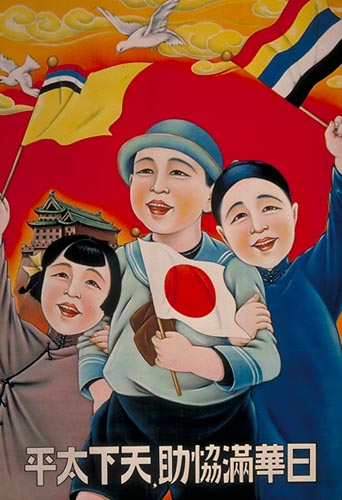
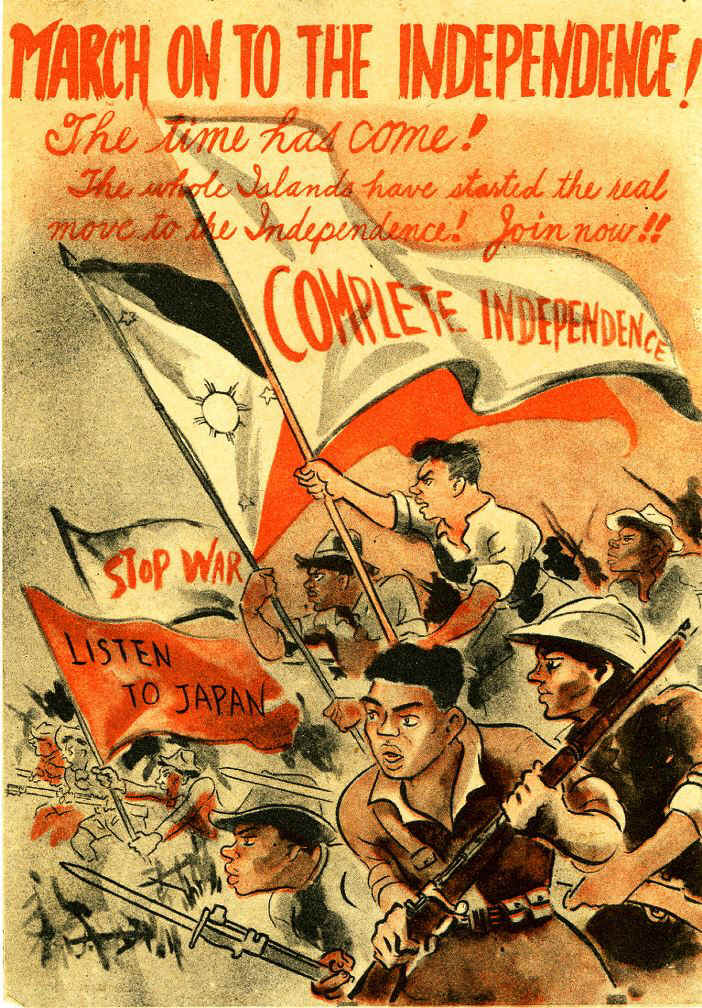
Propaganda aimed at Asia followed this line, with cheerful, bright imagery and very soothing, cooperative statements like “With the help of Japan, China, and Manchukuo, the world can be in peace.”. Here’s another instance – this time aimed at the Philippines – of the Japanese Empire attempting to get the native to rally behind their “vision”: “Dear Filipinos! Have no fear any more! Fighting is now over! American Forces who have been squeezing your land and people with honey words and threatening swords for a long time have now entirely been driven away, by Protecting God of Asia, the Japanese Forces. The only aim of the Imperial Japanese Forces is to free Filipinos from the oppression of white men and establish a paradise for Filipinos on this beautiful land of Philippines.” A Japanese “Independence” for the Philippines
Of course, soothing pan-Asian rhetoric aside, Japan had ulterior motives and agendas for pressing for the so-called “Co-Prosperity Sphere”, which necessitated forceful anti-Chinese rhetoric even while they continued to insist it was “for their own good.” The New York Japanese Chamber of Commerce, for instance, wrote in 1937 – the even of the outbreak of the Second Sino-Japanese War, of the Empire’s rationale for having fought the First Sino-Japanese War in 1904, “Back in 1904-05, Japan… fought Czarist Russia… upon Chinese soil. She fought, first, to save China and, secondly, to save herself. The two were the same thing, because Russian absorption of China meant Japan’s own eventual doom. While Japan was fighting to save China, what was China doing? Secretly she entered into an alliance with Russia against Japan.” Japan likewise characterized its motiviations this go-round in similar “good and only good”, “Pro-active self-defense” rhetoric. Foreign Minister Koki Hirota wrote, “It is hardly necessary to say that the basic policy of the Japanese government aims at the stabilization of East Asia through conciliation and cooperation between Japan, Manchoukuo, and China for their common prosperity and well being. Since, however, China, ignoring our true motive, has mobilized her vast armies against us, we can only counter her step by force of arms.”
In fact on Dec. 15, 1941 – just a week after the US entrance into the conflict following Pearl Harbor – Japanese planes dropped a series of 4-page leaflets over San Miguel once again asserting their moral righteousness. The propaganda said, for instance:
WHAT IS THE NEW ORDER IN GREATER EAST ASIA?
India, china, Philippine, the East Indies and Indo-China were the lands of paradise created by God. During the last two or three centuries, however, these lands turned into an area of misery and suffering by the aggressive exploitation of the White race – the English, French, and Dutch. It was like an invasion by a burglar while the whole family was asleep.
The good natured people did not know how to defend themselves from the burglar with weapons. There was no other way left for the people who were dreaming in their paradise, but to let the invaders do what they please.
[…] Japan will utilize her arms to destroy the wrongs and establish the right…The oppressed must be emancipated from the oppressor…To bring this end is the task and an honor given to Japan today…Drive out the White tyranny of England and America! Let us overthrow the old regime and establish a NEW ORDER in Asia!
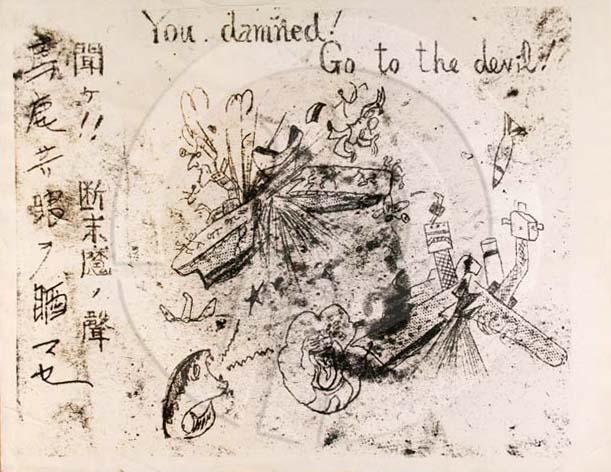
This glowing self-praise aimed at explaining Japan’s aims in Asia can be contrasted with leaflets dropped over Hawaii during the Dec. 7th Raid. YOU DAMNED! GO TO DEVIL! The official U.S. Navy caption explained as of Dec. 27th, “Japanese flyers who bombed pearl harbor on December 7 came equipped with more than just high explosives. They carried crudely phrased propaganda leaflets and supplies of concentrated provisions for forced landings. Pictured here as it was reproduced by duplicating machines on rough foolscap, the propaganda leaflet advised in its English heading, “You Damned! Go to the devil!” Beneath this greeting were drawings of an aircraft carrier and battleship exploding, a fish spitting destruction and a caricature of President Roosevelt. In Japanese characters, a further admonition appeared, reading “Listen to the voice of doom. Open your eyes, blind fools.” “
The Japanese name for China at this point – and where, in part, our English term comes from, as well – was 支那 (Shina), which had actually been used by the Tang Chinese emperor Xuanzong to refer to China as early as the 8th century. Up until the 20th century, it had been simply a neutral terms for China – just like we consider China to be a neutral descriptor without any negative connotations. Nevertheless, as the 20th century had rumbled on and the Qing Dynasty had been replaced with the Republic of China (中華民國, Chn: Zhonghua Minguo, Jpn: Chūkaminkoku), the Chinese KMT had begun pressing Japan to use that name or the short-form 中国, but was rebuffed, persisting in using the archaic “Shina” instead. By the late 30’s this had come to be seen as not just archaic but an outright insult and epithet – by referring to China by its “old” name, that was understood to imply its antiquity and obsolescence. This was furthered upon by Japan’s other name for China (though it was by no means the only national power to use such terminology at the time): 東亞病夫 (Chn: Dong Ya Bingfu, Jpn: Toabyofu), literally “The Sick Man of Asia.” China was old and diseased, and Japan was the cure.
Japanese soldiers took up this archaic and by now insulting epithet in reference to Chinese as well, who they had been taught to view – like all non-Japanese – as racially and culturally inferior. A typical name for a Chinese soldier was 支那兵 (Shina-hei, lit. “Sina-soldier”) while Chinese civilians were referred to by the far more insulting 支那豚 (Shina buta, lit. “Chinese pig”). For good measure, terms dating back back to the First Sino-Japanese War and the 19th century also occasionally cropped up, with probably the most common of these old terms being チャンコロ (chankoro, a corruption of the Hokkian pron. of 清國奴、lit. Qing Dynasty slave”… closest English approximation is probably on the likes of “chinaman” or “coolie”). Another term was 土人 (dojin) meaning “dirt person”. Edit: it means something closer to "Person of the Earth" and was typically more a sarcastic reference to backwardness/uncivilized nature, not actually referring to dirty or being made of earth. ~Thanks to /u/zeropointcorp for pointing out my poor explanation of that, as well as pointing out that I missed the classic "Foreign Devil" 鬼畜米英 (kichiku beiei), and of course the equivalent of "Yankee", アメ公 (Ame-ko).
Those, of course, didn’t tend to make it on to propaganda posters.
Koreans – who had been forcibly annexed into Greater Japan along with Manchuria and northern China (Manchukuo) following the First Sino-Japanese War, had their own derogatory names from the Japanese. Probably the most common was to call Koreans チョン “Chon” – which came about as an abbreviation for the Japanese word for Korea itself Chōsen (朝鮮)、but also a term dating back as far as the Edo Period as meaning “inconsequential person.” For both Korean resistance as well as Chinese guerrillas – specifically Communists – the term 匪賊 (hizoku) was used, meaning “bandits” or “rebels” in a dismissive sense.
Whoops... outstripped the character limit... Pt. 2 here
Edit: Thanks to those who caught my 國 - 主 mess up. That's what I get for cycling back and forthe between Hiragana/Kanji and Traditional Hanzi - neither of which are my "Comfort zone" - all while humming the "March of the Volunteers" to myself. :P Fix'd!