I mean this from a logistical perspective.
I saw this photo of Warsaw in 1945 and it got me thinking, practically every building has been completely destroyed. (http://imgur.com/gBlTzur) It seems like an impossible task to turn ruins back into a functioning metropolis.
Do they just completely disintegrate them and start again? Where do they put the rubble, do they reuse it?
How are goods transported on destroyed roads?
Where do people live? There is no running water or food surely?
What about Law and Order?
As you might have guessed, turning a bombed-out ruin back into a modern economic center is a difficult and time-consuming task. However, it's not impossible. That said, this transformation did not take place overnight. Berlin and Warsaw are both rather unrepresentative of the general post-war rebuilding process for different reasons.
Berlin is a bit of an odd case compared to many cities in post-war Europe because of it's rather unique political situation. The construction of the Berlin Wall in 1961 fundamentally disrupted the existing economic patterns of the city, but both East and West Germany (and their superpower patrons) had an political incentive to subsudize reconstruiction efforts. Nevertheless, the rebuilding Berlin was a decades-long effort. Real estate prices in West Berlin remained low because of an oversupply of empty lots relative to the population well into the 1980s and the current Berlin skyline really only began to take shape in the early 1970s with the building of iconic structures like the Fernsehturm and the Park Inn Hotel along the Alexanderplatz. That said some substantial parts of the city like most of the Potsdamer Platz were not redeveloped until after reunification in the 1990s.
But you asked about the underlying logistical efforts of rebuilding a major city. Despite having nearly 80% of it's housing stock and other buildings destroyed by allied carpet-bombing, much of the underground infrastructure like municipal water systems and subway tunnels survied the war largely intact with only moderate repairs need. Many buildings, especially those made out of masonry rather than wood, still had habitable lower floors once a rudimentary effort was made to construct a make-shift waterproofing "roof" on the former upper stories. Immediately after the war, people would be living in these structures, or even in lean-tos built atop the rubble.
Berlin: Divided City, 1945-1989 (eds. Broadbent & Hake) is probably the best book to discuss both the culture and built environment of Berlin during the Cold War.
Broadbent explains that the rebuilding of Berlin in the post-war era can be viewed as having several distinct phases.
1945-1950: debris removal and makeshift repair of standing residences; main repair of infrastructure
1950-1955: real repair of residences and important public buildings; some new residence buildings. This period sees the onset of the mass-fabrication of brutalist concrete slabs that still dominate as residential construction thruough the former East Germany.
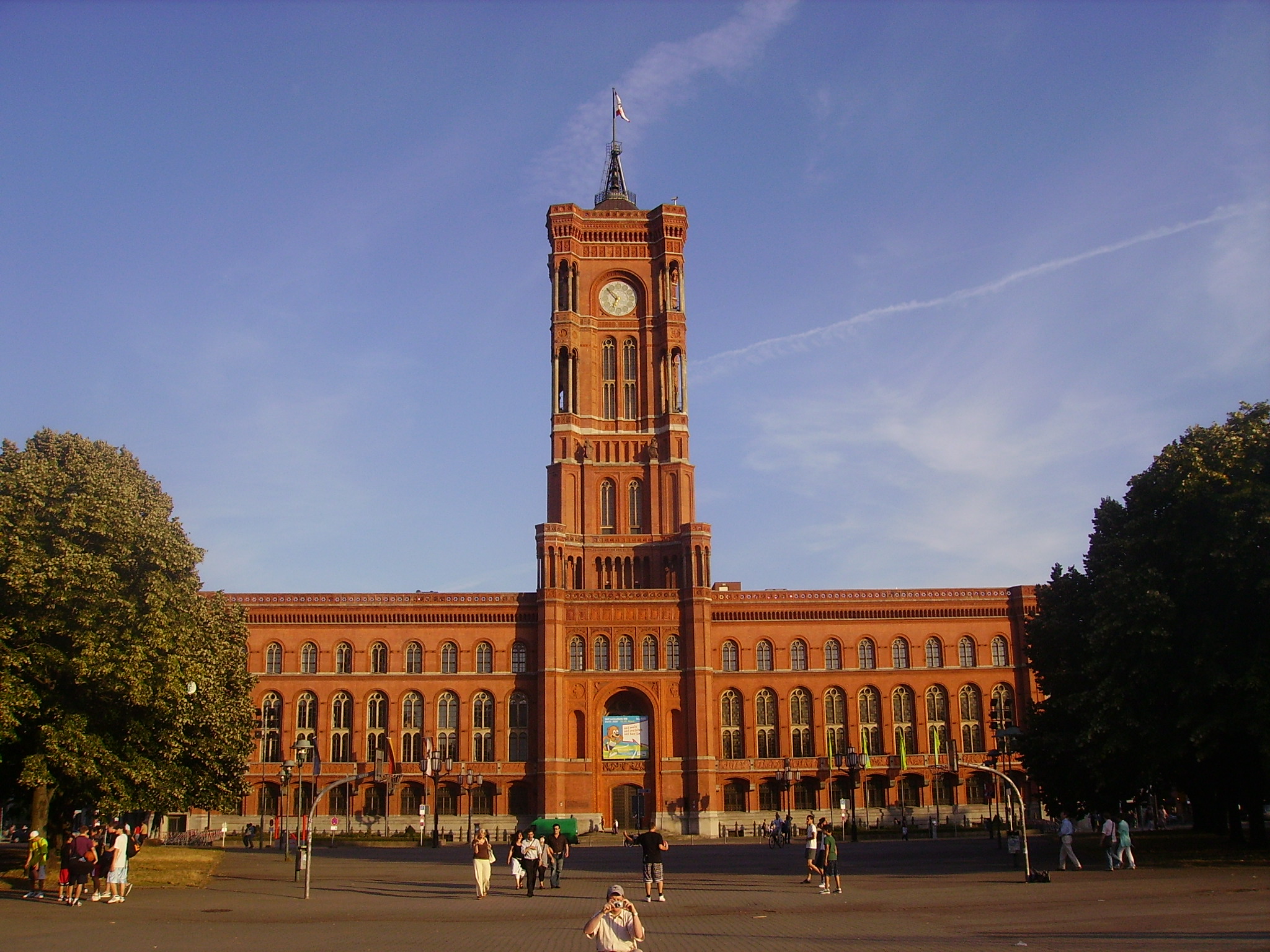
1955-1960: rebuilding of residence buildings and important public buildings. For example, the Red City Hall in East Berlin was rebuilt to it's original plans in 1956.
1960-1965: repair and rebuilding of 'representative' buildings (e.g. the rebuilding of the Charlottenburg palace was finished 1962).
By 1968 or so Berlin was still a shadow of it's former self, but was at least functioning as something resembling a normal with new skyscrapers and a mix of modernist and "replicated architecture".
Further resources:
Here's a West German propaganda film from 1949, proudly showing that the rubble has been cleared from Stuttgart: https://www.youtube.com/watch?v=eeRunqMciD4
Der Spiegel did a special five-part retrospective on the rebuilding of German cities entitled Out of the Ashes: A New Look at Germany's Postwar Reconstruction. The first part can be found at the provided link.