I know there have been auditoriums of some kind for centuries, but I'm specifically talking about speeches like we see in movies where a king or queen or some military leader stands up to give a motivational speech and he or she is talking to hundreds if not thousands of people. They're out in the open, not surrounded by something that would provide acoustics.
I thought of this question this weekend while at the Renaissance Festival during a big moment when they have the joust. People without audio assistance are having to basically yell and even then only the people nearest can make out what they are saying. And as far back as the "queen" was in this case (she had audio assistance), I cannot imagine that anyone could have heard her.
Is this just a cinematic thing done for dramatic purposes? Or were there large gatherings but where only the people closest to the speakers could make out what's being said?
I'll use examples from Ancient Rome because that's what I'm familiar with. The short answer is yes - according to Suetonius, Caesar spoke 'in a high voice, with extravagant gestures' in order to get his point across. The Ancient Romans also had a 'rostra' - a large platform facing the audience - from where they delivered speeches. This was supposed to help acoustics and visibility, as hand signals were a major part of rhetoric back then.
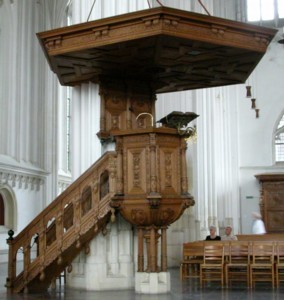
Devices like the preaching chair were also invented in the Middle Ages to improve acoustics. But the most common technique would have been to rely on the audience passing your speech around. Still, orators were expected to have a certain 'power' in their speech; as Cicero writes in De Oratore, the worst thing is to be 'exanimatus' - where your breath (sound) abandons your body. From a modern perspective this would be like 'choking' in a rap battle.
Ancient Greek battle accounts frequently involved a general's speech to the troops. In our surviving sources, these speeches can be as short as one sentence or as long as an essay. There is no indication that the audience consisted only of officers; it is implied that the entire army was being addressed.
The trouble is that, as you say, there are practical reasons why this seems difficult to achieve, and especially the long speeches preserved by the historian Thucydides seem theatrical, unnecessary and boring. For this reason, the Danish scholar Mogens Hansen has argued that they are entirely a literary fiction. Speeches can serve many purposes in historical texts, and it seemed much more likely to him that they were invented for the sake of the narrative than that generals actually spent many minutes screaming their lungs out at their assembled forces instead of doing anything constructive.
However, several scholars have responded to his argument, claiming that the speeches in our sources were definitely real (although perhaps not in the long-winded form they have come down to us). They pointed to historical examples of men with voices that carried far, for instance a preacher heard by Benjamin Franklin:
He had a loud and clear Voice, and articulated his Words and Sentences so perfectly that he might be heard and understood at a great Distance, especially as his Auditories, however numerous, observ'd the most exact Silence. He preach'd one Evening from the Top of the Court House Steps, which are in the Middle of Market Street, and on the West Side of Second Street which crosses it at right angles. Both Streets were fill'd with his Hearers to a considerable Distance. Being among the hindmost in Market Street, I had the Curiosity to learn how far he could be heard, by retiring backwards down the Street towards the River, and I found his Voice distinct till I came near Front-Street, when some Noise in that Street, obscur'd it. Imagining then a Semi-Circle, of which my Distance would be the Radius, and that it were fill'd with Auditors, to each of whom I allow'd two square feet, I computed that he might well be heard by more than Thirty-Thousand. This reconcil'd me to the Newspaper Accounts of his having preach'd to 25000 People in the Fields, and to the ancient Histories of Generals haranguing whole Armies, of which I had sometimes doubted.
They also point out that pre-battle speeches don't just appear in the sources as a rhetorical exercise. There are references to people making speeches without those speeches being spelled out; there is also a specific reference to the Spartans not bothering with speeches, which must indicate a general habit among other Greeks. There is one case where an Athenian general is interrupted mid-speech by the enemy's advance. The whole practice seems to be treated as commonplace, and it was even possible for generals to make trite speeches full of clichés, as Thucydides says:
Meanwhile Nikias, appalled by the position of affairs, realizing the greatness and the nearness of the danger now that they were on the point of putting out from shore, and thinking, as men are apt to think in great crises, that when all has been done they have still something left to do, and when all has been said that they have not yet said enough, again called on the captains one by one, addressing each by his father's name and by his own, and by that of his tribe, and adjured them not to belie their own personal renown, or to obscure the hereditary virtues for which their ancestors were illustrious; he reminded them of their country, the freest of the free, and of the unfettered discretion allowed in it to all to live as they pleased; and added other arguments such as men would use at such a crisis, and which, with little alteration, are made to serve on all occasions alike—appeals to wives, children, and national gods,—without caring whether they are thought common-place, but loudly invoking them in the belief that they will be of use in the consternation of the moment.
-- Thuc. 7.69.2
The point is that these speeches were regarded by the Greeks as a crucial way of boosting the morale of the troops before battle. Since morale was the essential factor in Greek battles, no general would want to do without a speech unless (like the Spartans) he was supremely confident of victory. This is why generals would usually try, however feebly, to make a speech, however brief, before the men charged into the fray.