I worded my title pretty vaguely, because I couldn't really think of a concise way to put it, or rather, I have one very general question and one very specific one.
I've always been interested in ancient warfare, but just recently started reading about the more specific aspects of it, and from everything I've learned about weaponry back in the bad ol' days, it just makes me wonder how anyone managed to kill anyone back then.
Hardened steel plate armor was borderline impenetrable. The only real way to kill or seriously injure someone wearing such a piece was either blunt force trauma (transmitted through the armor) or getting a weapon, such as a dagger, through the gaps.
This I understand. Armor in the late medieval/renaissance period was extremely protective... so why, in the 15th century, did we start seeing things like the Kriegsmesser become popular? I mean, it's a curved sword. What did that do against armor?
Which leads me to my more general question. I had always thought that it was only really plate that was highly protective, but it seems like mail and even leather could protect extremely well against cutting attacks. So why were curved swords ever popular in the first place?
The obvious answer that springs to my mind was that armor, even relatively simple armor, was very expensive and therefore difficult to obtain, but I have since learned that that isn't really even true.
I guess I could compress this rambling mess into this: how did anyone ever manage to get dead back in the day, when armor was this protective? Why were swords ever used over a spear or blunt weapon in the first place?
I appreciate that this is a very broad topic. Thanks for taking the time.
You are absolutely correct that falchions, messers, and indeed any cutting attack from a sword aren't going to penetrate plate armour. Allan Williams measured the maximum energy of a sword or axe blow at 60-130 Joules (swords would be on the lower end of this), and sword slashes in particular are very inefficient in how they distribute force - along the entire length of the strike, dispersing the energy of the attack. 2mm of decent quality steel can withstand a good deal more than that - 2mm of steel or a bit less is a rough average breastplate thickness in the 15th century. Limb armour might be thinner, but there blows are less likely to strike at 90 degree angles. Even buff leather (as in a 17th century buff coats - leather armour was not a major form of protection in 15th century battles) can withstand slashing blows of 70 joules of force, while cuir brulee can withstand slashes of 90 joules; meanwhile a jack made of 30 layers of linen can withstand a 200 joule slash, more than any sword can produce.
So the question is-why where falchions, messers and other weapons used? They weren't used against armour, that's for sure! It is not clear to us how well armoured the average 15th century soldier was. This probably varied greatly between times and places and types of troops. However, what we can say is that while full plate armour was used frequently by men at arms, other soldiers on the battlefield - archers, gunners, pikemen, halberdiers and others - would not be wearing armour that protected them head to foot. Some might not wear armour at all. Common infantrymen very often wore armour that did not protect any of their legs (the household accounts of the Earl of Oxford do not mention leg armour at all when they list the inventory for his retainers, except for what might be some mail skirts for the very upper thighs), and often the arms might go unprotected as well. So weapons that could efficiently kill unarmoured men were valuable on a medieval battlefield because so many of your opponents would be unarmoured or partially armoured.
So how did people kill people in armour?
They shot them with something powerful - an early gun would be the best. Handguns are first used effectively on the field by the Hussites, but technical limitations and tactical liabilities mean that they won't dominate battlefields until the 16th century. 15th century handguns might not penetrate armour of good quality at long range, but they were far better at penetrating armour than bows or crossbows.
They struck them hard with a pollaxe or other staff weapon. There are a number of accounts of knights being wounded in -tournaments- held with pollaxes, which would be done with weapons that weren't even sharpened. On the battlefield, the pollaxe was probably the most common weapon of dismounted men at arms in the 15th century. Pollaxes with back spikes (becs de faucon) might be able to produce enough force to penetrate plate armour, and the axed blades and hammer heads would also strike with a great deal of force. That said, while you have a -chance- to injure a man in armour by striking him with a staff weapon, his armour has a good chance of protecting him. It's not a 100% kind of thing.
They ran him through with a lance - Tobias Capwell has measured lance impacts at over 300 joules, which is more than armour of most thicknesses can withstand (as per Williams' tests). To protect against lance stricks armour often had reinforcing pieces added to it. However, keep in mind that strking 'square' and efficiently conveying the force of the lance can be hard - if a blow is not 'square' it might just glance off.
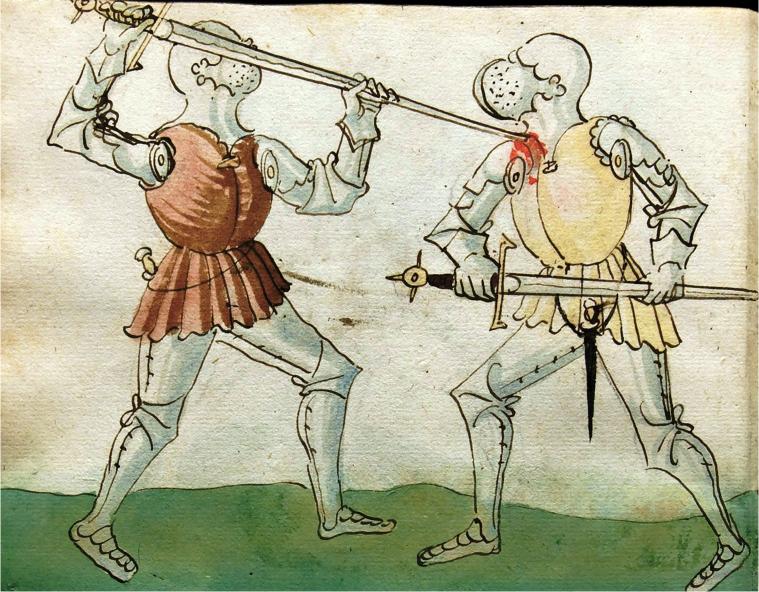
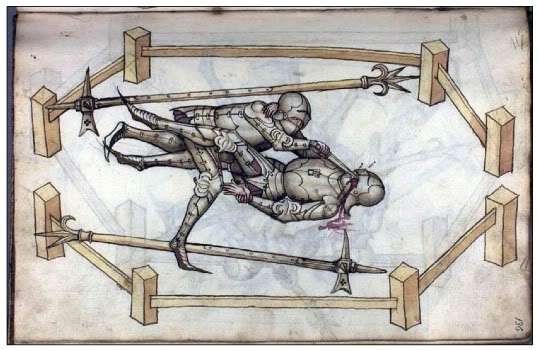
They stabbed in to the gaps of armour - this is probably the best way to kill a fully armoured man. Hit him where his armour isn't. Fighting manuals include techniques for making this more efficent like half-swording, which allowed men at arms to control the point of their sword well enough to aim for gaps in eyeslits, elbows etc. Wrestling could be used to pin and opponent before stabbing them somewhere vulnerable. Even pollaxes and lances would be much more effective if their points found a gap! I should also mention longbows here. Longbows weren't powerful enough to penetrate the fronts of helmets or breastplates, but they were strong enough to shoot through mail protecting the neck or groin or backs of the knees. If archers shoot enough arrows, they increase their chance of striking an unarmoured or less-armoured area.
They killed him in the route. In all honesty this is by far the most likely. Most of the killing in a medieval battle happened when one side routed. Without the support of their fellows, fully armoured men at arms could be surrounded, unhorsed (if they were mounted), pinned to the ground and killed in whatever gruesome manner was most convenient to their pursuers.
1 and 5 are the simplest and most reliable, followed by 4. Penetrating armour in close combat is hard, even with the right tools.
Sources:
Williams, Alan - The Knight and the Blast Furnace
Edge and Paddock - Arms and Armour of the Medieval Knight
Strickland and Hardy - The Great Warbow
Capwell, Tobias - Armour of the English Knight 1400-1450