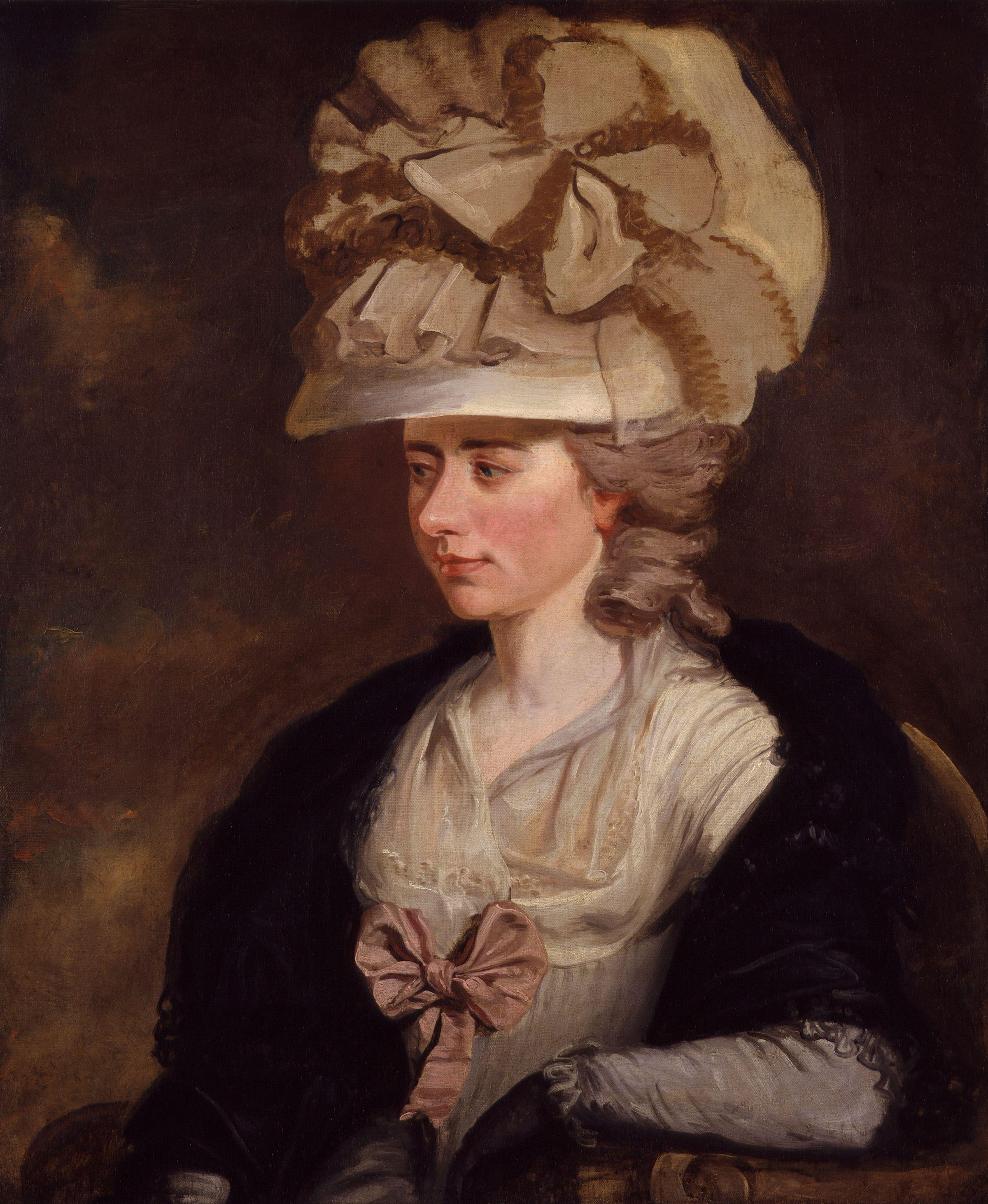
I find it hard to believe that a respectable married woman would wear a neckline so low. Any suggestions on where I can get answers about the clothing of the day?
Just as standards of physical beauty change over time, so too do standards of propriety. For much of the 18th century, women's gowns,^(1) whether formal or informal, were made with their necklines fixed in the same spot. This was due to the gowns' construction. Women's underclothing consisted of their boned stays (what we now call a corset); a linen shift, cut with a fairly deep, rounded neckline that would ideally come very close to the neckline of the stays; and any supports used to hold out the skirt. A stomacher, generally made in the shape of a triangle with the tip pointing down, was pinned on top of the stays, with the upper edge not too far above the necklines of the underclothes; the gown was made so that the front edges of the bodice essentially came straight down from the shoulders, with these edges being pinned to overlap the edges of the stomacher. A good view of the front edges of the gown's bodice can be seen in A Laundry Maid Ironing, and you can see a huge collection of stomachers here at the Metropolitan Museum of Art. In the late 1770s, it became more common for women to skip the stomacher and close the bodice edge-to-edge down the front of their stays, with pins (most common) or hooks and eyes - however, they continued to make the gown's neckline run close to the level of the shift and stays. There was nothing disreputable about a low neckline, and all portraits of respectable women of the period show them, usually even lower than in this costume (or others from the same show, or most other 18th century shows, to be honest). (Examples: 1, 2, 3.)
However, in informal situations, women usually added something to cover up the expanse of flesh somewhat. This could range from a sheerer, lace-edged handkerchief to a more opaque and concealing one (more typical of older and/or poorer women), to an actual short cloak, to nothing more than a fur tippet or a lace frill around the neck, often extending down the chest. With all of these it was common to wear a tucker: a fine linen or cotton ruffle sewn to the neckline of the shift.
(1) This excludes riding habits, which were made to button to the throat; traveling dress that was made partly in the style of riding habits; and bedgowns, full and unfitted jackets
First, yes, necklines were fashionably that low and sometimes lower. However, the open neck was usually either filled in by a kerchief or a tucker (small ruffle). Neither of these were for modesty, but instead to finish off the look of the neck. It just looks open and bare otherwise. The kerchief also serves for warmth or to protect from the sun, so that's the most common method for day to day wear. Simply, wearing a low neckline wasn't seen as inappropriate. It was certainly understood that it was an attractive area of a woman, but covering up the body due to sexual shame was more of a 19th and 20th century issue. There's a famous portrait of the Princess de Lamballe (NSFW) where her neckline is low enough to expose her nipple. This is seen in French fashion plates of the time as well, so it's not a singular occurrence. That's not to say it wasn't commented upon, as this English satire (NSFW) of the ladies at the Opera shows. You can look up portraiture through museum sites such as The Met, V&A Museum, prints from the Lewis Walpole Gallery (search by year in the call number section by ignoring the "1", so 776 for 1776), or even utilizing Pinterest, Wikipedia, or Tumblr for more imagery.