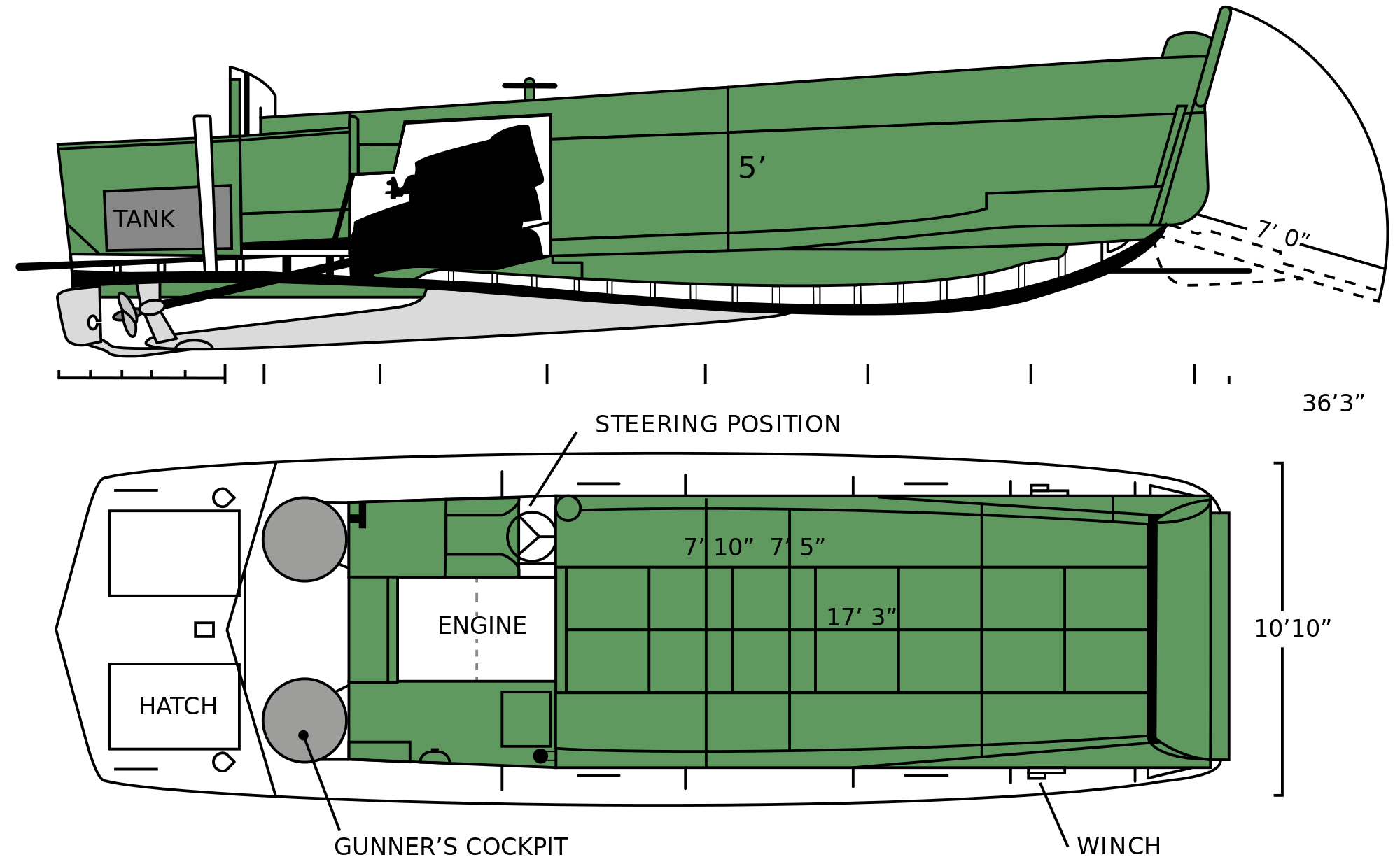
The D-Day craft to which you are referring (the LCVP) was based heavily on the a boat designed by Andrew Higgins in the prewar years, ostensibly for "oil workers" but probably a smugglin' swamp boat during Prohibition. The Marine Corps was not happy with the contemporary Navy options for landing troops on beaches, and so Higgins' design was shoved into production. It underwent a few different versions, the last of which (the LCVP) had modifications based on the earlier Japanese Daihatsu-class landing vehicle. The ramp opens front so that troops and vehicles can (ideally) exit onto the shallow part of the beach while the propeller stays in deeper water, enabling the craft to back up and return to the big ships afterwards to pick up another load. If the ramp were to open to the rear, you've got troops and jeeps exiting into 8 feet of water. Yes, when one of these opened into the face of a German MG-42, it was bad, but for every one of those, there were 20 more landing (relatively) safely and unloading cargo and men efficiently.
You seem to be treating the single scene from "Saving Private Ryan" as evidence that this was how a large number of soldiers died during landings. The scene was put there primarily for effect and not to represent the typical fate of the landing squad. For landing craft to stop directly in front of the gun was just bad luck.
The idea was to place machine guns in such positions that they would have interlocking fire zones for sweeping fire at effective ranges. Sweeping fire was meant to stop the landing forces on the beach and pin them to the ground while they would receive mortar and artillery fire rather than getting killed outright because as deadly as machine guns can be they are not the greatest threat infantry faces in open spaces. That would be HE and fragmentation shells.
The idea behind an amphibious assault is also that you claim the beachhead by breaking out from the beach and establishing a defensive perimeter. When that happens the beachhead is being loaded up with supplies, vehicles and is the staging ground for further reinforcements, medical facilities etc. As long as you are stuck on the beach forming a beachhead is not possible and you are holding up the landing space for the next wave of troops and vehicles and later supplies. If the troops are kept on the beach then every next wave of landing troops is making the beach a better target for the artillery.
It is the difficulty in negotiating obstacles, advancing across the beach and the dunes/banks under machine gun and artillery fire rather than getting out of the boats that is the greatest challenge for the landing wave. The greatest threat for the landing force is either getting stuck on the beach and pounded or disembarking too far from the shore and getting hit while still in the water or drowning, losing weapons and supplies etc. Also you might appreciate how important that is when you take into account how difficult running on sand is, and how comparatively harder running in the water is. Then add to it the necessity of running out through an opening along with your platoon without tripping over, falling, losing anything and then sprinting through water, sand, dunes, barbed wire and whatnot towards the nearest cover.
From the standpoint of the assault as an amphibious operation it is delivering the troops as close to shore as possible and getting back to the main transport ship for more troops as quickly as possible that is the main challenge. It is also not as easy as it seems when you have hundreds of ships maneuvering between obstacles. The goal - again - is to get the troops as quickly as possible, brute-force the fortifications and establish a perimeter so that reinforcements, logistical base on the shore and preferably light artillery and tanks can get there before a counter attack arrives. For that purpose the bow ramp is actually the optimal solution because save for that rare instance where it opens directly in front of a machine gun nest it allows the LCVP to unload its troops quickly and along the shortest route and then be gone for more.
All those things considered together the Higgins boat was a great design which proved so successful that nobody really bothered to address the "death trap" of bow ramp.
Well, they were designed to function in very shallow water (as aside from being flat-bottomed, ballast could be pumped out as it came into shore so the LCVP sat lighter in the water) so opening the front would cause negligible flooding. This gives you a good idea of how they should function in an ideal situation - with the LCVP's bow-ramp opening above the water. This is aided, of course, by the fact that beaches are generally angling upward!
The bow-ramp is a good example of Higgins' masterfully economic design: the LCVP's hull was plywood with a steel plate for protection, but the ramp itself was all steel - tough enough to take a pounding from rough seas, hard-packed sand, pebbles or coral, and the love-taps of incoming fire.
Obviously conditions could be less than ideal (and there's accounts of the occasional ramp being opened prematurely, jack-knifing the LCVP and flooding it) - the water was choppy and craft were drenched with spray, but as with any modern boat the pumps voided the excess water. Primary sources recall men helping bail out their landing craft with their helmets when the pumps were pushed to capacity (buckets were also available).
Sources: US World War II Amphibious Tactics: Mediterranean & European Theaters by Gordon L. Rottman and D-Day, June 6, 1944: The Climactic Battle of World War II by Stephen E. Ambrose