Great question! I pray this answer is up-to-standards. I am not a survivor or witness to the events in Sarajevo during the siege, however, I did study the Bosnian War in university and have since studied the siege specifically due to my personal interest in the topic.
So what was life like for the average citizen of Sarajevo during the siege?
In order to understand this experience, first it is important to examine the overarching conflict that led to the nearly four-year-long siege of Sarajevo. I'll try not to dwell too much on the causes or intricacies of the Balkan Wars as that can fill an entire post in itself, but try to focus specifically on the experience of Bosnia-Herzegovina and Sarajevo.
Following the end of Josip Broz Tito's presidency (1945-1980) upon his death, the former Yugoslavian State (comprised of the "six republics" of Croatia, Slovenia, Serbia, Montenegro, Macedonia, and Bosnia-Herzegovina) began to fracture and by the early 1990's fell into armed conflict. Again, I won't go into the specifics of Yugoslavian history/politics but this is a great paper on the factors for the country's dissolution.
The two largest ethnic groups within the area are the Serbians and Croatians, of which both live in large numbers within the borders of Bosnia-Herzegovina and thus became the focal point of conflict in order to avoid becoming the minority group within the former Yugoslavian state. What emerged was the Republika Srpska/Serb Republic (comprised mainly of ethnic Serbs) and the newly independent Bosnia-Herzegovina. This point centered directly on Sarajevo, the capital and largest city of Bosnia-Herzegovina (comprised of a mix of Bosnians/Croats/Serbians/Muslims).
By April 5th, 1992, divisions of the JNA (remains of Yugoslavia's military) comprised of ethnic Serbs living in Bosnia, renounced their allegiances to Bosnia-Herzegovina and merged with the newly created Serbian Republic Army (VRS), surrounding the capital of Sarajevo, and trapping the numerous but under-equipped Army of Bosnia-Herzegovina (ARBiH) with approximately, "two-hundred-sixty tanks, one-hundred-twenty mortars, and innumerable anti-aircraft cannons, sniper rifles, and other small arms." (5)
So what was life like for the average citizen? That depends largely on when and where. The following is meant to be a projection of what you as a citizen of Sarajevo may have thought and felt regarding the siege around you. Since the nature of the question seems to ask directly about the life of the "average citizen" I'll try and keep it generic, yet accurate as possible. All events and references are sourced at the bottom.
Let's pretend it's two years into the siege, April 5th, 1994. You remember how two years ago the country seemed to split along its seams after Bosnia-Herzegovina declared its independence and Serbian armed forces began setting up barricades and roadblocks on all the routes in and out of the city.
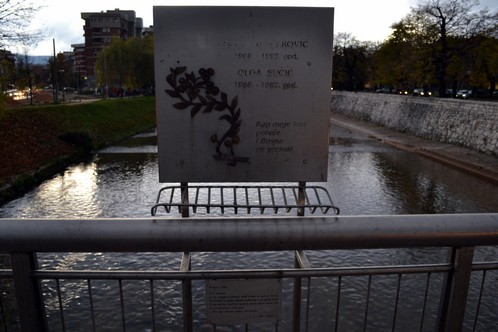
After the VRS took control of the airport, and reestablished the barricades, all of the fuel ran out. Then the electricity, then the heat, and then the water. Soon food and medicine became a memory, except for what you could get from aid-packages or steal. You remember when the President spoke on RT-Sarajevo, asking all able-bodied men to fight in defense of their country. Whispers and rumors flew throughout the homes and offices of all those trapped within the valley when the reality of the war became true to you all. A peace rally led by citizens across the Vrbanja bridge ended with snipers killing the two students Suada Dilberović and Olga Sučić for in whose memories, the bridge was renamed. Was it the same day or the day after when the Bosnian/Serbian couple, Admira Ismić and Boško Brkić (NSFW) were also killed by snipers crossing the Vrbanja bridge?
Whenever it was, that was the day you learned to tread with care through "Sniper's Alley," and to take heed of the wisdom that "if you can see the peaks of the surrounding hills, they too can see you." (5)
The shelling and gunfights all across the city was never anything you truly became accustomed to, but due to the staunch resistance of the ARBiH, the VRS responded with 200 shells landing across the city daily. And that was a quiet day. Most of those injured or killed are due to the shelling. By this time in 1994, some 2,160 people have been killed by artillery alone, and since Suada and Olga and Admira and Boško, 699 people have been shot by hidden snipers, concealed in ruined apartments or among the trees upon the ever looming mountains. You didn't know them at all, but by now there isn't a person in Sarajevo who hasn't heard of them, and the countless others.
CONTINUED BELOW
Followup question: what would morale have been like for them?
Hi there good user of this sub, old and new.
This thread has received some very well-deserved attention for it is a great and really interesting question. Unfortunately it has also received a slew of answers that are not up to the standards of our rules.
For some of you who have been here for a while this might be familiar but threads like these always bring in new people (welcome new users! Hope you enjoy our sub!) and thus we know that it is useful to have a sticky to either remind people about our rules or introduce them to them.
Since this is a sub with the stated aim "to provide serious, academic-level answers to questions about history", all answers posted to questions such as these should be in-depth, comprehensive, and informative as well as measure up to the standards of of Historiography and Historical Method, i.e. answers that give context to the events being discussed so that someone who is unfamiliar with the area can understand.
For those familiar with Star Trek, this is our prime directive so to speak. The vast majority of our users come here for exactly these in-depth, comprhensive etc. answers (almost 95% of all users who took our last survey) and for this reason, we ask everyone attempting to answer questions here to ask themselves the following questions:
Can I answer follow-up questions?
From this, our prime directive, originate also a number of other rules very pertinent to this thread:
Please don't just drop a link to a book that you found pertinent to the question. People come here for comprehensive answers, not links and sources should be discussed in their context.
Please don't post personal anecdotes. While they are interesting and an important part of history, they pose several problems as discussed here, the biggest one being that they are unverifiable. This is an anonymous internet forum. For all everyone else knows, you could be who you say you are but you also could be a 13-year-old on their parents computer looking to troll somebody. We do get comparatively lots of arguments about this rule but it is one we can't really change due to the nature of this forum.
And probably the most important reminder:
The siege of Sarajevo and the events surrounding it are for many people a very emotional and difficult part of their personal, national or political history. All of which is completely understandable. However, we can't and won't abide any sort of bigoted or racist posts here. We are a sub for serious and academic discussion, not a forum to air various stereotypes and racist opinions about people of certain nationalities. Anyone not following this, literally our first rule, will face very grievous consequences.
Thank you!