No, they did not think they were oceans.
Samuel Champlain's 1615 adventures in Ontario represent the first written account we have of a European regarding the Great Lakes. If you consider Lake Champlain to be the "sixth Great Lake", then Champlain's "discovery" would be sooner, but it wasn't until his 1615-1616 travels that he reached Lake Huron and Lake Ontario.
He came to the lakes from what is (to a modern eye, looking at a modern map) an odd direction. Traveling up the St. Lawrence River to the modern site of Montreal, he explored the Ottawa River to the west, past the site of the city that would later be built on its banks. He continued west, reaching Lake Nipissing and then downriver to Georgian Bay in Lake Huron. Traveling southeast along the eastern shore of Georgian Bay, he navigated a series of tributaries and rivers between lakes Huron and Ontario before reaching and crossing that latter lake.
Champlain wasn't traveling alone, of course. His voyages were an attempt to make allies and ensure the fur-trading routes along the upper St. Lawrence and Ottawa rivers stayed open. As a friend of the Huron confederacy, he traveled in a fairly large party, contributing his European firearms to campaigns against the Iroquois and others. I'll use the 1907 translation on Archive.org for this, so you can read the account in full if you want.
Champlain had kind words of the Nipissing people, whom he encountered around the lake of the same name and the northeastern portion of Lake Huron:
"These people are very numerous, there being from seven to eight hundred souls, who live in general near the lake. This contains a large number of very pleasant islands, among others one more than six leagues long, with three or four fine ponds and a number of fine meadows ; it is bordered by very fine woods, that contain an abundance of game, which frequent the little ponds, where the savages also catch fish. The northern side of the lake is very pleasant, with fine meadows for the grazing of cattle, and many little streams, discharging into the lake."
This passage in Champlain's account refers to Lake Nipissing, which is connected by French River to Lake Huron.
In his account, Champlain refers to Georgian Bay of Lake Huron as "Lake Attigouautan" or the lake of the Attigouautan, a term given by the Huron to Champlain.
"All this region (of Lake Huron) is still more unattractive than the preceding, for I saw along this river only ten acres of arable land, the rest being rocky and very hilly. It is true that near Lake Attigouautan we found some Indian corn, but only in small quantity. Here our savages proceeded to gather some squashes, which were acceptable to us, for our provisions began to give out in consequence of the bad management of the savages, who ate so heartily at the beginning that towards the end very little was left, although we had only one meal a day. But, as I have mentioned before, we did not lack for blueberries and strawberries; otherwise we should have been in danger of being reduced to straits."
Again and again in Champlain's account, he discusses the quality of the soil and the food/game available in the area. This is because Champlain's journal isn't just a travelogue; it's supposed to serve as a letter in support of settlement and colonization of the area.
So our first account of the lakes is effectively written by a land developer, someone encouraging others to "buy" into the area.
Allow me to jump ahead almost 200 years. That's nearly how long it took for Europe to learn that the lakes definitively did not connect to the Pacific Ocean. Up until the end of the 18th century, there was a thought that the lakes could, from their western end, connect to a bay or inlet of the Pacific by river or other watercourse.
Warren Cook's Flood Tide of Empire is my favorite work when it comes to the Spanish presence in the Pacific Northwest, and it does a great job of explaining why the Spanish had a vested interest in keeping the Pacific Northwest unexplored as long as there was the possibility of a Northwest Passage.
In 1592, there was a rumored voyage by a man named Juan de Fuca, who allegedly found a route eastward. There's been no definitive evidence that there was such a voyage or even that de Fuca existed. The sole account of Fuca's voyage was in a 1596 account written by Michael Lok in Venice, who told it to another man, who had it published as part of a larger account.
Regardless of the truth, de Fuca's account was carried forward as authentic or at least partially authentic until the 1790s, when Spanish and British voyages of exploration began poking into Puget Sound. That the myth survived so long is attributable to the existence of the Columbia River, which wasn't definitively explored until Americans did so until the last decade of the century.
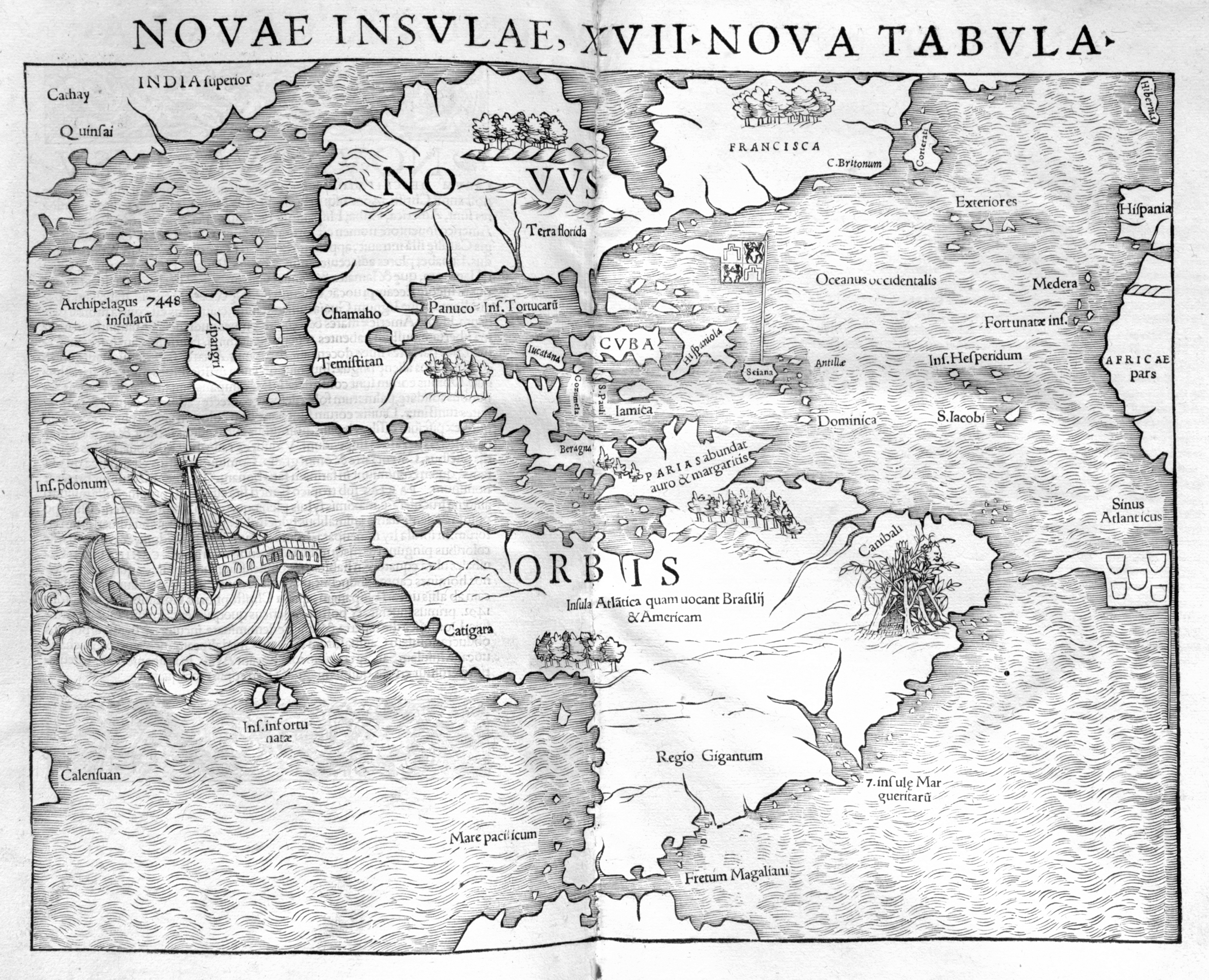
Here is a map by Sebastian Münster, from 1540, which shows the lake area connected to a great north sea extending to the Pacific. [via Princeton]
The main argument against the idea that they would be considered oceans is the fact that they are fresh water, not salt water.
Given that the St. Lawrence River (leading to the Great Lakes) was a major route for the French colonization of America, my guess is that they had a better idea of the Lakes sooner than the inland areas beyond them.
Wisconsin's Water Library has a selection of maps dating back to 1670 that show a fairly good understanding of the areas long before the US would be founded.
Could I use this post to ask if the same was thought about Lake Victoria also?
Are there records of what Native Americans thought of the great lakes?
The first recorded European to have explored the Great Lakes was Étienne Brûlé. He was asked by the Governor of Nouvelle-France Samuel de Champlain to help him in finding a way to the Pacific Ocean by going off to live with the natives (Hurons) west of Nouvelle-France.
Brûlé was illiterate, so he left no maps and no writings of his discovery, and also nothing of the native tribes he met around there. His discoveries are unofficial. Most of what we know of his explorations are shrouded in speculations. We know he had contacts with natives tribes, and it's speculated that they knew the Great Lakes were, well, just lakes.
We also know that all the Lakes weren't officially discovered all at once. Champlain "re-discovered" Lake Huron (1615) and Lake Ontario (1616). Brûlé "found back" Lake Superior in 1629. Jean Nicolet found Lake Michigan in 1634 and Louis Joliet found Lake Erie in 1669 (Source: "À l'ouest des Grands Lacs : communautés francophones et variétés de français dans les Prairies et en Colombie-Britannique", 2004)
The chronological order of the discoveries match the quest of the era: some North-West passage to the Pacific Coast. That was theorized as soon as 1490 by the explorer John Cabot. That's where exploration efforts were concentrated. There's no record of any misconceptions about the Great Lakes being taken for oceans. They're not that big for explorers. The Hudson Bay, in comparison, is a whole lot bigger. And Henry Hudson might, for a time, have thought that he had discovered a way west. But he was abandoned in a rowboat after a mutiny and never seen again.
EDIT: clarified first paragraph.