How is it that France, Gemany, Italy, and the rest of Europe all speak wildly different sounding languages even though they boarder one another? Even under Roman rule and the spread of Latin and "romantic" languages (Italian, Spanish, French) they still manage to be so incredibly different? The word for water in French is "Eau" and in German it's "Wasser" Granted Water is Acqua in Italian and Agua in Spanish but still. So completely different yet these two countries and societies have been next to one another for centuries. Why wasnt one official language used like English is today?
Completely different? Are we entirely sure?
Not only are Eau, Acqua and Agua more similar than you think (they share the same Latin root, Aqua). But if we look at what languages people were speaking in the Mediterranean basin five hundred years ago, just as national borders were solidifying, a Catalan in Barcelona would say "Ura," an Occitan in Marseilles or Montpelier would say "Aiga," while a Ligurian in Genoa would say "Aegoa."
The consecration of Languages only happens with the emergence of the concept of the Nation-State. Consequentially, French schools began teaching the French spoken in Paris, Spanish schools the language spoken in Castille, and Italian schools taught a weird sort of fourteenth century Literary Tuscan. Consequentially, nowadays roadway signage between Ventimiglia and Menton abruptly changes between Italian and French, but historically the change would have been much more gradual, passing through all a manner of local varieties of Ligurian and Occitan before you started hearing the language that is the ancestor of Modern French as you approached Paris.
These gradual changes in language existed precisely because of the imposition of Latin as the primary language of the Roman Empire. Think about it: no television, no radio, no telephones, and the vast majority of people are engaged in agriculture and will never travel more than a few dozen miles from their home. Obviously, even after five hundred years of roman rule, most people were not speaking the same Latin as the orators in the Roman Senate; they would be speaking the Sermo Vulgaris, or "Common Speech." The farther you got from Rome, the weirder people would speak; it is a curious circumstance then that the French now speak a language derived of the Vulgate from the far northeast of France. Had the center of power of the Kingdom of France been in Marseilles, perhaps we'd be asking why Italian, French and Spanish are so similar.
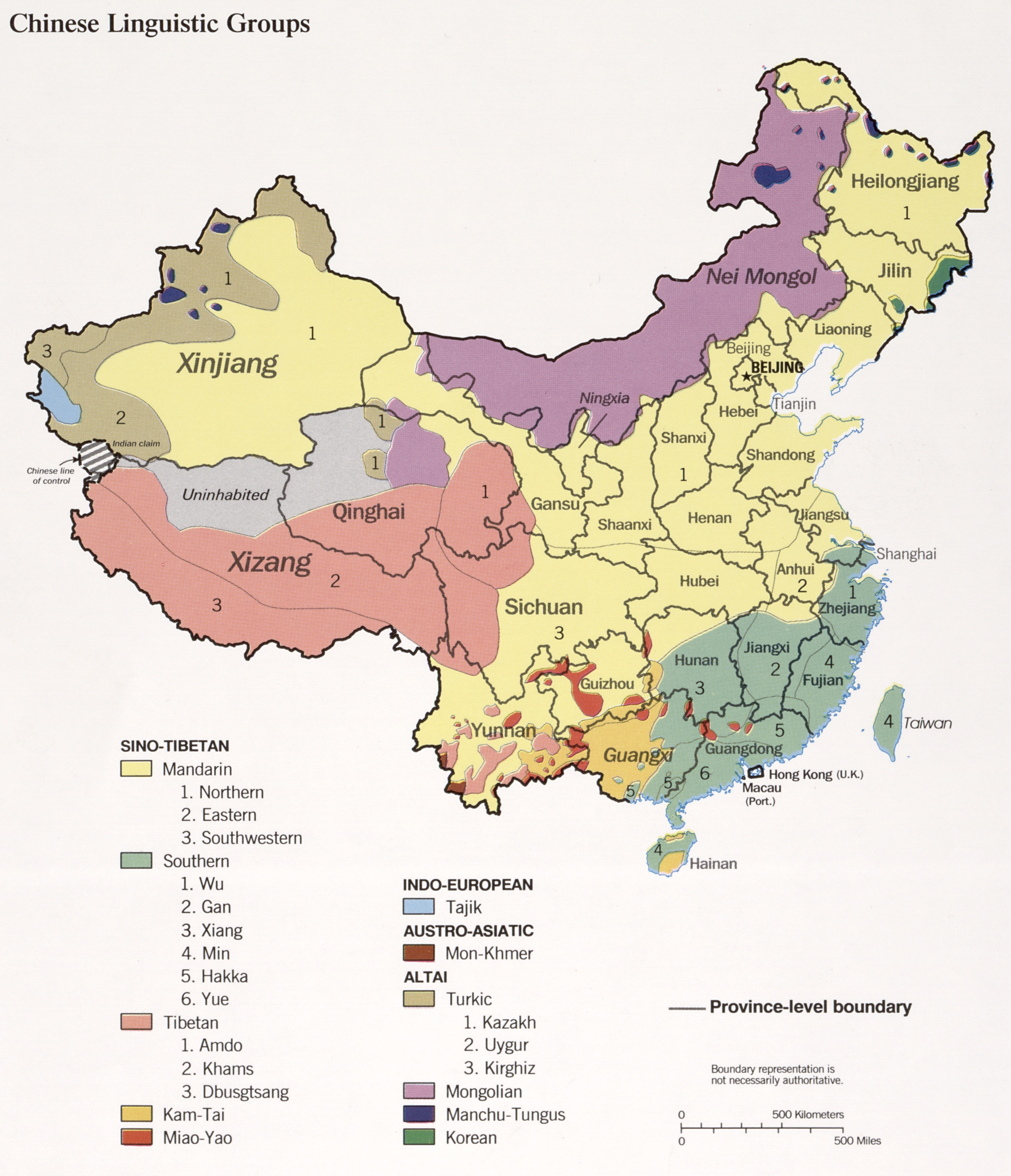
The proliferation of different Romance languages within the former Roman Empire isn't exactly something unique. Although for many years it was the policy of the Chinese Government to impose Mandarin, the language groups of China are equally diverse (and I'm sure that map is incomplete, I'm not an expert on China by any means and immediately see the map leaves out Manchurian). India also has a fantastic agglomeration of languages as does South Africa.
Perhaps the only large countries that lack significantly different language groups are Post-Colonial States where languages were brought over by a single colonizing population with limited mixing with the native population: The United States, Mexico, Brazil, and Argentina are large countries with different language/dialect groups, but the changes are not as significant as in Europe. The only country where I can think of a similar homogenization of language is in Russia, but I have no idea why; it might have something to do with westward expansion by the principalities of old Rus.
And lastly, why is German so different from the languages around it? It's actually not. The Romans never successfully imposed themselves past the river Rhine, so at no point were people in what became Germany speaking Latin Vulgate (medieval clergy did, but that's a pedantic exception). German is actually remarkably similar to languages spoken in Scandinavia, and is related but less similar to Non-Celtic languages spoken on the British Isles. Further, prior to the dramatic population shifts in the 20th century, German and dialects of German were widely spoken on the southern coast of the Baltic Sea. Further, in Eastern Europe many neighboring languages are also remarkably similar; Polish, Czech and Slovak are mutually ineligible to varying degrees, as are many Balkan languages.
So the proliferation of different languages in Europe is nothing unique, and apart from notable exceptions (Hungary!) very few languages are all that different from those of their neighbors. In the modern age, national borders and national language curricula did a lot to interrupt "smooth" transitions between languages, imposing widely different languages within clean-cut borders.
I'd like to point out that what you're seeing is the rule, not the exception. Consider India (where many states have their own regional language), or China (where, despite the long dynastic histories, there are multiple Chinese languages). Or South Africa (with Zulu, !Xhosa, etc.)
An official language often requires some sort of political or cultural institution behind it to enforce its use. Why? Because as time moves on, people in different regions begin speaking differently. That's why people in Texas and Boston sound different, for example. Therefore, unless there is some reason for people to learn this "link language" (as well as a way to do so), people simply won't. Usually, in large empires and states, public education teaches children the "link language" (e.g. schools in China teaching standard Mandarin, schools in the Middle East teaching Fusha).