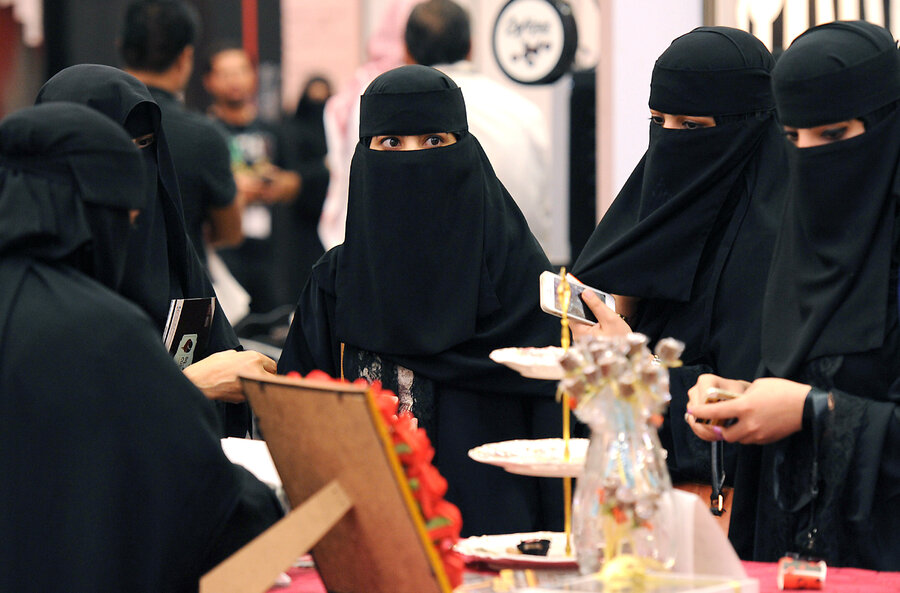
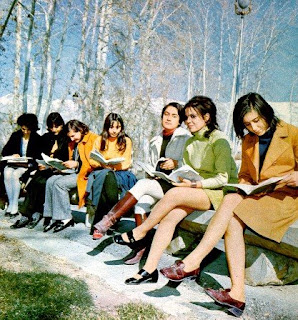
I have seen pictures of women in the middle east 30 or 40 years ago wearing similar clothing to western counterparts. Was there a long period where women were not required to dress like such and recent regimes are the reason for the comeback? Have these traditions been revived as another tool to oppress women in these areas and many who defend it are simply ignorant of these item's history?
Ok before we begin, let's just start off with a bit of terminology.. The broadest catch-all category for all of these is either "veil" or "hijab" as these can both refer to a practice rather than to a specific style. So when using these terms, this is a veil just as much as this is a veil.
Right, let's crack on.
recent regimes are the reason for the comeback
The only 20th century regimes that have forced women to veil are Saudi Arabia, Iran (post-1979) and the Taliban regime in Afghanistan.
Affecting a far greater number of women in the 20th century were actually regimes that passed laws forcing women, either completely or in certain circumstances (such as in university settings or if they're a government employee), to not wear a veil, which would include Turkey, Iran (pre-1979), and Tunisia. A larger number have enforced such bans within our 20 year rule.
I have seen pictures of women in the middle east 30 or 40 years ago wearing similar clothing to western counterparts.
These kinds of pictures can be pretty misleading. Whether it's Iran in the 70s, or Egypt in the 1960s, these pictures almost inevitably depict women who are 1. urban, and 2. wealthy.
In societies that are overwhelming rural and impoverished, that's going to skew the perception significantly.
That being said, from Huda Sharawi's public removing of her veil in the 1920s to some of the more forceful and legally restrictive Westernization efforts in Iran or Turkey, not to mention the overall climate in, say, the Arab world when secular pan-Arab nationalism of a leftist bent was the dominant political ideology, this period from roughly the 1930s to the 1970s did see the most pronounced efforts to culturally Westernize in the Muslim world, including for women's head coverings. In that sense it's unsurprising to see more of these kind of photos from that era than before or since. And in that sense it's the 1930s-70s that should perhaps be viewed as unusual, not the time period since.
It's difficult to quantify but since the 1970s there has been a revival of Islamic piety generally across the Muslim world. The 1979 Islamic revolution in Iran is the most obvious example, but Islamist movements and Islamic revival movements had been gaining strength and support prior to that (for instance, Anwar Sadat's detente with the Muslim Brotherhood) and would continue to gain strength after that (for instance, Saudi Arabia's policy after the seizure of the Grand Mosque in 1979 of increasing the power of the religious police and of funding evangelization (dawa) efforts internationally.)
Have these traditions been revived as another tool to oppress women
There's no doubt that, for instance, the Taliban's imposition of the burqa on women was oppressive. But the increased veiling of women in society has been used polemically and as a political wedge, particularly in the west, in a way that I don't think actually is reflective of the challenges women face. So you have quite a lot of polemical articles like this that purport to show:
the gradual but steady Islamic radicalization invading the Middle East and the rest of the world in the last three decades.
In the form of four photos of graduates from Cairo university increasingly wearing the veil from 1959 to 2004.
So on the one hand, that's completely hyperbolic. On the other I don't doubt that there are secularist women who are very concerned about this.
But as a broader point the problem with articles like this and questions like yours is that too often women's clothing is used as a political lightning rod to justify certain policies towards Muslim countries. So if you conclude from these photos that:
these traditions been revived as another tool to oppress women in these areas
Then it becomes justifiable to oppose that oppression, presumably by any means necessary. I don't want to get into 20 year territory but that kind of argumentation has been used quite extensively since 2001.
I don't agree with all of her points but one of the most thought provoking articles I've read on this question is Lila Abu-Lughod's Do Muslim Women Really Need Saving? Anthropological Reflections on Cultural Relativism and Its Others.
It's a political article writing about recent issues, but I also find Shadi Hamid's writing on this, and on concepts like "forced liberalism" (i.e. countries like France enacting veil bans) to be incredibly useful for understanding this discussion: http://www.theatlantic.com/international/archive/2015/01/france-muslims-liberalism-crisis/384901/