Okay, I realise my question maybe sounds a bit rough as there are several different architectural traditions, all with different elements in design. Yet it seems to me there are certain stylistic elements within the chinese, korean, japanese, vietnamese and to an extent Thai architecture that just look very similar and have a consistency troughout the ages. Just googled Han architecture, Ming and Qing architecture and it seems to me there is a bigger consistency going on than for example between early and late middle ages in europe.
So basically what I want to know is, when were these stylistic elements developed, where did they start, why was there such a consistency (or am I just too ignorant to notice bigger differences) and also were there other trends and traditions before and how did they look like?
Asian architecture is a huge subject, but one particular consistent style has its origin in Nepal. Tibet and Nepal were a center for the Sakya school of Tibetan Buddhism in the 12th and 13th centuries, where they developed a Buddhist style of art and architecture.
In the 13th century, there was a rivalry between Kublai Khan and his brother Ariq over the title of Great Khan of the Mongols. Kublai was elected by the council, but the rivalry continued and the brothers continued to fight for dominance. Kublai accepted the Sakya school of Buddhism to gain support from the large number of Buddhists in his empire, and he picked its leader as his personal instructor. The leader of the Sakya sect at the time was Drogon Chogyal Phagpa, who was thus appointed Imperial Preceptor in Kublai's court.
There was a young architect at the time, born in the Kathmandu valley in Nepal in the Newari community, by the name of Aneka. He was apparently an artistic prodigy, mastering painting, sculpture and architecture while still in his teens. He was working on building a Buddhist stupa in Tibet when Kublai ordered Phagpa to build a stupa in his capital. The war with Ariq had been heating up, and Kublai thought the stupa would win him favor among the people and also secure the blessings of Buddha.
Phagpa was new to Kublai's court and knew no artisans in China. So he sent to Tibet for a team of architects and craftsmen, and around 80 were selected by the Tibetan king and sent to Phagpa at Kublai's court. Aneka was among them, and he was 17 years old at the time. He is referred to in the Chinese histories as "Araniko", so that's how I'll refer to him from now on.
Phagpa was much impressed with Araniko and appointed him head of the team to build the stupa for Kublai, which he did in two years. After that, he wanted to return home to Nepal, but Phagpa persuaded him to stay, accepted him as a disciple in the Sakya order, and presented him personally to Kublai. Araniko then married a Mongol woman and settled down in Kublai's court.
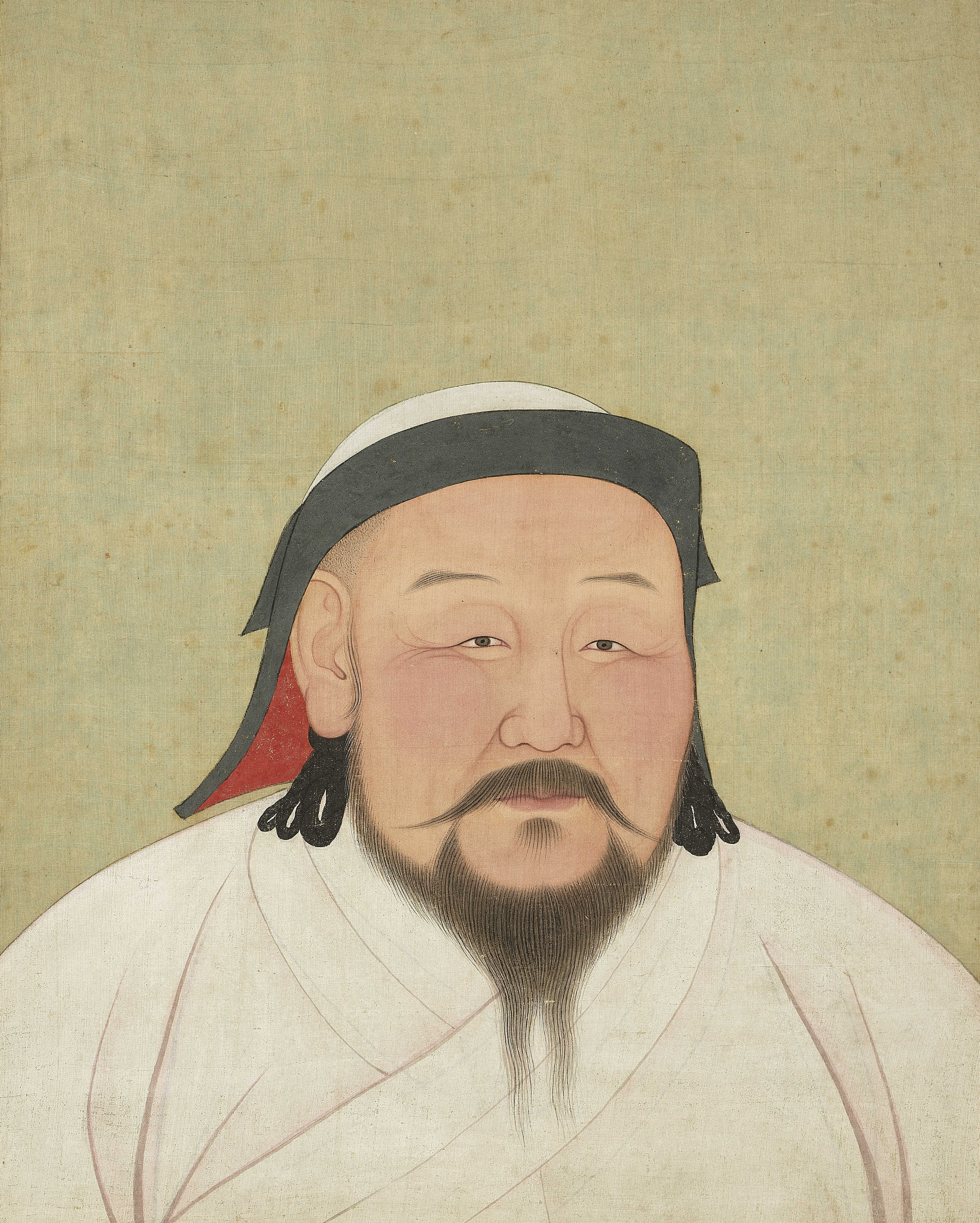
Over the next few decades, Araniko built dozens of Buddhist temples, stupas, and also Daoist and Confucian shrines in the Sakya style. He also did hundreds of paintings and sculptures in the Sakya style. This famous painting of Kublai and this one of his wife Chabi were made by Araniko.
Probably his best known work was the white stupa at the Miaoying Temple in Beijing, which was the tallest structure in China at the time. It's known as the White Dagoba today, and is still standing and considered one of the national treasures of China.
Araniko was offered many honors in Kublai's court, being appointed the director of all artisan classes, kind of the head art guy in charge of all architecture, sculpture, painting, etc. He opened a school, and trained lots of Chinese students in the Sakya style, which became popular all over China, and from there spread into Korea and Japan.
He became very rich and respected, marrying 7 Chinese wives, 2 Mongolian, plus a Nepali wife he brought back from a trip home. When he died, the Emperor declared a holiday and the court went into mourning. He was buried at Xiangshan with imperial honors.
Like I said, Asian architecture is a very complex subject, but one source of the uniformity was this Nepali guy who traveled to Kublai's court in 1260, built a lot of temples, and started a famous school teaching Sakya art.
He is mentioned in many Chinese histories, but most of this information comes from Cheng Xuelou wenji (The Collected Works of Cheng Jufu, who was his contemporary).