I may be proven wrong, but this deeply sounds like it's a myth?
Yes, this account is based on an actual ritual practice in the Roman triumph. The slave standing in the triumphal chariot behind the general, holding a golden crown over his head and whispering “Look behind you. Remember you are a man” is probably one of the most emblematic features of the Roman triumph as known today (cf. the 1970 film Patton). However, our sources to the ritual (and triumphs in general) are fragmentary and contradictory, and there's nothing to prove that the slave was the original and permanent fixture in the ceremony - which he is often assumed to be. It's unclear whether the person holding the crown was always a slave, and there are different versions of his whispered message. This most famous version comes from Tertullian, a second-century CE Christian writer:
He [the emperor] is reminded that he is a man even when he is triumphing, in that most exalted chariot. For at his back he is given the warning: ‘Look behind you. Remember you are a man.’ [Respice post te! Hominem te memento!] And so he rejoices all the more that he is in such a blaze of glory that a reminder of his mortality is necessary.
Tertullian, Apologeticus 33.
However, Tertullian does not mention that the man standing behind the triumphee is specifically a slave. Jerome, another and later Christian writer, believed that the man in the chariot holding the crown was the general’s companion. Jerome repeats half of Tertullian’s phrase (’Remember you are a man’), but he most likely used Tertullian as a source. Where Tertullian would have picked this phrase is unclear; he was from Carthage, Africa, and as far as we know he never went to Rome or witnessed a triumph himself.
A few other authors do mention spoken words, although they are somewhat different. Cassius Dio (7.21.9) does have a public slave in the chariot in his version, but his slave simply says: ”Look behind you”. He explains that the purpose of the ritual is to make the general conscious that disaster may follow, because human life is changeable, so no point in getting too puffed up by pride. So, the message is a bit different in Tertullian’s and Dio’s interpretation. Pliny the Elder also makes a very obscure reference to the tradition (and this passage from him has been badly corrupted), but he seems to imply that there was a slave in the triumph chariot (33.11) holding the crown, and elsewhere he says:
…as a remedy against envy, Fascinus [the embodiment of divine phallus] hangs under the chariots of generals and protects them and a similar verbal remedy urges them to look back in order to conjure away Fortune, the butcher of glory, from following behind him (iubetque eosdem respicere similis medicina linguae, ut sit exorata a tergo Fortuna gloriae carnifex).
Pliny, Naturalis Historia 28.7
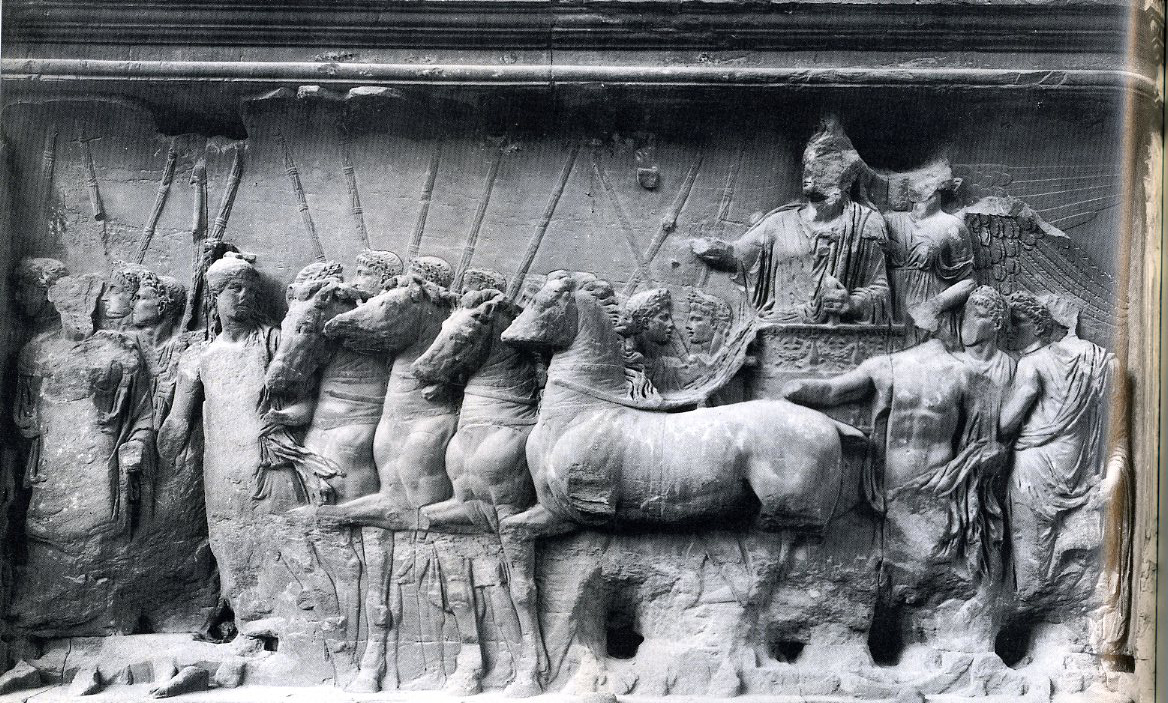
So, a ’verbal medicine’ supposedly urges the triumphing general to look back in order to protect him from the envy of Fortune, which might mean that there was a whispering slave/companion in the chariot. The handful of other existing ancient references are equally elusive. Other issue is that when the triumph is depicted in Roman art, the general usually has the goddess Victory standing behind him (e.g. the emperor Titus on his arch or the emperor Marcus Aurelius from a triumphal panel or then the triumphee is just shown alone. Mary Beard did find a few cases where a plausible slave is shown in the triumphal chariot, but this is extremely rare; a relief from Praeneste showing the triumph of Trajan is one of them.
So, to sum up, the popular claim that “a slave stood behind the general in his chariot and repeated the words ‘Look behind you. Remember you are a man’” is the result of stitching together different strands of evidence, but no ancient writer presents that whole picture. All our sources to the practice come from different times and contexts (and none is earlier than middle of the first century, BTW), so it’s rather impossible to reconstructs the ’facts’ of the triumph. But, there’s no reason to think that the triumph was somehow fixed and constant; the ritual might have changed over time or depending on the context. But, it seems safe enough to say that there are at least some elements of truth in the whispering slave.
I got most of this stuff from Mary Beard’s 2007 book, The Roman Triumph - your best and most complete source to the practice if anyone’s interested!
Is this where the phrase "Memento Mori" comes from? "Remember, you are mortal/will die?"