I was looking through this website and reading the info on golden age of piracy weapons. For the long rifles, it reads...
Long rifles, although they are black powder weapons, were much more stable. Used both by pirates and marines, these were the assault weapons of the period. When fixed with a bayonet, the barrel of the gun is plugged, but the weapon retains functionality as a boarding pike. In the period, some of the French buccaneers were renowned hunters and their accuracy with a long rifle, whether killing a boar or a man, was the stuff of legend. It is interesting to note that although the British and French were known to use long rifles from the rigging (or more accurately from the fighting tops), the Spanish never did -- their Admiralty believed that the risk of fire in the rigging far outweighed the benefits of guns. Even as late as the 1700's, the Spanish used bows and crossbows in their fighting tops.
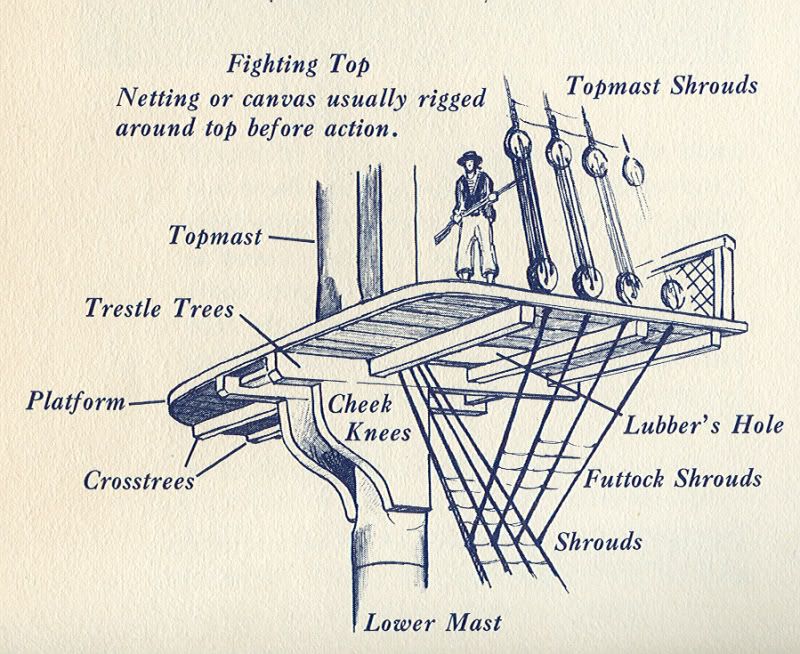
Also, is fighting tops the correct term used for those platforms on the masts? Would "crow's nest" be a term just coined by fictitious stuff on pirates/sailing ships?
I can't speak to the first part of your question, I'm not finding a source to hand and I may have to dig into some more obscure (to me, I am not great at reading Spanish) things to answer that.
But to the second part of your question: yes, a fighting top is a real thing that is distinct from a crows nest. Masts on sailing ships of the 1700s were generally made up of sections; the place where they joined could be extended with a platform for better working the masts, and also for a place to mount small swivel guns and to station men with muskets and grenades during battle. Here is a representative illustration. they were used in battle throughout the period; Horatio Nelson was mortally wounded by a musket-ball fired from the Redoutable's tops at Trafalgar. By comparison, a crows nest is a dedicated lookout platform, usually just large enough to hold one or two men, used on a whaler or merchant ship.