From my understanding Pryor was a student in West Germany, not East Germany, and the trouble came from having an East German girlfriend. Is that the case?
From my understanding Pryor was a student in West Germany, not East Germany, and the trouble came from having an East German girlfriend. Is that the case?
Correct (mostly) - Pryor was studying in West Berlin, but (unlike what is shown in the film), he was on holiday in Denmark when the fledgling wall was built in the wee hours of 13 August 1961. He was back in Berlin "after [the wall] had been up for a couple of days", but was not arrested for trying to help somebody escape. It was a case of being in the wrong place at the wrong time.
Pryor went into East Berlin for three reasons:
One, to hear a speech by Walter Ulbricht [the head of the Communist Party], justifying why the wall went up. Two, to visit the sister of a friend of mine to see if she had any messages for me, since communications [between east and west] had been cut. Three, to give a copy of my dissertation to an East German professor who had been helping me.
When Pryor went to visit the friend's sister, he learned that she had fled to the West. He didn't realise that her apartment was being watched by the Stasi and, even though Pryor didn't go inside, the mere fact of showing an interest in her whereabouts (especially as an American) was suspicion enough for the Stasi men to arrest him. When they found his dissertation, he was sent to prison.
How much warning did Western students like Frederic Pryor actually have before the wall went up?
Aside from the inaccuracies stated above (and a few more, see The Guardian article below) the timing of the border closures and the construction of the wall as shown in the film is quite accurate. It wasn't totally unexpected, but it was nonetheless so sudden that it took many ordinary people (including students like Pryor) completely by surprise — and that was the point.
In spite of the many rumours about an impending change in the status of the border, its actual closure on the night of 12-13 August 1961 caught most East Germans by surprise. In marked contrast to the regime's indecisive and in- effectual efforts to control cross-border traffic during the previous years, the sealing of the border was planned well in advance and carried out with remarkable efficiency. Most Berliners awoke on the morning of 13 August to find that there was little they could do except wait and see what happened (Ross, 32)
The reason for the rapid closure of the border can be explained by one central factor: the GDR (East Germany) was haemorrhaging people. From the GDR's establishment in 1949 to the construction of the wall in 1961, between 2 and 4 million people left the Soviet satellite for life in the West. This brain drain came with steep costs. In letters to Soviet leadership, Walter Ulbricht (First Secretary of the governing SED party and the GDR’s de facto leader) estimated that Republikflucht (desertion from the republic, namely the GDR) was responsible for production losses between 2.5 and 3 billion DM. The loss of many talented individuals (including countless scientists, doctors, engineers) dealt a big blow to the already economically weak GDR.
With the situation as it was, the GDR could not announce in advance that it was going to build a wall. It had to do so suddenly and without warning. As Ross mentions in the excerpt quoted above, the wall construction was planned well in advance. Materials were deviated from housing projects and other construction areas in anticipation, and workers were even brought in from the USSR to assist in setting up the wall. All Ulbricht needed before he could proceed was approval from the Soviet premier Nikita Khrushchev, which he received during a discussion on 1 August 1961. On the evening of the 12th, Ulbricht met with top SED officials at a retreat outside Berlin. There he signed the orders for GDR forces to seal the border and commence construction at midnight.
Sources
EDIT: To the kind person who gave me Gold (for the first time), thanks! :-)
The Berlin Wall as most people understand it (huge death strip, can't get near it on the eastern side, massive surveillance, etc) did not go up over night. That was years of effort, work and strategy.
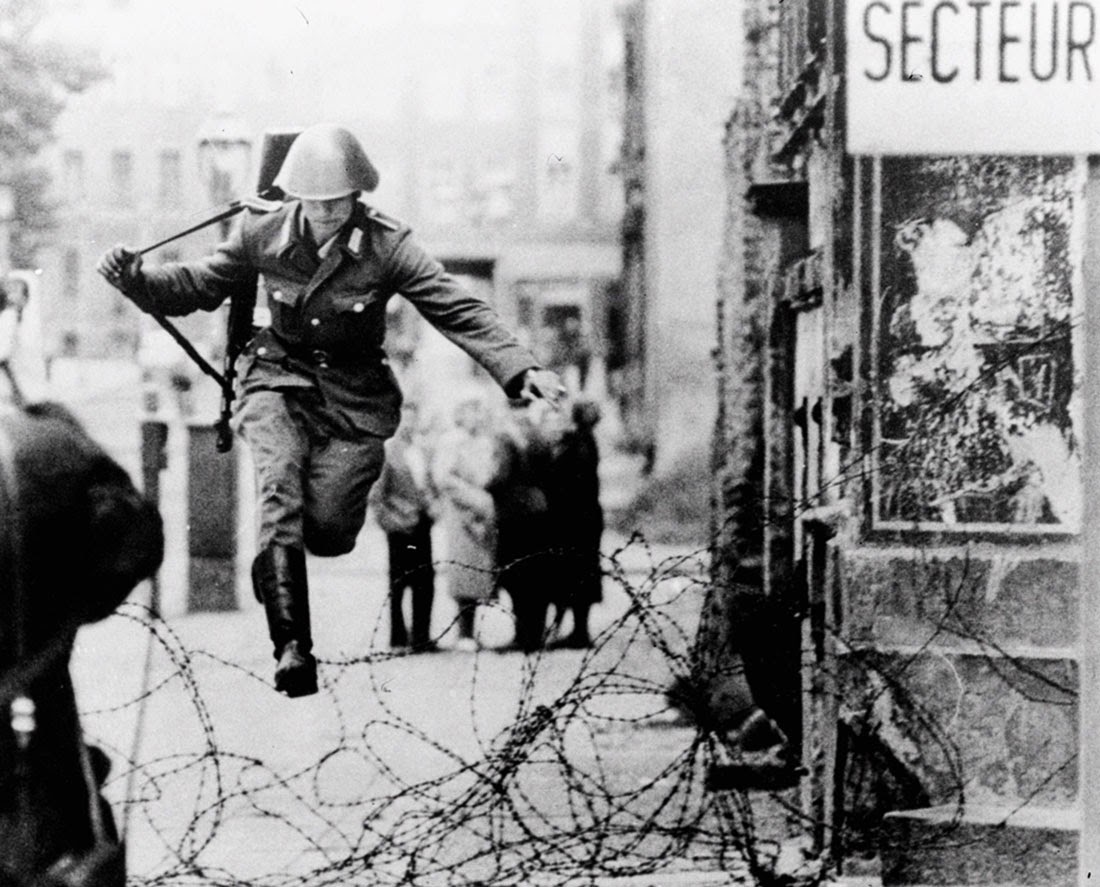
The wall that went up on August 13 1961 was essentially a glorified, guarded barbed wire fence. You've probably seen this image of an East German guard defecting. That's essentially the wall that went up over night.
I mostly have knowledge of this from the East German perspective, so I'm not entirely sure it fits exactly the movie scenario. It's not that there was NO warning it was going to happen. East German drain of people bailing left and right was palpable and impactful and both Germanys had more than just a feeling Walter Ulbricht and the SED were going to do something about it. About two months prior to the building of the 'wall', Ulbricht announces, famously, to the world 'Neimand hat die absicht eine Mauer zu errichten' or 'No one has any plans/thought to build a wall'.
So was there official warning that week that there would be a wall going up? No, of course not. Did most people wake up on the 13th and go 'what on earth?' Most likely. But it wasn't as though the world, the DDR/BDR and their people hadn't already realized the possibility.
Sources: Extensive work in museums/tourism sites telling the history of division, the narratives the engage and the methods they use. http://www.hdg.de/berlin/traenenpalast/ http://www.berliner-mauer-gedenkstaette.de/de/ https://www.dhm.de/en/about-us.html
Also: Berdahl, "Where the World Ended"; Pierce "The GDR Remembered: Representations of the East German State since 1989"
Couldn't people just walk around the wall, find an opening through woods of something? Or were the soviets all over the border between east and west Germany?