Interesting question! I did a lot of my studies about British India at Oxford, and I always found reminders that the University was at one point the nursery for Britain's imperial missionaries. If you go to what was, when I was a student, the History Faculty Library, you will see its tower adorned with a weather vane in the shape of an elephant; it was once the Indian Institute building, dedicated to scholarship of Britain's most important territory, the arch-legitimizer of its imperial mission.
Do you mind if I don't firstly suppose you're the son of an Indian prince? Let's imagine instead you're a woman, a Christian, the daughter of a Parsi Anglican Reverend, born in Pune ("Poona"); let's imagine you're Cornelia Sorabji, the first female graduate of an Indian university, and you came to England to attend Oxford University to read for the Bachelor of Civil Laws exam. You are not just the first Indian woman to do this, you are the first woman ever to take the exam. Cornelia went up to Somerville (a woman's college), and became not just a tutee but a real protégée of Oxford tutor Benjamin Jowett, a larger-than-life figure whose fame at Balliol was great indeed. She was introduced to Jowett by Agnes Maitland, then Principal of Somerville, and was invited to dine at Balliol's High Table by him - being a gentleman's college, she had to be chaperoned by Miss Maitland (one of the principal's jobs at a women's college was to act as a chaperone in all manner of social engagements - even visiting the dentist).
In England, Cornelia always wore a sari, even though as a child she wore Western garb in Poona. Jowett, who to many students was an intimidating figure, took the unintimidated Cornelia under his wing and through him she met many important Victorians, including Florence Nightingale. Jowett created a special course in law for her, since she was originally at Oxford to read for English. Cornelia's social life in Oxford seems to have been one of relative privilege compared to many students - her case was rather a famous one, for she found entry to Oxford difficult - but she does not record difficulties finding a social life or taking exams because she was an Indian. Granted, she was a Christian, with a glass-cut English Establishment RP accent, but she was dark-skinned. Instead, her obstacles, mostly institutional, given that formats did not then exist for her to do many of the things she ended up doing, seem to have been because she was a woman.
If you want a nice, approachable touch of personal history to deal with this, please see the talk given by Professor Richard Sorabji (yes, tellingly of the same name) back in 2010 when I was there that Oxford helpfully hosts here: http://podcasts.ox.ac.uk/cornelia-sorabji-jowetts-prot-g-e-oxford-1889-1893
Now let's think about the aristocratic dimension to the question. For this, I think a really interesting work would be David Cannadine's book, Ornamentalism, the title of which is obvious reference to Said's Orientalism. Said outlined the institutional racism of imperialism, in which the West's imagination of the East served as much to make concrete a subservient relationship as did the practical deficits created within the relationship. Cannadine argues a modification of this, pointing out ways in which race was a much less important element to the way Britain related to India (and other parts of its empire) than, say, class, rank, or social status. Cornelia's case seems to help this case.
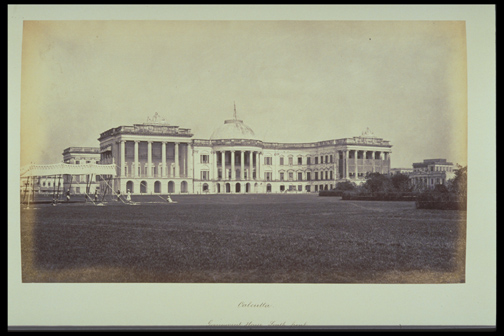
Specific examples illustrating this case come if we look at how the British behaved in India. If we take the example of Viceroy the Marquess Curzon, we see the patriarch one of the most ancient aristocratic familes in Britain becoming a government-appointed king of India, residing in a palace that was modelled on the very house he was born in. (See: Kedleston provided the architectural inspiration for Government House in Calcutta) If we examine Curzon's social habits, we know that his preference was to spend time amongst Indian aristocracy if his other choice was middle class Britons. He would regularly attend princes' estates to go hunting; we can see him here proudly posing with the Maharajah of Gwalior. He found commoners, frankly, annoying; they were interested in money, and imagined themselves superior to all Indians purely on the basis of being British. He found them smallminded and petty social climbers, who sought his favour for their own elevation; he thought the elevated social status of British commoners in India artificial, and detested going to Simla (the place of summer government, when it was too hot in Calcutta) because he was trapped there with cricket-playing middle class British busybodies. Curzon was raised believing his blood made him the inheritor of natural superiority; this is something he had in common with the Maharajah, and something that distanced him from many of his fellow Britons in India. Part of people like Curzon's imperial mission was to export the social order that they saw as existing at home. When the Hawaiian King Kalakaua (thank you /u/bigjameslade for this correction of nationality and providing the name) was seated in higher order than the Crown Prince of Germany at a royal banquet, then-prince Edward (Edward VII) riposted to a complaint, "Either the brute is a king, or else he is an ordinary black nigger, and if he is not a king, then why is he here?" This is so obviously a backhandedly racist comment, but it crystallizes for me in a really nice way the dichotomy in the mindset of imperialists what the world order was. White people were superior, yes, but a black king was superior to a white prince. Here, Edward would have probably found disagreement from many who were not aristocrats in Britain.
So: this is not to say racism did not exist, or to say that Curzon did not believe the British were superior to Indians. It is to say, however, that the imperial relationship is extremely complex, with many layers interacting at many different levels. Social strata overlapping and intermingling make it difficult to extract an answer to your question. A shopkeeper might have refused to serve the son of an Indian prince whilst he studied at Oxford (I actually doubt this, but let's imagine a case of everyday prejudice) but meanwhile he would be invited to high table, to visit English country houses on the weekends, and enjoy all the privileges of a gentleman scholar, far beyond the aspirations of your average Oxford commoner, be he English or Welsh(!) or Indian (commoner is a class of student at Oxford - in former times, an aristocrat could purchase a scholarship that accorded benefits). Indeed, many Indians of common (non-noble) status studied in England to take the exam for the Indian Civil Service, and it might be there that you'd be able to get a more straightforward example about racial discrimination.
Further listening, please have a look at Oxford's "Indian Traces in Oxford" series of recordings, which have a selection of Indian experiences at the University: https://podcasts.ox.ac.uk/series/indian-traces-oxford
A related question: how does the case of Shapurji Edalji, ordained in England in the 1860s and later the target of, to a lesser or greater degree, racist treatment along with his son George, shed light on the original question?
I would be very curious if anyone could expound more on the life of Prince Victor Duleep Singh, as I think it would be very illustrative of the sort of experience OP is looking to learn more about. The extent of my knowledge of him comes from the book "Lady Almina and the Real Downton Abbey," so I'm certainly not qualified enough to answer the question myself.