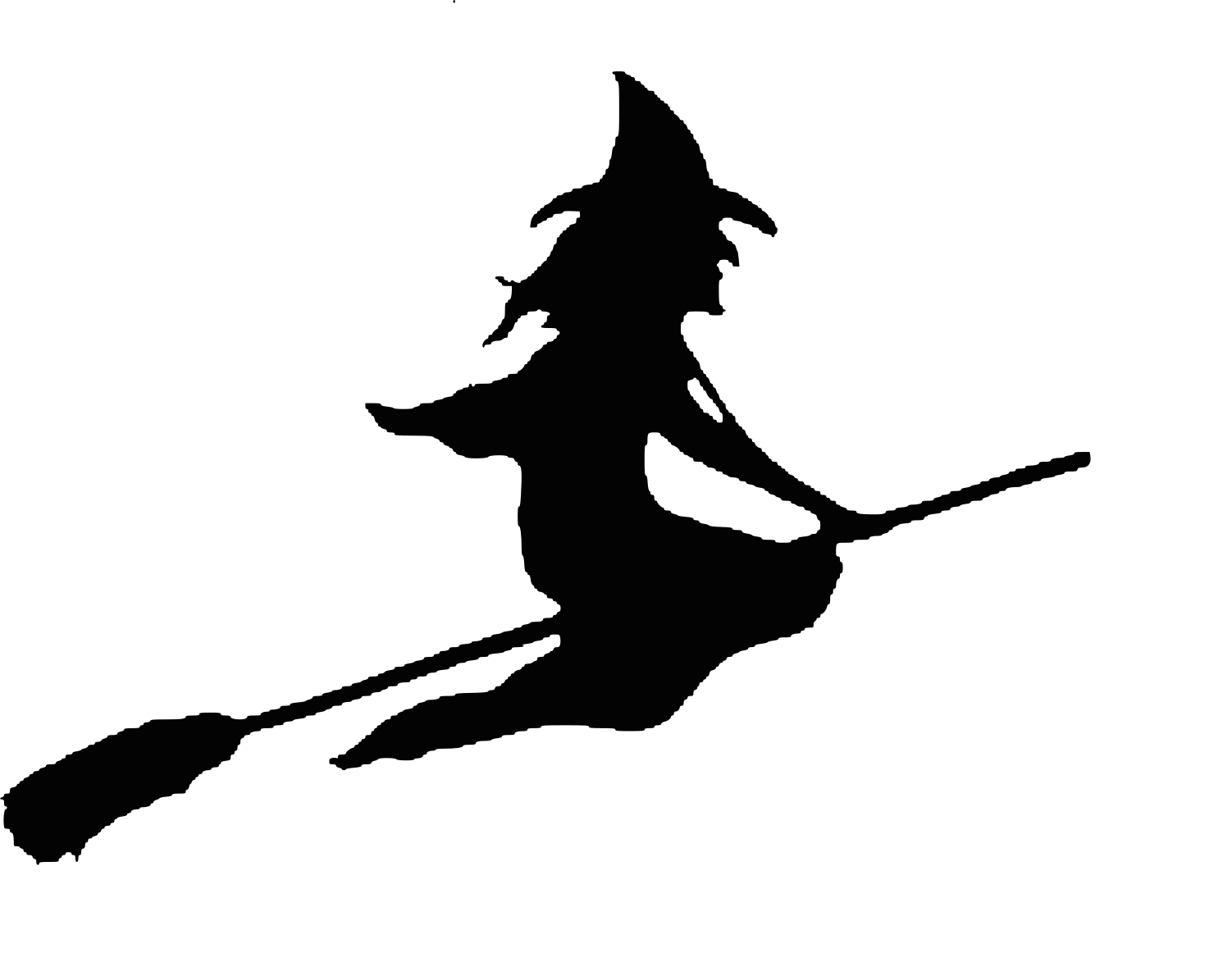
Earlier today, I replied to a comment in a thread about Luis Recardo Falero's "Witches Going to their Sabbath". The comment asked why, in Falero's work, the brooms were 'backward': with the bristles facing forward rather than behind.
Modern images of witches flying in brooms have the bristles behind the witch, like so.
My comment suggested that the modern interpretation of the flying witch uses some principles of aerodynamics: modern vehicles, specifically planes, are visually back-heavy and come to a more narrow snout. My thought was that this made more visual sense to the modern interpreter, but that someone in Falero's time (1870's) may not have the same perspective. It may even make sense that the bristle end goes first, since that's effectively the business end of the broom. But even if principles of vehicle design someone remained the same, Falero might have chosen to paint the broomsticks that way to further depict witches and magic as unusual or violations of common rules.
Of course, I have no idea if any of this is true. Another posted suggested that the brooms' orientations had to do with vaginal applications of hallucinogens using the broom's shaft. I have heard of this theory before, but don't know how supported it is.
Stacy Schiff's The Witches discusses the supposed broom flight of Ann Foster and Martha Carrier in 1692, but makes no mention of the orientation of the broom. I have some other books regarding witches in the medieval era, but can't recall descriptions of the broom orientations in them. People reporting on witches, I assume, had more interesting things to talk about than whether the bristle end went first.
This image from an 1865 book of Cornish folklore depicts the witches generally with the bristles to the back. One rides sidesaddle, so the direction is ambiguous, and another rides a cat. The illustration is by prominent Victorian-era illustrator George Cruikshank (1792-1878). The source is Robert Hunt, Popular Romances of the West of England (first series 1865).