Cicero describes the lex Maria in the de Legibus, in the middle of a passage discussing the influence of observers on voters:
Sic enim a me recitata lex est de suffragiis: 'Optimatibus nota, plebi libera sunto.' Quae lex hanc sententiam continet, ut omnes leges tollat quae postea latae sunt quae tegunt omni ratione suffragium, ne quis inspiciat tabellam, ne roget, ne appellet. Pontes etiam lex Maria fecit angustos.
For thus reads my law of suffrage: 'Let the ballots be known to the best men, and free to the people.' Which law contains this idea, to abrogate all laws which hide all reasoning of the votes so that no one can inspect a tablet nor question it nor solicit a vote [that is, ask the voter as he casts his ballot to vote one way or another]. The lex Maria even made the "bridges" narrow
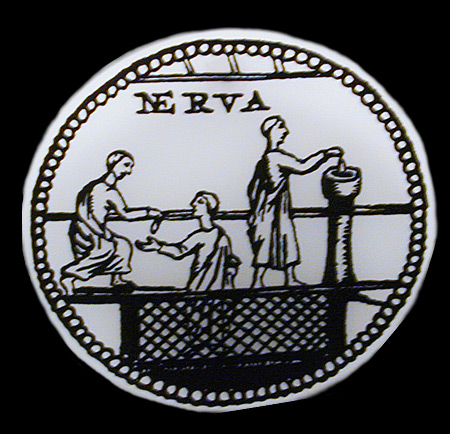
What are these bridges that Cicero's talking about? When the comitia assembled on the Campus Martius they funneled according to their either their centuries or tribes, depending on which assembly was voting, into little enclosed spaces, known by different names (usually either septa or ovilia), where they could confer with each other before submitting their tablets. The passageways to and from these little enclosures were called pontes, "bridges," because they were some sort of narrow wooden platform. While only members of that particular tribe or century were allowed within their enclosure, observers were free to congregate on the platforms to the enclosures and then again on the pontes leading from the enclosures to the little chests in which tablets were deposited.
Cicero's statement makes it clear that the idea of the lex Maria was to prevent influence of the voters by those outside their voting unit. Plutarch says pretty much the same thing, but doesn't actually describe what the law specifically did:
ἐν δὲ τῇ δημαρχίᾳ νόμον τινὰ περὶ ψηφοφορίας γράφοντος αὐτοῦ δοκοῦντα τῶν δυνατῶν ἀφαιρεῖσθαι τὴν περὶ τὰς κρίσεις ἰσχύν
In his tribunate [Roman Period authors use δημαρχία to mean the office of tribune of the plebs] he proposed a law on suffrage thought to remove the power of the nobility in elections [κρίσις actually means "distinguishing," and often refers to trials, but I think here it has to mean not just jury votes but all centuriate and tribal voting]
The idea of the lex Maria was that by narrowing the passages the nobility's ability to oversee the voting was somehow hindered. That's because when the pontes were wider there was more space for observers to stand by and petition for votes, hand out last-minute bribes, and even threaten voters.
I'd maybe add that besides the obvious desire to prevent loss of influence in electoral procedure (which must have been the primary reason for opposition to the bill), Metellus Delmaticus (the only Metellus that Plutarch mentions in the passage. Though the Metelli were close-knit, the idea of late Republican families as being some sort of Mafia-esque united political body is absurd--Cicero's brother, though in Pompey's camp eventually, was a Caesarian, and though one of Caesar's cousins was a supporter of his that same cousin's son fought under Cato during the civil war) probably was not particularly taken in by Marius' behavior. Plutarch describes the initial hostility towards the bill as being led by Cotta, who successfully convinced the senate to vote against it. The senate had no legal power to pass or prevent the passage of legislation, however, and Marius threatened to imprison Cotta unless he revoked the senate's opinion, at which point the bill would be taken to the Campus Martius for a vote. I don't think we're supposed to imagine that that made the motion particularly popular among the senatorial class in general or Metellus Delmaticus in particular, since Cotta was a consul--only after this, Plutarch says, did Cotta ask Metellus Delmaticus, who was the other consul that year, for his opinion. Metellus Delmaticus' opinion was the same as Cotta's, and on hearing this Marius had Metellus imprisoned, which surely didn't improve his opinion of Marius (just as a note, to reinforce what I said about families not being united in political opinion: the mistreatment of Metellus Delmaticus apparently had little effect on Delmaticus' brother, Metellus Numidicus, who asked Marius to be his legate during the Jugurthine War--their falling-out only occurred later)
The secondary studies to look at for questions about Roman voting are Yakobson, Elections and Electioneering in Rome, and Lily Ross Taylor, Roman Voting Assemblies. Yakobson's 1995 article on the secret ballot is especially on point here.
What you're looking at here is a measure to protect the secret ballot. Narrowing the passage means it's more difficult to have someone watching over your shoulder when you vote. (Here is a drawing taken from a coin of the system - the ballot is collected from an attendant on the left, and deposited in an urn on the right)
Originally voting was open and vocal; the voter announced his choice and the officiating magistrate marked it down. Starting in 139 different politicians introduced a series of laws that instituted a secret ballot. What Romans thought was happening with the secret ballot is apparently debated. I didn't know this until looking through the Yakobson article I mentioned, but apparently Gruen and Harris think the secret ballot was uncontroversial and the aristocracy didn't understand how it would affect their control.
It is (as Yakobson notes) an issue Cicero debated in de Legibus. This is a book probably written in the late 50s, so almost a century after these laws first started popping up, but Cicero is very aware of the damage the secret ballot does to aristocratic control. Cicero discusses Marius' law here though it is not strictly speaking a law about the ballot.
Cicero is writing a philosophical dialogue with himself, his brother, and his friend Atticus as characters, so we have to be careful about how we attribute the opinions he expresses, but I think we can take any ideas that occur in the dialogue as something it was possible for someone in the 1st century BCE to think.
Cicero makes his brother Quintus, usually thought to represent the aristocratic voice, go nuts over the secret ballot. The people didn't want a secret ballot when they were well governed; they only wanted a secret ballot when they were governed badly. What should have happened was laws preventing bad measures from being proposed, but instead the people have a
subterfuge whereby the tablet ensured the secrecy of a wrong-headed vote thus keeping the aristocracy in the dark about what each man thought.
Cicero (the character) makes sure to include in his model set of laws one guaranteeing the open ballot and mentions specifically Marius' law as one that should be opposed
If these measures are designed to prevent bribery... I do not object to them. If, however, laws will never succeed in eliminating bribery, then by all means let the people have the ballot as a guarantee of liberty, provided the vote is disclosed and actually displayed to the best and most unimpeachable citizens. In that way [and this is one of my favorite dastardly lines in political thought] liberty will exist precisely in the sense that the people are given the opportunity to do the aristocracy an honorable favor.
The secret ballot interferes with bribery because it prevents the one doing the bribing from knowing if the bribe was well spent. If you're going around throwing denarii to people, you want to make sure they vote your way, right? If the ballot's secret, you can't know if the bribee was honorable (? can you say that?) or not.
It also disrupts social relationships. From the Commentariolum Petitionis (probably a handbook on running an election) we know that a candidate expected his friends and relatives and clients to vote in his favor, and there was an insecurity about that. You have to hassle your friends and remind clients of past and future favors and so forth. Now, with a secret ballot, you have no way of knowing if your social relationships, built on an economy of mutual exchange of favors and obligations, are functioning correctly.
Why did the Metelli care? They were very rich and very aristocratic. Further, Marius was their client. He got his job (tribune) with their patronage. So, this is not just a move weakening the aristocracy generally, it is a personal violation of Marius' relationship with the Metelli. The break wasn't irreparable though; Plutarch concludes his discussion of the law by noting Marius patched things up by opposing a grain law a little later.
EDIT: one very unfortunate spelling, and a few others.