Looking for more information on what warfare looked like during this period. A few questions:
What were the arms and armor for the average infantry-man?
What about more prominent citizens?
How does this period of warfare compare and contrast to the previous Mycenaean style and later warfare of Classical Greece?
Bonus: Where does this fit into the Iliad? Is this the "Heroic warfare" we hear about, or is that more related to Mycenaean?
Despite its age, and several discoveries that have been made since its publication, the single best book on military equipment for this period is Anthony Snodgrass' Early Greek Armour and Weapons (1964). A much more recent book, which includes an interesting look at Early Iron Age Greek warfare, is Hans van Wees' Greek Warfare: Myths and Realities (2004).
we know nothing about the "average infantryman" in this period, if such a concept even existed. The only real evidence is Homer, and there is a centuries-long debate about whether the combat depicted in Homer accurately reflects the "Dark Age" battlefield, or else is an idealized version of a distant past.
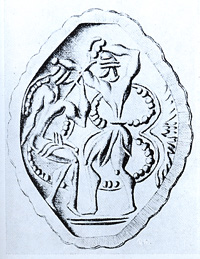
almost every single piece of equipment we have preserved from this period are from graves, namely elite "warrior graves." Their typology is similar from Lakonia to the Argolid to the Korinthia to Attika to Boeotia to Euboea: "killed" iron or bronze sword blades (deliberately bent), iron or bronze spear heads, or other such blades. Very very rarely, a piece of armor (like the very famous 8th century cuirass and helmet, from the Argolid and now in the museum at Argos). Towards the very end of your defined period, we begin to see Late Geometric rudimentary figural representations of hoplites. They carry shields shaped a lot like a type scene in the Bronze Age, like this. This is a seal cast from Mycenaea, Late Helladic I-II period.
The concept of the polis was just beginning to coalesce in the 8th century, and it usually this new collective identity which is thought to have driven the citizen "phalanx" and that style of warfare. It is likely that before the 8th century, armed force was primarily represented by "big men" leaders (like the one buried at the Toumba structure at Lefkandi) attended by small, hyperlocal warbands -- that is, something very similar to the Homeric heroes and their private militias, varying in size and capability depending on the resources and prestige of the leader. The polis structures allowed for the organization of resources on a much larger and more regional scale, and harnessed more fighters to common goals. We have essentially no evidence for anything like this in the "Dark Age" of Greece.
Bonus: a complicated topic, and whole books have been written on it.
For a good overview of this period, you should check out Robin Osborne, Greece in the Making (1996, rev. 2009). He covers all the basics from all the angles, all while keeping the book very accessible. From there, he offers bibliography of where to jump next on individual topics (including warfare). If that is too broad, you might check the late J.N. Coldstream's book Geometric Greece: 900-700 BC (rev. 2003, I believe). It is a bit dated now but still holds up quite well, and Coldstream was a giant on this topic. The book will be very archaeological and will talk a lot about pottery, since that is one of the most productive bodies of evidence for the period. I'm not sure how much he talks about Dark Age warfare per se, but he will definitely cover the warrior graves and implications of them.