I don't recall any literary references to painted marble sculpture off the top of my head, but Pliny the Elder discusses the careers of many famous Greek and Roman painters in book 35 of his Natural History. According to him, Apelles (fl. 4th c. B.C.) painted portraits of individuals "so absolutely lifelike that:"
"incredible as it sounds, the grammarian Apio has left it on record that one of those persons called ‘physiognomists,’ who prophesy people’s future by their countenance, pronounced from their portraits either the year of the subjects’ deaths hereafter or the number of years they had already lived."
We ought probably to envision painted Roman statuary as having had the same lifelike qualities as this Classical panel painting (albeit with a wider palette of colours), rather than the gaudy, starkly-coloured reconstructions of painted Roman statues on display in some modern museum exhibits, which tend to be rather conservative and strictly evidence-based in their assumptions about colour. There was, however, an excellent exhibit at the Ara Pacis several years ago, where a projector was used to projection-map the monument's original colours back onto it. (A similar event was held, by the way, to recolour the facade of the Gothic cathedral at Amiens, which was also once brightly painted).
Much else was painted in the Roman world as well. Frescoes decorated exterior facades and interiors of public and private buildings, where coloured stones, mosaics, and inlays of glass, metal, ivory, and tortoiseshell were also used. Wooden vehicles and architectural elements were also sometimes painted with encaustic (wax), and Pliny the Elder remarks upon how wonderfully colourful it all was in his day (ca. mid- 1st c. A.D. to A.D. 79):
"indeed nowadays also for cargo vessels [we use encaustic paint], since we even decorate vehicles with paintings, so that no one need be surprised that even logs for funeral pyres are painted; and we like gladiators going into the fray to ride in splendour to the scene of their death or at all events of carnage. Thus to contemplate all these numbers and great variety of colours prompts us to marvel at former generations."
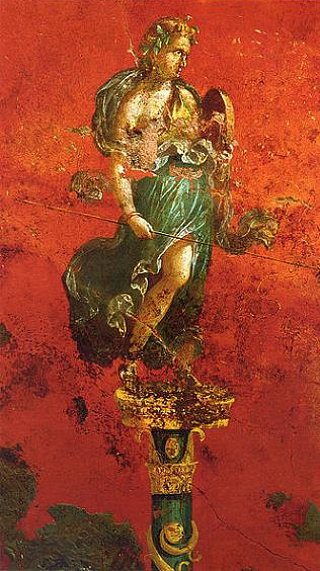
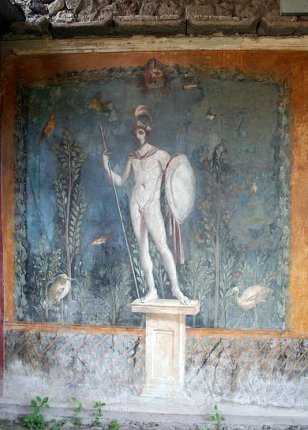
Perhaps the best proxy visualisations we have for ancient coloured sculptures, however, are in Roman wall-paintings. Specifically in paintings of the 3rd and 4th (so-called) Pompeian Styles, where we find lifelike mythological figures standing on plinths, holding various objects that relate their attributes. Although these are often assumed to be painted representations of the mythical individuals themselves, they might actually be one step further removed - i.e. they might be painted (fresco) representations of painted (stone) statues.
A good place to see lots of examples of painted ancient sculpture and keep up with the latest developments is the website trackingcolour.com run by the Ny Carlsberg Glyptotek.