Something I've wondered about on occasion. I know there are variances in culture and "minor" things like basket weaving as a random example, but what about in agriculture or war (weapons or even tactics) and the like?
To start with, I do have an answer for you, but only reluctantly. I'd much rather say I reject the entire premise of the question. So I'll start with why I don't think the premise is sound, and then I'll give you part of the answer anyways.
So the trite complaint is to say that "advanced" is a highly relative and vague term and most anthropologists aren't going to use it for exactly that reason. However, I can already hear you saying: "Yes, but surely there are some things we can say are objectively more advanced, like gunpowder weaponry compared with bows!". To that I say: absolutely, but we need to make sure we understand what criteria we are using to define "advanced".
Generally, people think of Native American societies as less advanced than European societies because they are defining advanced on the basis of metalworking technology and highly-complex state society, neither of which were well developed in the Americas north of Mexico. However, that is only one dimension we could evaluate how "advanced" a society is.
Let me elaborate by quoting from Eric Wolf (1997:5), emphasis mine:
Many of us even grew up believing that this West has a genealogy, according to which ancient Greece begat Rome, Rome begat Christian Europe, Christian Europe begat the Renaissance, the Renaissance the Enlightenment, the Enlightenment political democracy and the industrial revolution. Industry, crossed with democracy, in turn yielded the United States, embodying the rights to life, liberty, and the pursuit of happiness.
Such a developmental scheme is misleading...History is thus converted into a tale about the furtherance of virtue, about how the virtuous win out over the bad guys. Frequently, this turns into a story of how the winners prove that they are virtuous and good by winning.
What Wolf is describing as a developmental genealogy here (Greece to Rome and so on) is very frequently the basis for qualifying the idea of what "advanced" means. The idea being that the qualities of European societies in the late 18th and into the 19th centuries are the benchmark for "advancement". For example, the ability to project power across the planet in colonial and imperialist projects. A frequent question about the relative lack of advancement in Native societies north of Mexico is "where are the empires?". However, we have to question whether or not "empire" is really an advancement, or necessarily a marker of moral success.
Now you might say that I'm conflating moral success with technological or social advancements, but that idea of moral success is really very much bound up in the ideas we have about what an "advanced", or "modern", society consists of. As Wolf says, the genealogy of the West is often told as a moral success story, with each "advancement" moving closer towards the virtuous society of the present. It's really important to decouple this idea of virtue from advancement. Why do we define virtue (and advancement, consequently) on the basis of conquest? What is so inherently virtuous about empire that we consider it "advanced", for instance?
Indeed, in the present it is fairly uncontroversial to say that empire, colonialism, and monarchy run counter to our democratic ideals. Yet, in the past, we don't often consider Native societies in North American - considerably more egalitarian on the whole than their monarchist counterparts in Europe - as embodying "advanced" or "modern" society. Since they are not part of this genealogy of the West, the virtues we value in a "modern" society are glossed over as "primitive", rather than being "advanced".
So, my objection to the very premise aside, we still have to have some sort of definition of "advanced" to work with to actually answer your question. In this case I'll just use "complexity" as a byword for "advanced". In anthropology, "complexity" is an analogy borrowed from biology that describes an organism (or society, technology, etc.) as more or less complex on the basis of how many components it involves. For instance, a dog is considerably more complex than a bacterium. In a social sense, a state society is generally more complex than a foraging society because there are a larger number of social roles inside that society ("organs", perhaps).
However, just like with the biological example, complexity is just descriptive, and doesn't necessarily indicate how successful and organism might be. Bacteria are extraordinarily successful organism despite not being very complex, while you can list any number of extinct mammals, for instance, that are considerably more complex but not nearly as successful. As this applies to technology, let's say that the complexity of a technology is a product of the social complexity necessary to produce it. Firearms, then, require a number of specialists to produce, while a bow and arrows can be produced by a single individual. It could be argued that early firearms were hardly superior to bows despite their greater complexity, so again, complexity doesn't necessarily equate with efficacy, but that is a bit of a tangent.
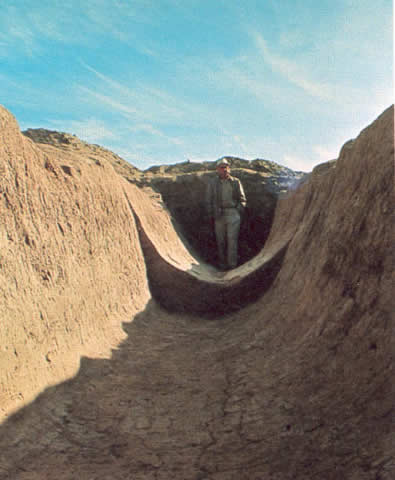
In terms of complex technologies north of Mexico, agricultural technology in the U.S. Southwest was significantly more complex in many ways than in other regions. Particularly irrigation technology. The Hohokam farmers of southern Arizona (primarily in the Phoenix and Tucson basins) were able to construct extensive irrigation canals that ran for many miles and seem to have functioned for many hundreds of years, with the apogee being between about A.D.800 and 1300. These canals cover an absolutely huge area. For instance, a map of the canals under what is most of modern Phoenix. A map that includes the lower Gila River as well, showing some of the extent to which the entire Phoenix basin was covered in irrigation canals (and therefore put under cultivation).
These were not simple irrigation channels either. As you can see from the maps, many ran for a number of miles. The engineering that has to go into a canal to ensure it flows continuously on a gradient over that long a distance is a feat unto itself. These weren't small canals either in many cases, especially the large central "trunks" of each canal system. The complicated, branching structure of the canal system is also a feat of engineering in that it requires a good understanding of how large each ditch needs to be to provide sufficient water for all the side channels. We know also that many of the main canals are positioned so their openings take advantage of areas with high flow along the Salt River, due to areas where bedrock encroaches on the surface.
While there are traditions of irrigation in other parts of the U.S. and Canada, none come even close to the scale of these Hohokam systems. Even in the Eastern Woodlands, home to the largest extent of agricultural societies north of Mexico, no irrigation systems reach this level of complexity. Though, to be fair, there is significantly more ground water and rainfall in the East that makes such systems much less valuable than in the extremely arid deserts of southern Arizona.
There are any number of other examples of technological variation across the Native societies of the U.S.A and Canada, but hopefully this gives you at least an idea of one dimension along which that variation exists.
Edit: Need a citation for the material from Wolf!
Wolf, Eric R. 1997. Europe and the People Without History. University of California Press.