I read that the common citizen of ancient Rome didn't write in all caps but used a handwriting style of cursive. Can anyone explain it to me, how common was it, how do we know what it was, when it was used, etc...?
That's a good question! And there are several aspects to it that you already mentioned. It's true that for day-to-day writing, acient Romans did use a cursive style of their more well-known monumental style letters that we know from the famous latin inscriptions. Here is the canonical example, the inscription from Trajan's column in Rome. A well measured, beautifully and geometrically constructed script, with a careful layout to achieve the maximum effect, mother of all the subsequent antiqua-scripts and typefaces. It evolved in the Augustan age from the from the less sophisticated republican letter forms, where all strokes had the same width. The influential modern Futura script and its derivatives were still based on the construction principles of the ancient Roman monumental script, which can tell you something about both the effect it had on our imagination as well as how well thought-out the whole thing was. In any case, this type of script is called capitalis monumentalis, the monumental capital - which is where the 'capital' letter comes from, since this is a script that only consists of majuscule letters.
But to complicate matters a bit, there were no minuscule letters in any version of Roman script - that was simply a distinction that was not made. Sure, there were different ways to write the letters, and some letters were written taller than others, for stylistic reasons, or to signify the length of a given vowel (especially in the case of 'I'), but in general, there was no distinction between 'CAPS'-capitals and minuscule letters. In fact, this was a development that came only much later, in the Carolingian age, with the evolution of the Carolingian minuscule script, itself based on Roman cursive and monumental and the following uncial and half-uncial scripts. See also this thread for a discussion exemplifiying the whole thing with the letter 'a', and here for the 'long' s. But I digress - the main point to make here is, insofar as Romans are concerned, there are only caps.
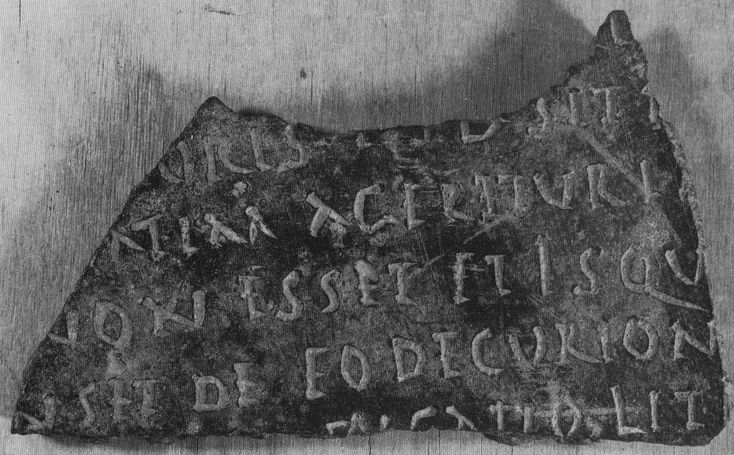
Now to get back to where we came from, writing in such a well-measured and geometrically constructed way is obviously a great way to inspire and awe the passerby, to decorate a monument, and to generally impress the reader. It is also obviously a great way to waste your time if your purpose is to write something practical, do your business communication, write a letter or keep a diary. Or defile some innocent walls with your graffiti. So they had a different way to write more practical or time-sensitive matters down. This was, as you said, the cursive script. The cursive script evolved out of the monumental script, and it shows in its evolution. We can also see this in the inscriptions itself - longer inscriptions, for example law texts, which all had to be published in aere inciso, inscribed into Bronze and hung on a public place. Roman laws tended towards being quite long, so this could take up lots of space. For that, the capitalis libraria was used, a style of scropt that owed much to the cursive, as we will see in a moment. It's letters are narrower, the horizontal bars of letters like E, F or T are much more undulating than straight, Vs have curved diagonals, and As tend to approach the form of the lamda a bit by omitting the horizontal bar and having the left diagonal slide a bit towards the bottom, with the same happening for the left bars of N and M. You can see it for example in this piece from the senatusconsultum about Cn. Piso.
The things are mentioned are some of the main features of the older Roman cursive script. Elongation of the letters, sometimes to an almost comical extent, the vertical element becoming more dominant, edges become rounded, straight lines become undulating ones, lines diagonal to each other become parallel. To better understand this, I think images are better than text. These are two images from my notebook, the first showing letters from inscriptions and graffiti where the stilus was used. That is, the letters where scratched, either into the paint on the wall of a house, or into wax-tables, which were used for day-to-day writing, and learning to write as well (the way could easily be smoothed over and used again). The left column is from walls of Pompeii, the right one from wax-tables. I tried to order them by closeness to their 'standard' form, which might help to show their possible evolution.
This led to a style (which is also where that word came from) that was quite distinct from the one that resulted from the use of ink and pen or brush, as you can see below. The examples are ordered from early to late in the columns (~AD 1, mid 1st century, early 2nd, mid 2nd century).
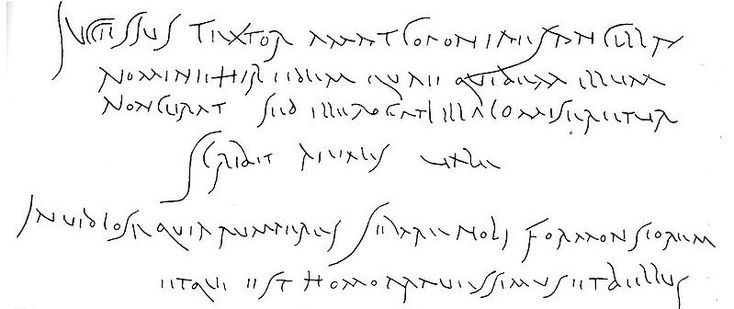
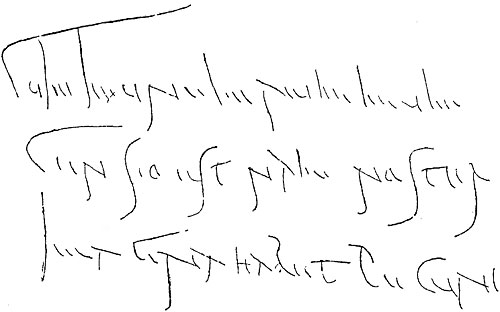
What becomes immediately clear, I hope, is that the style is immensely different from the Roman capitals, so much as to become almost unrecognizable - Papyrologists need lots of study to be able to read text written in Roman cursive. One can imagine, that, much as today, there were Romans who had good and bad handwriting, and they can both look puzzling at first. Take this example, which is not even a bad one, taken from the walls of Pompeii [CIL IV 8259]. Can you decipher it?^1 This is one of the main sources from where we know of the cursive script, grafitti. These once must have been ubiquitous in the cities throughout the Empire, but since they were usually scratched directly into the paint on the wall, or the walls itself, examples to a very large degree only survive in Pompeii or Herculaneum due to the special conditions of preservation there. These are the same kind of grafitti that we find today so often, toilet humour, messages of love or enmity, boasting about sexual conquests or feats of drinking, expressing ones support for politicians or sports heroes (in those times usually gladiators), (erotic) poems and so on.
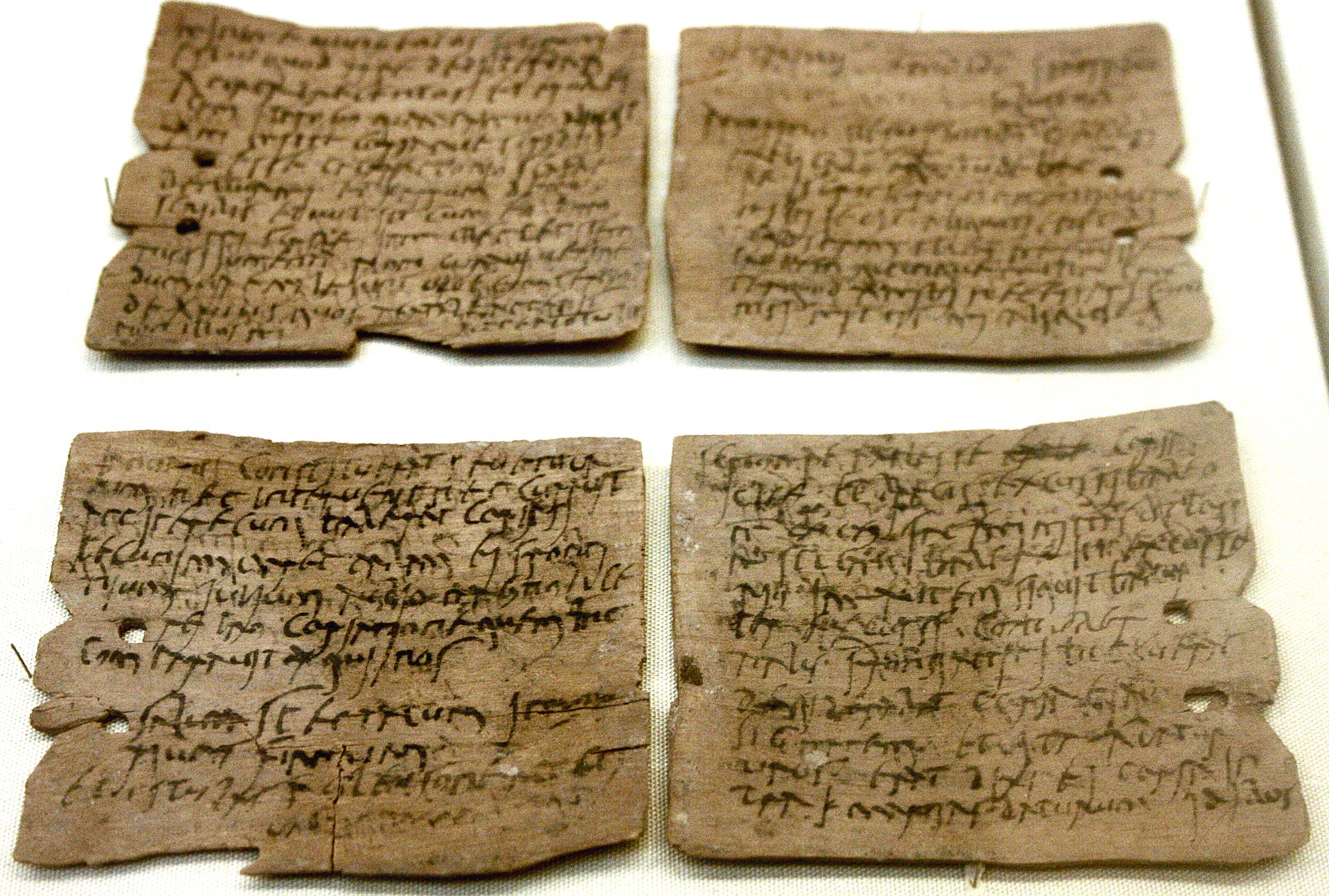
Another area where these survive are tablets, such as the wooden tablets from Vindolanda, written in ink, which tells us lots about the day-to-day life and needs of Roman soldiers in Britain.
These are all examples of the older Roman cursive. In late antiquity, the style began to change again and evolve into two different types of script. One was the so-called litterae caelestes, the heavenly letters of the imperial chancery, written in a very elaborate, rounded style that was hard to imitate - and thus could also served as proof or sign of authenticity. This example from Ephesos shows such heavenly letters on the bottom below the Greek letters. It's a dating formula, given in Latin, and reads: "Dat(um) III Februar(ias) Co/nstantinupo(li) Imp(er)a(toris) / d(omini) n(ost)ri [Maurici T]/iberi pe(r)pe(tui) Aug(usti) ann(o) III / et post cons(ulatum) eius(dem) / ann(o) I" - Given on the third day before the Ides of February in Constantinople in the third year of the Emperor, our Lord Mauricius Tiberius, perpetual Augustus."
The more common style was also much more rounded than the earlier cursive styles, and together with the uncial scripts became one of the main influences on the Carolingian minuscule. An idealized comparison with the older cursive style can be seen here, and a practical example would be this letter from the early 4th century.
As you can see, both of these styles didn't really help the problem of easy legibility - in fact they have not much to do anymore with the monumental capitals still found in the inscriptions - and while they were still in use for a long time (knowing how to write, and how to write in the accepted style, can be a form of social capital as well), died out in Carolingian times when a much easier way to write in cursive became widespread.
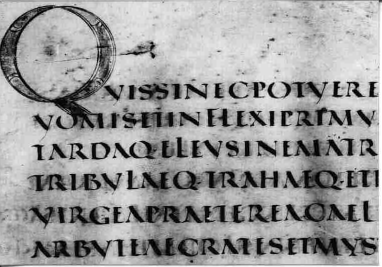
This is not to say that all Roman handwriting was done in cursive. There were two forms of script that were used for writing which were more directly based on the monumental capital script (capitalis monumentalis), the capitalis quadrata or elegans (the 10x10 units rectangle was the basis for the construction of all Roman letters) and the capitalis rustica, or actuarial script. These scripts were used for books and papyri, and the quadrata when it was supposed to be extra-sophisticated and precious, since it would have taken lots of extra time to complete. We have examples of the quadrata f.e. from a late antique (~5th century) manuscript of Vergil's Georgica [Vat.lat. 3256, sadly the digitized version doesn't seem to work for me right now, only the thumbnails] of which you can see examples here and here. You can see that it is based on the monumental capital, with differently weighted strokes depending on how the scribe held the pen. In fact there are few examples of this surviving, and the use of quadrata has probably been overestimated.
Outside of, say, inscriptions, most (literate) people wrote in cursive--the angular block-like letters that we now use as our capitals were reserved pretty much exclusively for epigraphy, where the difficulty of carving into stone or metal rendered the comparative speed and ease of cursive on paper moot. Capitals might also be painted for public inscriptions, as on the publicly-read notices at Pompeii, where (as with incriptions) time and energy was usually saved not by using a faster cursive script but by using abbreviations. On papyrus cursive was written, though, pretty much always. Cursive forms developed rapidly, generally being added to the tools of a scribe rather than superseding older forms, so by the late Principate there's a whole bunch of different cursive forms in Latin. By late antiquity cursive forms had diverged into two classes, the rapid shorthand of the imperial administration and the everyday script of convenience--these were, under Theodosius, made legally separate, with the use of the former becoming officially the exclusive privilege of imperial scribes, with forgery of the style becoming a major criminal offense.
Most forms of Latin cursive were basically what it sounds like, a rapid method of writing using ligatures, the stroke that joins the letter just written with the next letter. Sometimes cursive wasn't actually written with the letters joining, in a semi-cursive style, but it's still recognizably cursive. Breaking down exactly what cursive looked like is sort of hard, not because we're lacking in examples, quite the opposite. Different hands can be pretty radically different and cursive styles developed extremely rapidly, and the medium on which cursive was written could also change its style. This copy of a Claudian manuscript is very different from this script, from a wax tablet found in Dacia in the mid-2nd Century. Depending on how fast or formal the writer wanted his work to be, you can have styles that basically just look like really hastily-scrawled letters or properly-formed cursive letters with real ligatures and long chains of joined letters. Two examples from Pompeii illustrate the difference in styles even among writers of the same time. [This very famous graffito] from Pompeii (http://www.katapi.org.uk/images/G&LPalaeography/G&LPalaeography15-206.jpg) containing a couplet of Ovid (Amores I. 8. 77-78) followed by one of Propertius (IV. 5. 47-48) shows a hand that's basically just the capitals written really really fast and all smooshed. Compare it to another famous graffito from Pompeii (the communem nummum couplet), which is entirely different. Not only do we see real ligatures, but the shapes of the letters are unrecognizable without training--if I didn't tell you that the second letter that looks like a wonky lowercase W was the letter O (and I just told you, so there) you might have no idea without looking at a transcript. By late antiquity Roman cursive took on a very different look both in imperial documents and private manuscripts. The rare imperial script and more common private cursive both developed less angular forms and became more consistent with their ligatures and letter chains, and the forms of the letters often no longer resembled their official epigraphical forms at all--it took quite some time to decipher the imperial script actually. Roman cursive continued to develop into the early Middle Ages, where it either becomes basically calligraphy with rounded, beautiful forms or a totally illegible scrawl of joined letters--eventually these scripts died out in manuscripts and were replaced with new scripts, especially the Carolingian uncials.