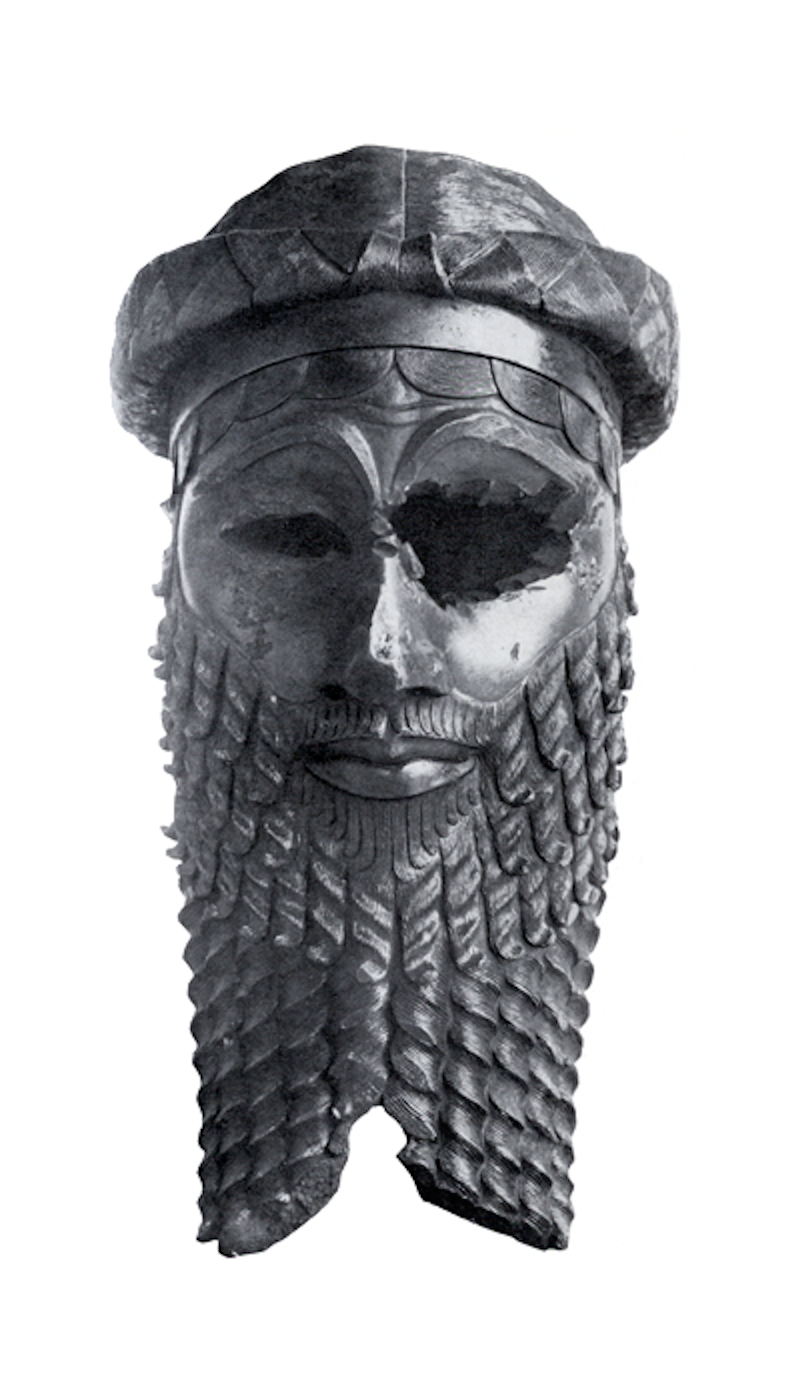
(Edit: I should mention I'm a near eastern archaeologist and not specifically a historian) The thing is, it's almost impossible to say for sure if they actually wore their beards like this. There are a myriad of Mesopotamian depictions of men with this style of beard throughout history. They may have well worn their beards in such a fashion, but primarily the beards were likely used as an ethnic identifier in public displays. The average citizen would have been able to recognize different peoples by how they were depicted on reliefs, and the beard was just one aspect of that. The "warrior bun" is also a common hair style depicted for Mesopotamians and was likely worn by soldiers at the time. Reliefs like those linked here are also full of symbolism better explained by an art historian.
Do you have a picture showing exactly what you're referring to?
As a follow up/refinement, do we have any depictions of the Mesopotamian bearded men produced by other cultures, and did they more or less resemble how the mesopotamians depicted themselves on the beard aspect?
Stylized, geometric art was the norm in Mesopotamia (with, of course, immense variation over time) from pre-history up to at least the Islamic period. From very early on, the forms of statuary and iconographic depictions used ( stone, clay, occasionally soft metals or gems and sometimes even wood) lent themselves to somewhat formulaic, representational depictions which expressed details and distinction via a composite of abstractions and pattern. This applies to most Mesopotamian artwork, and can be distinctly seen in the depictions of various styles of beards. Some of the earliest, most basal examples that I'm aware of are these votive statues from the Early Dynastic period (the earlier part of the Third Millennium BCE, when organized, urban temple-palace complexes were really starting to take off). The geometrical patterning is distinct in the beard: zig-zagging, repetitious lines giving the effect of a long wavy beard. Also interesting are beards on bulls, like the famous Bullheaded Lyres of Ur, this older copper bust, or this Post-Akkadian statue. I've read an article from the 1920s which claimed that the tradition of anthropomorphic beards on what otherwise appear to be regular domestic bulls - which are physiologically beardless, a fact sure to have been visually apparent to the agriculturalist Sumerians - comes from cultural-iconic memory of the great bearded Eurasian bison, which may have once inhabited parts of the Zagros mountains and the Iranian plateau. The author went on to speculate connections between the physical power of the bison and the beard's associations of masculinity, strength, and pride. It does strike me as a kind of whimsical connection, but I will note some potential lexigraphical evidence to support it: the Sumerian alimbu, a mythological variant of bison often referred to as "the wild bull with the lapis lazuli beard" buru ekdu sha Alimbu zigni un-ni-i zaqnu" (why his beard is lapis lazuli is anyone's guess; I suppose it was just a highly-esteemed material with connotations of divinity and virility). In any case, Sumerian beards and Sumerian bull-beards do look similiar. That could just be due to both tending towards curly, naturally-matted "dreadlock" facial hair. Oh, also check out the much-later Assyrian bulls and lions, which demonstrate an even more distinctly-human and highly stylistic curling.
Moving on, one of the most famous and iconic instances of this type of beard can be seen in this bronze bust of Sargon the Great or his grandson Naram-sin, respectively the founder and the third ruler of the formative Akkadian Empire. The beard is shaped into deliberate, beautifully-organized curls in tightly-coiled pillars. His hair seems to be woven into an intricate chignon du cou, which itself becomes a very commonly-depicted hairstyle throughout the next 2000 years. You can find numerous other examples from around the Akkadian period of this type of beard, and it's possible that either the style itself or its symbolic connections to the royal authority propagated in part due to the religious-societal centrality of Kingship; the ruler's image was an oft-emulated ideal, at least in the propagandistic sense of visual art if not in actual practice. You see it in the kings of Ur, in mythological scenes on cylinder seals and religious icons, and variants are even noticeable in victory scenes on triumphal stele amongst sequences of war-prisoners. It wasn't by any means a universal male fashion, but it did seem to become more common over time. The governors of Lagash, for instance, were from their earliest records always shown fully clean-shaven, head and beard, and the tradition persisted up until late in the life of the post-Akkadian king Ur-Ningirsu. His father Gudea appeared dozens of statues and busts completely shorn, and while the earliest depictions of his successor follow that style, the last one of Ur-Ningirsu to survive shows him with a beard as long as any Akkadian and in the same coils.
I could go on listing examples, especially as we proceed into the 2nd millenium BCE whence the coiled beard becomes the standard feature of kings and gods in imagery, but this is taking me freaking forever. I'll just note that several sources (Karen Rhea Nemet-Nejat's Daily Life, an apothecary website, etc.) seem to take it as common knowledge that by the Middle Assyrian period, it was commonplace for beards to be styled with a combination of braiding, pressing with hot irons or coils, beads, and the application of diverse oils and mineral powders (such as labdanum, resins, and dyes), but I can't find any primary sources or archaeological evidence to back that up. It seems reasonable to assume that as the artwork becomes more and more refined in its portrayal of ornately curled and tiered beards and hair coifs, this might correspond to the proliferation of actual fashion which would certainly accord with the greater availability of luxuries from Imperial trade economies in the early Iron age and the expansion of wealthy elites. It's not a huge stretch of the imagination to see the development of beard stylization as accompanying the increased urbanization of Mesopotamia, though in all periods the style is marked by its patterned regularity and geometric orderliness (as stated above, a unifying characteristic of the types of monolithic royal iconography that served to bolster the mythic-cymbolic importance of the king and state and his embodiement of an orderly world/kingdom). I think we can assume that the coiled fashion has existed from pre-historic times, arising out of a genotypic inclination towards curly hair and cultural valuation prizing it as a marker of masculinity, either from mythic associations or those of kingship's visual propaganda. I wish we could say how common it was amongst everyday people and how closely it actually resembled the representational idealizations of Mesopotamian art, but our evidence seems mostly restricted to iconography and limited textual evidence. The most exhaustive source you can read for more on the former is Betty L. Schlossman's Portraiture in Mesopotamia in the Late Third and Early Second Millennium BC, which covers far more than I could. For more on the latter, I can go into a lot more detail on the philological occurrences of the Assyrian and Akkadian words for or relating to beards if anyone is interested (it's a lot to type about and I wasn't sure how much was relevant to this specific question, but there is some interesting stuff to be said).