Here is the scene. The older clergyman raises an eyebrow but otherwise says nothing. Was it acceptable, or at least tolerated, for male people to present as women in this setting and in this way? Was it common? Did they get dance partners?
As far as I know, no, not in NYC the 1860s. The closest thing I'm aware of to it is American professional women that presented in male clothing--Dr. Mary Walker openly dressed in male clothing during that decade, defended it vehemently, and and was arrested for it multiple times. There were women who presented as male and fought in the Civil War. Emma Edmonds presented as male, fought for the Union, and published a memoir in 1864 describing her experiences that sold +175k copies. I'm unaware of any records of male persons doing so openly in the same period, or writing about it.
You could find male people openly cross dressing in dance halls if you skip forward a few decades, though they were often arrested and not accepted by the wider populace. The urbanization of the United States lead to much more people being concentrated much closer together in city centers, which led to people we would now describe as GLBT being able to find each other and form a community in ways they could never have done scattered across sparsely populated rural areas. By the 1890s there were what we would now describe as gay bars in multiple urban centers where cross-dressing was permitted internally, if not by wider society. In 1907 there were a group of black male cross-dressers in St. Louis that were arrested for "carousing and dancing with white men."[1] In Chicago in the 1920s there were annual drag balls officially billed as masquerade parties and thus legal, where participants of both sexes would cross dress. This still wasn't something that would be permitted to happen in a random church, as it's depicted in the clip.
[1]Originally reported in 1907 by Charles Hughes, quoted in Katz' Gay American History
[2] The greater source for all of this is Eaklor's Queer America, chapters "Into the 20th Century" and "Sexualities and Communities Through Two World Wars".
Follow up question; In this scene you see the female character choosing her male dance by looking at them through a mirror. Was this actually a thing?
Immigrant men, particularly of Italian descent, were quite well-known to be less discriminatory than most when it came to sexual relief around the turn of the century; a man's sex drive was thought to be an overpowering force, and its release a medical necessity. Thanks to the strict gender segregation of the time, as well as the Catholic Church's harsh admonishments against sex with women, many lower-class men did indeed have sex with biological men; though, for the most part, the latter group were not considered men, but a third sex.
Sexuality at time was based far more around one's gender presentation and level of masculinity than the biological sex of one's partner; a masculine man could retain all semblance of normality while openly seeking satisfaction from another man, so long as that man was in the feminine, "taken" role.
As to an open, clergy-approved situation like this, it's difficult to say. I haven't come across anything that mentions the clergy with regards to male sexual relations in the early 20th century. The type of relationship I described above, however, was almost non-existent in middle-class, educated communities; therefore, it seems unlikely that a clergy-member would have nothing to say on the matter.
SOURCE: George Chauncey, Gay New York
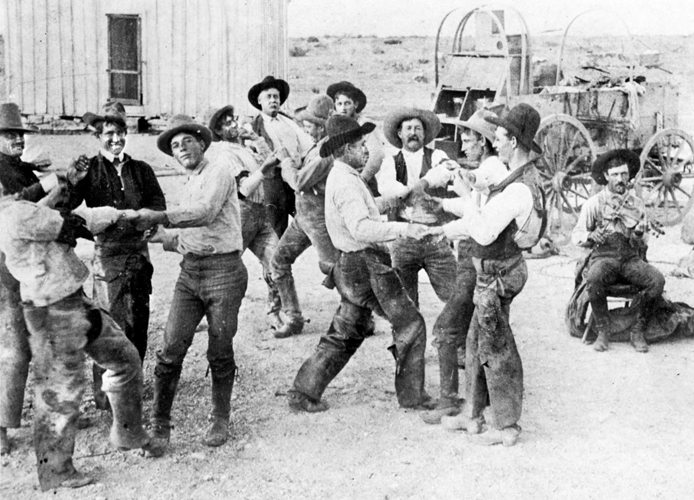
It's been common practice in many situations were there were no women, or not enough women to around, for men to dance with men.