their own people
Vikings regarded most people as 'their own people'. They did not have much of a distinction between foreigners from, say, Russia, Ireland, or the next valley over. There are plenty of Viking inscriptions and sagas about people with regional ancestry, for example referencing to someone as 'the Swede' or 'from Gotland', but not 'the Scandinavian'. This also meant that vikings generally applied their own moral laws on others, that is, they would not treat the Scots or Anglo-Saxons any different from how they would treat a Dane. Just that the Anglo-Saxons (or the Franks), being Christian, would not play by their rules (because they were Christian), was irrelevant for them.
Some interesting examples of how the Vikings saw 'the other' in their various expeditions are discussed in: Miller, W. I., 1986. Gift, Sale, Payment, Raid: Case Studies in the Negotiation and Classification of Exchange in Medieval Iceland, Speculum 61, p. 18-50.
A view of what made the Vikings distinct from an Anglo-Saxon (and Frankish) perspective is Guy Halsall's 1992 Playing by whose rules? A further look at Viking atrocity in the ninth century. Medieval History 2, volume 2, p. 3-12.
A more fundamental discussion on what ethnicity meant to early medieval people is found in Florin Curta's 2011 Medieval Archaeology and Ethnicity: Where are We?, History Compass 9/7, p. 537–548.
There is ongoing debate among Anglo-Saxon archaeologists about just how many people from Scandinavia, Germany, or the Continent actually migrated into 'Anglo-Saxon' England, or what significance these migrations had on the local culture of England. Most would agree that the majority of people in 'Anglo-Saxon' England were actually the descendants of the Romano-British population. There's more debate about whether these people were culturally Germanic, but I would personally make a strong argument that they were not. As a consequence, I would reject the premise of your question - Vikings and Anglo-Saxons weren't ever the same people (though many persons moved back and forth around the North Sea during the early middle ages).
Let's start with the hard science, and move toward the (more important) cultural questions. A number of fascinating DNA studies have been published in the past couple of years, and they are helping to clarify what percentage of the population of Britain came from Angles, Saxons, etc. One, published in Nature in 2015, used data from modern populations to estimate that between 10-40% of southeast Britain's population (the people living in the 'Anglo-Saxon' kingdoms) had migrated from regions in Germany around the fifth century. That implies a significant movement of people, but also that 60-90% of the people in these areas were natives, not immigrants.
A second study, published earlier this year, looked at ancient DNA from Iron Age British, early 'Anglo-Saxon', and middle 'Anglo-Saxon' (200 years later) skeletons, and found two interesting things. The first was that the early 'Anglo-Saxons' were a mix of DNA: two had the most in common with Continental genetic mutations, one was most closely related to the Iron Age British bodies, and one had mutations from both sides (they'd intermarried). Second, the bodies from 200 years later (so, well after the migration / conquest was supposed to have ended) were recent immigrants from the Continent. That means that migration was ongoing two centuries later - which makes sense if you think about how easy it is to cross the North Sea.
This genetic info complements another kind of evidence that's been piling up for the past decade, which is studies of the isotopes in people's teeth. When we're growing up and our tooth enamel forms, trace elements from the ground water we drink are preserved in our teeth. Scientists today can extract these elements and, from the ratios in which they are present in the teeth, figure out where someone spent their childhood. You can use this to trace migration, comparing the places where people were born with the places their bodies were buried.
A number of studies have been done on 'Anglo-Saxon' cemeteries in England, and they tend to agree with the genetic data: some people came from the Continent, some people were local, and some people came from the western part of Britain. In fact, often, there are more people from western Britain than there are people from the Continent. The Welsh were moving east into 'Anglo-Saxon' regions, settling down, and being buried alongside the locals. That doesn't fit at all with the old story of eastern 'Germanic' invasion, but works very well with the idea of a mixed population that was 10-40% genetically German and otherwise local. Example, and another.
What to take away from these studies? They point toward a very different version of events than our written sources give us (these written sources shouldn't be trusted for a number of reasons anyways, something historians have long accepted): migration happened, but it seems to have taken a lot longer than we thought, and it seems to have involved a lot of intermarriage and genetic mixing, rather than one population replacing another. So we have to ask: what about cultural mixing - did one culture survive, or was 'Anglo-Saxon' culture as much a blend (or perhaps, a brand new thing entirely) as the people of post-Roman Britian were (in genetic terms)?
Culture is, of course, what actually makes two 'peoples' the same. It doesn't matter whether you share genetics with someone, they're only your 'kin' if you recognize each other as having a shared background, and that's rooted in your own ideas of who you - and they - are. So while genetically you can't really call the Anglo-Saxons and Vikings the same people, they could still share a common culture, or at the very least might imagine themselves as having shared a common ancestry that made them kin.
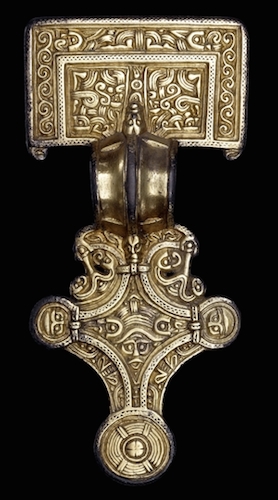
Here, as with the evidence for migration, the evidence is a lot messier than we'd like it to be. There were, certainly, connections between England and Scandinavia. The most iconic is a form of metal brooches called 'great square-headed brooches', and these originated in Scandinavia, were brought to England, and were then imitated by English craftspersons. You might also think of the Sutton Hoo burial, in which someone (King Raedwald?) was buried in a boat wearing a Swedish-style helmet; you see more burials very much of the same kind in Sweden a generation or so later. Clearly, there was something shared between these burial practices.
But England also shared a lot of culture with its other neighbors. There were deep, close connections between Anglo-Saxon England and France. Artistic exchange with Ireland. Even trade and travel to the Byzantine Empire. The Sutton Hoo grave, in addition to Swedish connections, also contained coins from France, artefacts from Egypt and other parts of the Byzantine Empire, and clothing copied from Persia. So is it more accurate to say that this burial reflects a common culture between Scandinavia and England, or that Raedwald, as a rich and powerful king, participated in an elite culture that stretched far across the many kingdoms that neighbored his own?
On a local level, 'Anglo-Saxon' archaeology from this early period looks, well, local. There's a ton of variety in settlement structure, burials, pottery, jewelry - you name it. Some of this connects with Scandinavia and some of it connects with Englands other neighbors, but it's really difficult to make an argument that England and Scandinavia were any closer together culturally than any of the other people who sailed across and around the North Sea. They clearly knew about each other, and some people clearly moved between these regions; but trading with someone doesn't you 'one people'. It's just neighbors.
By the ninth century, when the Viking raids and invasions of England were in full force, southeast England had begun to unify into larger kingdoms whose kings traced their ancestry back to tribes that once lived on the Continent (Angles, Saxons, etc - though there wasn't an independent Jutish kingdom anymore by this point). Just how literally we should take these claims to ancestry? Not especially - all the evidence, genetic and archaeological, points toward early 'Anglo-Saxon' England as multi-ethnic, diverse, and local, not the product of a grand invasion or even an organized large-scale migration. Rather, the 'Anglo-Saxon' identities of these kingdoms was fictional: the same way many Americans today point back to one ancestor in their family tree and say, 'I'm Irish!' Sure, that's sort of true - but most Americans are also from several other places, too. Ethnicity is often arbitrary. Which doesn't mean that it didn't matter: Angle and Saxon kings used their origins stories to support their claims to power, and people went along with it, so it clearly was a successful origin myth. But did that myth include a feeling of kinship with the Vikings?
As far as we can tell, the answer is a soft no. The Viking invaders would not have totally foreign to the English; they may have been able to talk to one another, and their cultures would not have been utterly incompatible. They were neighbors.
But they weren't the same people. People groups in the early middle ages weren't defined by culture or genetics, so much as by their relationships to each other and to their rulers. The Anglo-Saxon kingdoms were composed of close networks of friendship, obligation, responsibility, marriage, friendship, faith - that is to say, they were communities. Very complex communities (don't imagine a simple 'feudal' structure), but they had a long history of relating to, fighting, and getting on with each other. Scandinavians and the English, not so much - there was exchange across the North Sea, but they didn't interact in the same way. And these interactions, more than genetics or culture or even origin myths, were what made a people a people.
For futher reading:
The Vikings from Jutland may have been aware that the Anglo-Saxons had originated there as well, but this doesn't mean they would have regarded them as 'their own people', and therefore not to be pillaged.
Germanic tribes moved around a lot in those days and from reading the old texts it seems that identity was much more to do with a tribe or people (eg lineages) than place. If we're talking about the Danes, who were most identified with the Vikings from Jutland raiding Britain, then we can look at the 'Deeds of the Danes', the first full history of Denmark written by the Dane Saxo Grammaticus around the late 12th century. Books like this are unlikely to be accurate history, but they do tell us how the world of tribes, nations, peoples etc was conceived at the time.
This work does actually discuss the Angles being from Jutland and how they were related, but distinct from the Danes (though of course it was written long after the Viking age and references the work of the English monk Bede):
"Now Dan and Angul, with whom the stock of the Danes begins, were begotten of Humble, their father, and were the governors and not only the founders of our race ... Of these two, Angul, the fountain, so runs the tradition, of the beginnings of the Anglian race, caused his name to be applied to the district which he ruled. This was an easy kind of memorial wherewith to immortalise his fame: for his successors a little later, when they gained possession of Britain, changed the original name of the island for a fresh title, that of their own land. This action was much thought of by the ancients: witness Bede, no mean figure among the writers of the Church, who was a native of England, and made it his care to embody the doings of his country in the most hallowed treasury of his pages; deeming it equally a religious duty to glorify in writing the deeds of his land, and to chronicle the history of the Church." (Book 1)
Grammaticus mentions Jutland and the Jutes (the third Germanic people, along with the Angles and the Saxons, traditionally identified as having migrated to Britain) describing them as being a kind of vassal people or subgroup, e.g.:
"At this time Horwendil and Feng, whose father Gerwendil had been governor of the Jutes, were appointed in his place by Rorik [a Danish King] to defend Jutland." (Book 3)
The Saxons are also mentioned:
"Helge [A danish leader] ... took Jutland out of the power of the Saxons, and entrusted its management to his generals, Heske, Eyr, and Ler." (Book 2)
So this work indicates that the Danes saw themselves as distinct from the Angles, Saxons and the Jutes. Even if during the Viking period there were raiders who saw themselves as Jutes or Saxons, a period of 400 years of separate development seems more than enough time for separate identities to develop between those on the island and those on the mainland. Finally, it's not clear that even if some Vikings had regarded some of the people they were pillaging as their own people, that this would have meant they refrained from pillaging them, e.g. Grammaticus recounts conflict between some Danes (e.g. Zealanders) and others, e.g.
"The Jutlanders, a presumptuous race, thinking that because of his recent marriage he would never return, took the Skanians into alliance, and tried to attack the Zealanders, who preserved the most zealous and affectionate loyalty towards Ragnar [the Danish king]." (Book 9)
(I'm not clear from this quote whether he means Danes living in Jutland or Jutes)
What about the linguistic evidence?
Because the Jutes who settled England weren't really "Danish." They are better understood as a Germanic group who just happened to come from Jutland. Modern day Danes are descended from the Daner people who settled Denmark in the 6th century. They came eastwards from Scania/Sweden and concentrated mainly on Zealand. The Daner tribe are the chief anscestors of modern Danes, just like the French are descended from Franks and not Gauls, English from Saxons and not Celts, and Swedes from Svear and Götar (Geats) and not Herulians.
Vikings raided everyone, including eachother. They probably wouldn't have guven a good god damn if the Jutes had settled England only a decade earlier.