I'm curious about the intermediary stages between traditional warfare and firearm based warfare. Shields seem like an integral part of infantry loadout before guns came about, and then they seem to vanish instantly. Was there ever a significant attempt to use shields to defend against musket regiments? I imagine it must have failed if it happened.
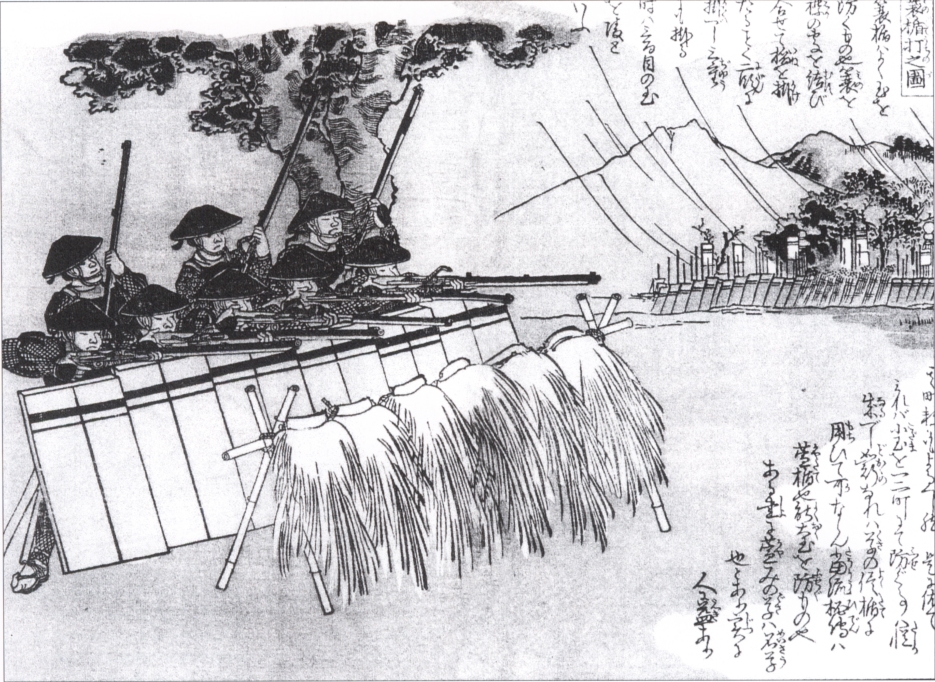
Not exactly what you're looking for (if I remember right in Europe shields fell from popularity long before the musket-wielding line infantry regiment of the late 17th to 19th century) but the Japanese were used to set up pavise-like shields for their archers and soldiers. This was kept after the introduction of the arquebus (see this picture) and eventually evolved into thick bundles of bamboo or iron shields to stop bullets, and was quite widely used in late Sengoku siege assaults for soldiers approaching the walls or retreating to hide behind. See these pictures:
bamboo bundle illustration
iron shield museum collection
how they were used
Apparently Tokugawa Ieyasu gave his generals an earful during the winter Siege of Osaka when they attacked the southern walls without order and without bringing these and failed spectacularly. Ieyasu told his generals to never forget bamboo bundles and iron shields. So they probably worked well enough.
In eastern Europe firearms were initially used to support defensive tactics, most famously the Hussite wagenburg where mobile wagon forts defended by gunners, crossbowmen and infantry were used effectively against better equipped armies of mounted knights. Gunmen and pikemen were also still sometimes protected by a wall of pavises as late as the early 1500s such as in this illustration of Bohemian soldiers at the Battle of Schonburg. https://s31.postimg.io/75u1s9h5n/Cgm_1598_Chronik_des_Landshuter_Erbfolgekriegs.jpg
Whether the pavises provided enough protection to make it worth it is probably debatable. The heaviest muskets could penetrate up to several inches of wood and by the late 16th century Sir Roger Williams was arguing that even a target proofed against anything heavier than a pistol would be too heavy to fight with for more than an hour. The wagenburg in particular eventually proved extremely vulnerable to Ottoman artillery.