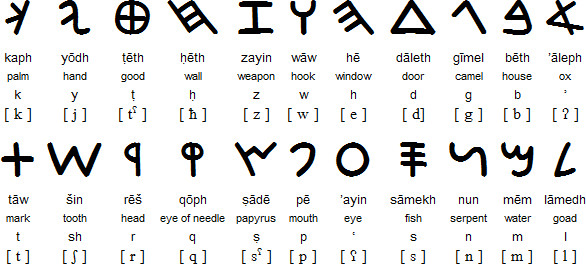
The Greek letter "P" was the capitalized form of the letter rho, which roughly denoted the "r" sound. However, in the modern English alphabet, this symbol represents the same letter as the Greek letter pi. What historical factors caused this?
The Latin /P/ does not come from Greek rho. The Latin alphabet is via Etruscan script, and the /P/ comes from the Etruscan variant of what would be pi in Greek. The pi comes from Phoenician pe. See here. The rho, meanwhile, comes from Phoenician resh.
As you can see by comparing the Etruscan and Phoenician, the adoption by the Etruscans is quite early. As a matter of fact, many are now starting to hypothesize that the Etruscans picked up the script in the 8th century BCE or earlier, and that it might have been a combination of Greek and Phoenician simultaneous input. There was a brief window of time when Greeks, Phoenicians, and Etruscans were all rubbing shoulders along the western-central coast of Italy, particularly at the short-lived "mixed" settlement at Pithekoussai, on the island of Ischia. The primary excavators (Buchner and then David Ridgway) were always careful to point out the "international" qualities of Pithekoussai (Greek pots, yes, but also Phoenician pots, lyre-player seals, etc). Pithekoussai was abandoned by about 690 BCE, perhaps because of volcanic or earthquake activity, and when settlement resumes across the bay at Cumae, it is thoroughly Greek and no longer so international (or so the evidence suggests).