Because we at AH occasionally get questions about going to Grad School as a historian or with a history degree, we decided to have a series of Monday Method Threads where our flaired and non-flaired users could share their experiences, opinions and tips about going to Grad School.
Today's first installment will deal with rather basic questions: Should I go to Grad School? What really is the purpose of a Grad School education and does it make sense for me? What conditions will I find and under what conditions should I do it (get a PhD without full funding?)?
Ask your questions those who contemplate Grad School and share your thoughts those who are already in Grad School / have completed Grad School!
Nest week: "They'll take our lives but they'll never take our transcripts!" Grad School Admissions part 2: The Basics and getting started
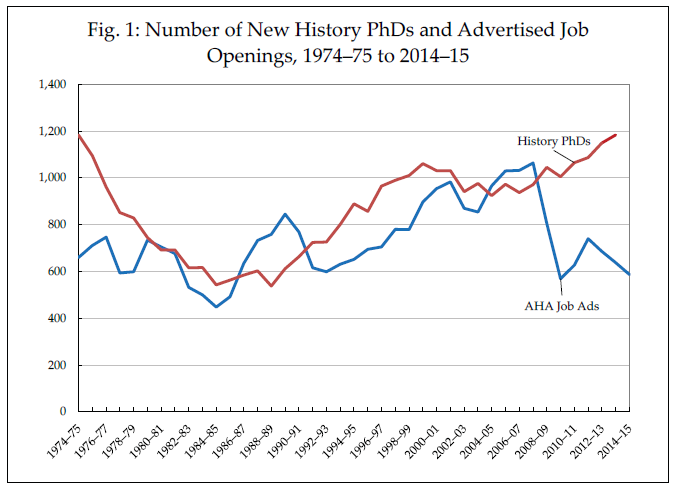
I have one graph that I think everyone thinking about starting a grad degree in history should see: Number of New History PhDs and Advertised Job Openings, 1974-75 to 2014-2015 (USA). (Source article.) Data doesn't speak for itself, so let's just dissect this a little bit.
The obvious part is that the number of new PhDs per year is about twice the number of jobs advertised. That's bad for newly-minted PhDs on the job market. In fact, that's bad for anyone who graduated sometime after 2008 and doesn't have gainful employment and still holds out hope for it. Consider that some number of those jobs will not be for new PhDs anyway, and that every year you are not just up against the newest grads, but whatever backlog of grads there are that didn't get jobs in previous years, as well as anyone who is trying to move institutions for whatever reason (and there are always many reasons).
That's the obviously downer part of this. Are there other things to note? Well, one is that these things move in trends, and if you're starting grad school now (in the United States, anyway) you won't be on the market for 5-8 years or so, depending on how speedy you are. And heck, you might not really be in the running for tenure track jobs for another decade (because it has become pretty common for people to spend at least 2 years in postdoctoral positions first). So the market you face is not the market that exists now, it's the market that exists in the future. So maybe it'll be better.
Of course, there are reasons to think that might not be the case. The economic crash of 2008 obviously is the cause for the current big dip... but after what looked like a small recovery in 2012 or so, we are back to those 2009 levels. And a lot of those jobs are probably pretty crap. One of the effects of the 2008 crash is that a lot of tenure track jobs turned into adjunct and temporary positions, and it's not clear if those tenure track lines are coming back. And, against all models of economic rationality, the number of people starting PhDs seems to have increased after 2008. (One can theorize why that might be: grad school can seem like a cocoon from economic forces, a place to "wait out" a bad job market, especially since history PhDs are often funded to some degree. Similarly, a tenured position is, in theory, excellent economic insulation during troubled times — though post-2008 various universities have found lots of creative ways to get around the un-fireable aspects of tenure.)
Will there be lots of new tenure track lines opening up in the future? It's not clear. Another post-2008 effect was that lots of older faculty were "bought out" with early retirement, to free up funding. Not necessarily a bad thing, to be sure. But the result is that the current American historical academy is much younger than it was 20 years ago. So there won't be any big "wave" of retirements for another two decades or so, when the current crop of 30-40 year olds start to bag out.
That's super depressing. As a point of reference, though, I just want to point out that when I started grad school, in 2004, it was a rare boom period — everyone graduating was getting a great job. The economy crashed when I had already put in 4 years of grad school, and I picked up my PhD in 2010. So those in my "generation" of PhDs really had to adjust their expectations and strategies (this is in no small part why I started blogging and whatnot, as an aside). Whereas you, in theory, can go in with eyes wide open, knowing what the challenges are going to be and planning for them well in advance.
Story time: I started grad school in 2004, as noted, and started my tenure track job only in 2014. And this is really not a sad story, in my case — I graduated from a top-tier university, did not go into debt at all for grad school, did not have to move around very much, have a wonderful wife who has her own great career, etc. I spent the first year after graduating lecturing and on a postdoc at my graduating institution, then spent three years on a postdoc in Washington, DC, and then got a wonderful job basically in NYC that let's me do what I want to do. So this is a good story. But it did take a lot of hustling and entrepreneurial activity. And I do basically spend all my time working, though that's how I prefer it. And I don't have children, by choice, which frees up a lot of my time and our money and gives me flexibility that a lot of my colleagues don't have. Out of my cohort of 8 people that I started grad school with, two others have tenure-track jobs, one has a good museum position, one left the academy and works in the State Department (currently stationed in Moscow!), one has a research position as a historians with a US government agency, one was in postdoc hell for a long time but now seems to be working as a consultant, and one stayed in grad school for something like a decade but eventually dropped out and is somewhat marginally employed. So that's not terrible but remember this was a top-tier program, the most prestigious in our sub-field at the time we started grad school.
If I were advising someone on getting a PhD in history today, my first question would be, "how bad do you want it?" Like, so bad that you'd be willing to wait a decade to have a "real job"? And yet — can you live with the idea that you might not be able to make it work as a professor, and be honestly willing to do something outside of academia? (And be willing to figure out what the hell that means, as someone whose resume will make you look like a crazy person to anyone outside of the academy?) You've got to own up to the fact that this is a real bind: you aren't going succeed unless you're willing to give it your all, but you might not succeed anyway so you can't go into it with no flex whatsoever.
OK, you want it, but you also are willing to do something else, and etc. What next? You need to be very strategic. Look at the different sub-disciplines of history and think about them from the perspective of both academic and non-academic employment. American history is completely over-stuffed with American PhDs — so if you're going to succeed at that, you're really going to have to find a way to stand out from the pack. Other sub-disciplines of history often have far fewer positions per department, but also the inherent competition is lower. Some sub-disciplines are more boundary-crossing than others (history of science, for example!), and make it possible to imagine applying for a variety of differently-listed jobs (my official academic title is not in history, but Science and Technology Studies, as an example).
My other advice for someone starting now is also to think about adding some "practical" skills to your toolset other than just the normal ones of history. Computer coding and a knowledge of database development have done me a lot of good over the years (I just happened to have also developed these skills; it was not a "plan" with regards to getting a job), and they are very flexible in their application (you aren't locking yourself into some fad regarding digital history — they're just useful things to know how to do). This is valuable both inside academia and outside of it. Anything worth learning takes a few years to learn — so start early.
And it's a sad fact of things that "brands" matter in academia. The "better" the grad school name (and advisor name), the easier it is to get past the "first cut" of jobs. Grad school is also where you can make up for a lackluster or non-traditional undergraduate degree — nobody will mind that if you can get into a top school. If you can't get into a top school, or they aren't willing to fund you, it might not be worth your while, passion or no passion.
So that all seems super discouraging, I know. It's not the intent. The intent is for you, the hypothetical grad student, to know what the game is before you get completely sucked into it. Because once you're in, it's hard to get out. For reasons that are both practical and psychological. Don't be the grad student who goes in believing they'll be "the one," and then get bitter and desperate by the end of it. Don't be the young student who comes to hate the academy or their discipline when they get into their 30s, because grad school sucked the life out of them with its lies. (Don't go straight from undergraduate to grad school, either — take a least a year to work in "the real world" so that later you can appreciate what a luxury it is to get paid to read books and write papers for a living.) Don't be the person who studies that narrow, narrow, narrow sub-field but then realizes there are no jobs in it, and flails around and worries about working at Starbucks because they never developed any other marketable skills. But don't also be the person who gets the most generic PhD possible and wonders how they will compete against so many identical candidates.
Don't go into it depressed. Go into it determined and with plans A, B, C, and D, and all of them sound OK as far as you are concerned. Because you might need all of them to make it work out.
The above is only specifically informed by the US situation though things don't seem all that great elsewhere as well, from what I've heard. Worth looking into these kinds of things, however unpleasant, if you are thinking about doing this. The schools themselves will rarely tell you this kind of stuff, because they benefit from your enrollment (you are a source of cheap teaching labor, absolutely essential for them to run the real show, and they do not suffer in any way if you don't get a job) — so do your own research!
Did anyone have any experience with applying to either an MA or PhD program without any (or any good) faculty recommendations? Unfortunately the history portion of my degree seemed to churn out different professors year-on-year so I'm not sure, if I were to apply to grad school, if I have any obvious professors I could reach out to. This despite quite good marks.
In any event I'll have been working professionally for several years, presumably professional recommendations are less useful? Or not so?
Are there any Australian post-grads here? Our system is so different to the US, and even considerably different to the UK, that a lot of the advice I see online seems a bit out of place.
That being said, I know the situation regarding post-grad jobs in History isn't much better down south - if anything, it might be worse.
Here is a fantastic resource for the Canadian perspective on Graduate studies and employment.
https://lilligroup.com/tips-for-the-job-seeker/
Something to note; the dominance of a few schools in producing PHDs that go on to become faculty is telling. Not all programs have the same level of clout, certainly.
Anybody have any opinions of the employability of traditional MA -> PHD programs vs Direct entry PHD degrees?