http://www.theglobaleducationproject.org/egypt/articles/stonetech.php
There are hundreds if not thousands of hard stone vases dated to the the earliest accepted dates of ancient Egypt. They are found no where else in the world. Vases that we can not replicate with modern machines. These vases are not found to be manufactured by more recent dynasties only the oldest ones. Did they just no longer enjoy making them? Did they forget how?
Can any of you truly look CaptainApollyon in the eye and tell him there is no legitimate mystery here? If there is no mystery I would like to see the evidence that has convinced you.
Most of the claims made in your link are unsubstantiated hyperbole or simply wrong, designed to hype up a non-existent mystery.
The Step Pyramid is believed to be the oldest stone pyramid in Egypt - the first one built. It seems to be the only place where these kind of stone housewares were found in quantity, although Petrie found some fragments of similar bowls at Giza.
These bowls and the tools to make them have been found at Fayum, Abydos, Dahshur, Lahun, Giza, Naqada, Takhan, Naga-ed-Deir, and Nekhen, too name a few. Some have been found as far off as Syria.
Stoneware such as this has not been found from any later era in Egyptian history -
While most popular in the Early Kingdom, there are examples from at least the 2nd, 3rd, 6th, 12th, 13th, 16th, 18th, 21st, and 26th dynasties, plus the pre-Dynastic period and Late Periods before/after regular dynastic numbering. That's the entire length of "Ancient Egypt" until Alexander the Great.
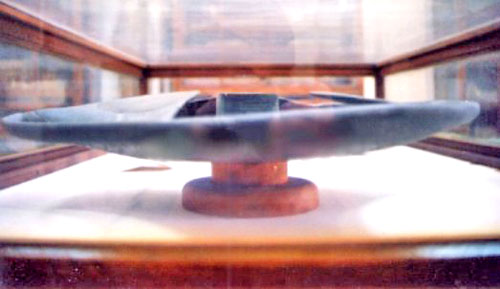
Here is a large (24" or more in diameter) piece turned out of schist [...] three areas spaced evenly around the perimeter [...] It is a truly amazing feat of stone work.
The tri-lobed "disk" featured is a mainstay of psuedoarchaeology sites because some people can't wrap their head around anything they don't immediately recognize. Seriously- there's no real explanations for it's mystery beyond "It looks funny!" Here it is from the side- quite asymmetric, eh? Hardly a "truly amazing feat."
Since we have yet to reproduce such pieces it is safe to say that the techniques or machinery they employed to produce these bowls has yet to be replicated.
Apparently the author has never walked into a Pier 1 Imports and seen modern vessels? Assuming he's talking about using period-appropriate tools, this is still wrong. Denys Stocks went ahead and tried doing it himself, with great success. You can see in his book chapter numerous ancient Egyptian depictions of people working the bowls and vases. Going off these images and known artifacts, he recreated the tool set of the ancient artists. At the end you can see his final result- a limestone vase with impeccable symmetry. Keep in mind that Stocks is not a trained sculptor in any sense. An expert would be able to do so much more.
They show the unmistakable tool marks of a lathe manufactured item.
The Egyptian tools are not that different from a lathe- why that's "mysterious" is beyond me. They used shafts with an interchangeable boring stone at one and suspended rocks at the other to provide balance. There's also solid evidence that some vessels, such as those made of granite, were first drill with a bronze pipe drill, something else that your link makes out to be "mysterious" but can easily be replicated with copper and quartz (see Stocks' Antiquity article). We actually even have a few examples of such pieces discarded part way through.
So why is it not mysterious to us? Because these bowls were quite common in both time and space and every aspect of their creation has been replicated using period-appropriate tools that we already had pictures of people using. Not really much to see there.
Ahrens, A. (2006). A JOURNEY'S END — TWO EGYPTIAN STONE VESSELS WITH HIEROGLYPHIC INSCRIPTIONS FROM THE ROYAL TOMB AT TELL MIŠRIFE/QAṬNA. Ägypten Und Levante / Egypt and the Levant, 16, 15-36.
Greene, B. A. (1989). Ancient egyptian stone vessels: Materials and forms. Doctoral dissertation, University of California at Berkley.
Kozloff, A. (1986). Egyptian Stone Vessels in Cleveland. The Bulletin of the Cleveland Museum of Art, 73(8), 327-339
Lucas, A. (1930). Egyptian Predynastic Stone Vessels. The Journal of Egyptian Archaeology, 16(3/4), 200-212.
Stocks, D. A. (1993). Making stone vessels in ancient Mesopotamia and Egypt. Antiquity, 67(256), 596+.
Stocks, D. A. (2003). Experiments in Egyptian archaeology: Stoneworking technology in ancient Egpyt. Routledge, London.