There are a couple reasons for the difference in terminology. First, the word "tell" comes from Arabic and Hebrew, and denotes a specific type of archaeological site. "Mound" is an English-language term, and is used for a slightly different type of archaeological site.
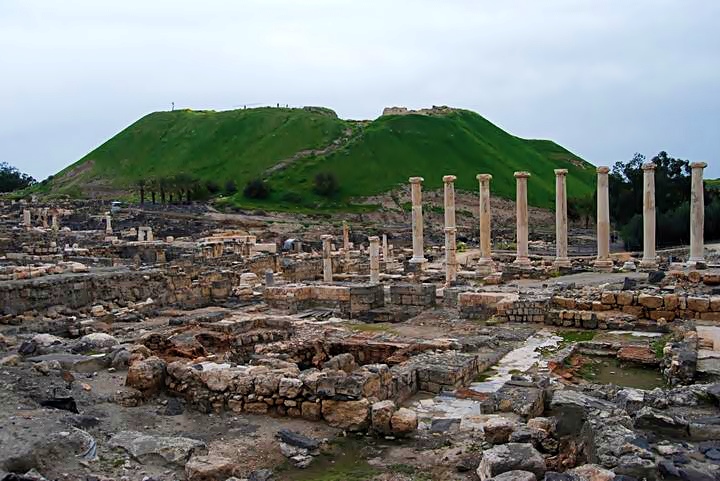
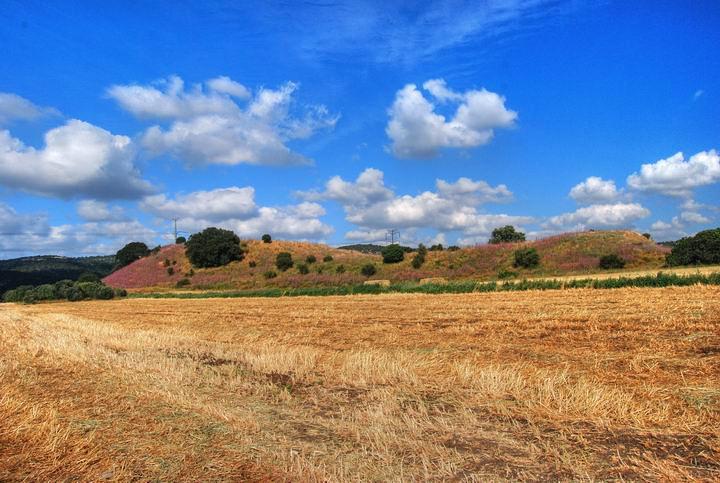
A "tell" is an archaeological mound that is created by human occupational debris. It's the result of cities being built on top of the ruins of previous cities. This process results in a distinctive flat-topped mound that looks like this, which is Tell Beth Shean, or like this, which is Tell Maamer.
The process of tell formation was outlined very well by Arlene Rosen in her doctorate thesis and subsequent book Cities of Clay: the Geoarchaeology of Tells. Her research (backed up by subsequent research from a number of articles including Friesem et al 2010) demonstrated that anthropogenic sediment deposition was the driving force behind tell formation. "Anthropogenic" means that people are producing and moving and providing the driving force for sediment deposition. One of the largest contributors is actually mudbricks, as they tend to erode easily in the rain (again, demonstrated by Friesem et al 2010), and the resulting mudbricky debris fills up the outlines of the houses.
It's much easier to knock down and fill up over a ruined mudbrick house and start over than it is to remove everything from the building site and start again, which is why you get lots of cities building on top of ruined buildings. Once you find a good place to live, you don't want to leave and find another, so you build on top of the ruins and the site gradually gets higher. I worked on a site with more than 23 distinct cities built on top of each other, creating about 8 meters of vertical accumulation.
In North America the situation is different. Native Americans built mounds for specific purposes, rather than as a byproduct of construction. They intended for mounds to happen. Tells are a byproduct of the way people made settlements in the Ancient Near East, but mounds were intentionally built as mounds. Sarah Sherwood has conducted several studies on the mounds and was able to determine the exact methods of construction and formation of the mounds (Sherwood, Sarah C., and Tristram R. Kidder. "The DaVincis of dirt: Geoarchaeological perspectives on Native American mound building in the Mississippi River basin." Journal of Anthropological Archaeology 30.1 (2011): 69-87.).
The TL:DR of it is that the two are very different things. North American mounds are intentionally built as mounds, for some social or religious purpose. Middle Eastern tells are byproducts of building and settlement habits.