Consider this thread a gathering place for stories about historical beliefs in magic, attempts to use it, attempts to restrict it, the relationship between beliefs in "real" magic and practices of human-created illusion.
Despite her existence being called into question since the fifth century, St. Margaret of Antioch became one of the most important saints in the late Middle Ages--as the patron saint of childbirth, she was especially popular among women. Margaret is counted one of the "virgin martyrs," apocryphal saints of the early Church whose medieval-era hagiographies depict their beautiful virginal bodies undergoing brutal torture at the hands of pagan rulers (and often their scheming wives) but never renouncing their faith.
But Margaret doesn't just get tortured; she gets eaten by a dragon.
Of course the draco is a serpent, a demon, and Margaret's saintly virtue gives it explosive indigestion. She kills it by bursting out of its stomach. Scholars have observed that the iconography of Margaret's victory has strong similarities to contemporary iconography of Caesarean sections. In the Middle Ages, the latter was an absolute last resort and a tragedy, because it meant the death of the mother--they were typically performed as a desperate measure to be able to baptize the baby before it too died.
So why, in a Middle Ages of treasure hunting and love potions, maleficium and weather magic, do I tell a story about saints and C-sections?
In the late Middle Ages, pregant urban women used to acquire scraps or entire manuscripts of the hagiography of St. Margaret. They kept a copy of the text or a few words on an amulet in the childbirth room with them. Margaret's defeat of the dragon was seen as a "rebirth" that defeated (her own) death. A physical copy of the text was a religious-magical ward against the medieval mother's potential death in childbirth.
Also, I first learned about this connection while visiting a class at the grad school I ultimately chose to attend. May reading it today serve as a ward of protection and luck for everyone applying this year. :)
In Māori traditional beliefs, the spiritual and divine worlds are close to the physically and the boundaries between spiritual or not are blurred. Across Māori communities, historically at least, there existed a very real belief in the ability to channel, control and interact with spiritual energy or force.
Mana is essentially power and authority, which could exist in humans, but it could also exist in figures and physical objects, and therefore people could create vessels for example, in the form of a ceremonial canoe paddle, which, once created and carved properly, could contain mana, and a ceremony was held to ensure a child could hold mana. Mana was inherited or gained or lost, and all of these were deeply spiritual affairs. It isn't magic, but mana was required for the practice of magic in the form of spells and charms.
Tapu can, in certain contexts, mean spiritual purity, sacredness and holiness, often relating to a prohibition relating to what was deemed tapu, such as not stepping on tapu ground. Tapu was held in beings, in objects and even trees. However, rituals would allow for the removal of tapu - whakanoa- when necessary, for example, when felling a tree for the building of a canoe, or after the birth of a child. Tapu could also be formally placed on sacred sites and on people as well, an example would be rāhui, which can mean restriction in general, but in this context can mean making a place tapu after the death of an important person or after a particularly horrible or magic-caused death. Tapu could be strengthened or reinforced with a turuki incantation. This could often be seen as necessary, as violating tapu, reducing tapu (for example, a menstruating woman coming into contact with a man) would not just affect the individual, but by offending the spirit world and gods, atua, it would affect the whole community. There was a necessary balance, some things and people were noa, normal, others were tapu, and it was important to be able to maintain such a balance.
People did not passively live with the spiritual world, they could use it and channel it, not at will, but following certain rituals, traditions or acts, for example, a leader of a hāpu, a group which would make up an iwi, or clan, would hold mana and tapu, but their actions would be able to change the amount or to what extent they held mana or tapu. A brave and moral leader would have more mana and tapu than a cowardly, cruel leader.
Slightly differently, Māori societies certainly traditionally believed that physical objects could contain power which they could not themselves fully channel or control, as with the creation of vessels for mana. Sacred stones, coming from Haiwiki or coming with the first canoes of the iwi, the canoes which carried the ancestors of the clan when they came to New Zealand, could hold special properties, from ensuring that a river had plenty of fish to providing safety and protection. Their holiness and powers were due to their origins and creation, and a sacred stone was not simply made, it could not be a created vessel, and therefore their ability to use or control these powers were limited.
However traditionally these properties could be guaranteed or triggered through karakia, or rites and charms, which meant that although this was not used by a person directly, it could be indirectly harnessed. These stones, among other objects, such as carved sticks, or taonga, ancestral objects, were talismans, they held mauri, which allowed for the flow of spiritual energy, it was the essence of life itself, and it would ensure life continued and flourished either on the person it was used on or in the area it was placed in. Mauri protects hau, which is the self and being of a person or place. These talismans could protect against magic designed to take over or 'steal' hau, usually from a person. The power these objects contained appears to come from its relation to the ancestry of the iwi or hāpu, the stones or taonga draw from hundreds of tohunga and leaders, from ancestral tapu, from the first canoe, from Hawaiki and the semi-divine ancestors who came from there originally.
Unlike some periods and places where spell casting and religion were set firmly apart, or appeared to, Māori communities have traditionally held the ability to use spells, incantations and even curses to be very close to spiritual and religious practice. This can be seen through the use of spells by some tohunga. This word is commonly translated as priest, and for some Pacific cultures, tohunga were necessarily those who interacted with spiritual and divine worlds, but this was not the case in Māori societies, where tohunga could instead be defined as being respected, prominent and knowledgeable people. Tohunga could have immense medical knowledge, or be skilled at carving. Tohunga could be expert wayfarers, or even tattooists.
Some tohunga acted as seers, for example, tohunga matakite. Matakite meant the ability to divine the future. This was both innate and also learned, one could not be a tohunga matakite without extensive education and knowledge, not just in the ability to interpret natural phenomena, dreams and other omens or portents, for example, tohunga matakite of the Ngāti Wāi used the movement of the waves inside a coastal cave to predict the future, and many used divination sticks or entered trances (this varied between clans and regions, and also depended on what exactly they hoped to see) but they were also expected to be experts in traditional knowledge, for example, genealogy. Their powers were believed to come from their tapu and their channelling of spiritual figures. I don't believe this counts as magic, but it is an example of the spiritual tohunga figure. They could be men or women, although were most commonly men, and women were traditionally less respected, prominent or 'powerful'.
Tohunga were traditionally also able to use karakia, variously translated as charms or as prayers in the modern world and during colonialism, forms of placating or pleasing the spiritual world, and restoring spiritual power and ability, such as divination, through ceremony and ritual. It is said that before extensive European contact, karakia could also mean spells and incantations as well. Tohunga could therefore use active powers, both good and evil. Karakia was also used by those who were not tohunga, but it relied on mana, so a common person would be less successful or powerful. Nonetheless, people did use karakia frequently, for example, when doing something potentially dangerous, such as travelling or eating at a feast in a different clan. Typically karakia would take the form of a ritual chant, sometimes while the tohunga was naked, but sometimes it would involve chanting over a stone to be thrown into the sea or river, or over a ritual fire known as ahi taitai, or even when biting a wooden bar over the toilet!
Tohunga could curse other people, communities or places, but within reason: a cruel, evil or unreasonable one would lose their abilities, although they could, through good deeds and ritual repentance, regain them eventually. An illness caused by magic could also be diagnosed and cure by a tohunga, who could use their ability as a seer to find the cause of the illness, and could use charms and rituals to banish it, with the karakia tūa kopito, along with some other methods such as making the patient eat cooked food in order to banish evil magic and spirits. Healing could take the form of making the magic rebound on its user. Some charms were even thought to restore life to someone who was near death, but that required an immensely powerful tohunga, as would curing someone who had fallen ill not due to active magic or spells, but by, for example, trespassing on a sacred space or using a sacred object or tree without removing its tapu.
A karakia could be used to kill, to cure, for luck (or to ensure you did not at least experience bad luck), for protection (in war, in childbirth, against bad magic) and to ensure good health, for navigation, for inducing calm weather, for fishing, to make a weapon stronger or more powerful. It could be used to punish a criminal from a distance, if the person had escaped justice or was unknown. It could find, see and identify spells, talismans, spirits, gods. You could even make someone feel guilty for what they had done. Tohunga could poison food, drink and rivers.
The most famous tohunga who used spells such as this came over on the iwi canoe, the first canoes which carried the ancestors of the clan. The canoe/s name/s were remembered along with the name of the navigator- seen as the ancestor- and the tohunga. Stories about the feats of these tohunga abound, most famously. Magic and spell using tohunga were not just parts of genealogy, but also a part of day to day life. Magic was seen as having irreversibly shaped and affected the landscape, the people, the weather.
In Timothy Knab's book, A War Of Witches, he describes the past events of a small Nahuatl speaking community in Mexico that lead to a string of murders around the time of Mexico's revolution. The people in this village were divided over what they should use their land for. One group wanted to start cultivating coffee because it was a cash crop. The other group warned against the reliance of cultivating just one crop and wanted to continue to plant an array of crops for their own use and to sell. The feud escalated when an elderly woman passed away with no surviving family, but with a ton of land. As people scrambled to secure parcels they resorted to magic to harm and even kill others. A lot of the magic was physically, but perhaps not psychologically, harmless with people trying to charm others or influence their dreams, but not all of the magic. The harmful magic relied on poisoning others such as spreading a toxic dust in someone's home that would cause breathing problems as someone swept. Others included placing a leaf on the back of someone's neck as you hugged them and this leaf would leach toxins into the person. A great many people died leaving behind just two witches who didn't want to practice magic anymore let alone teach it. Knab's book is an ethnographic account written from his own perspective and written like a murder mystery. He interviews the last two witches who are quite elderly by the time he interviewed them. His format received criticism among anthropologists, but I still found his book to be entertaining and insightful.
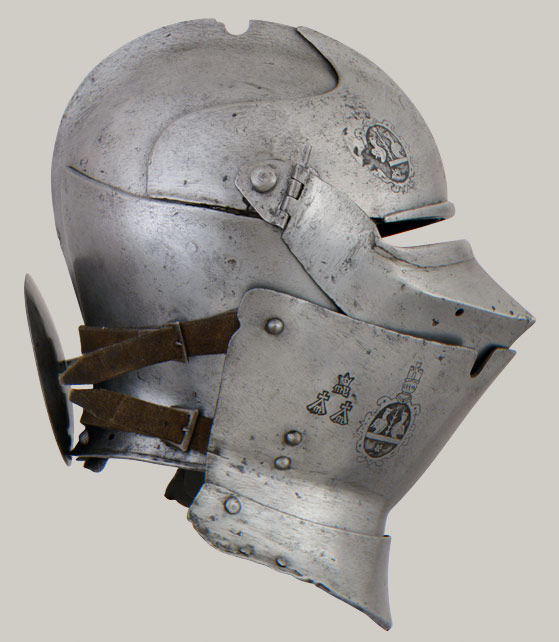
Medieval armour was often inscribed with mottos and (sometimes) designs. Originally chiselled in with drypoint pin-pricks (either to the steel or to an applied brass border), in the later 15th century these decorations were etched with acid (you paint the surface with wax, and parts where you don't paint the wax or where you stratch it away are etched by acid), and sometimes gilded using mercury gilding (you make an amalgam of gold dust and liquid mercury, paint it on and then heat everything so that the mercury boils off, leaving the gold^1) Some of these were purely decorative, like fantastical designs of feathers and scales. Others might have personal or political meaning, like personal mottos or symbols of a lord's domains.
Other symbols and mottos however, appear to have had a protective purpose. These include religious inscriptions, like the name of Jesus or snippets of prayer like 'Ave Maria', or they could be religious iconography. One famous armour that includes both 'charm' inscriptions as well as mottoes is the 'Avant Armour'^2 of the Matsch family of Churburg Castle in South Tyrol. All of the decoration on this armour is done with drypoint engraving, rather than with acid etching, which was not yet introduced in the mid 15th century. It is decorated with the repeated motto 'Avant' ('Forward') but also with protective religious invocations. These include 'YHS' ('Jesus') on the upper edge of the breastplate, 'Ave Maria' ('Hail Mary') on both shoulder defenses and 'Ave Dne' ('Ave Domine' - 'Hail Lord') on the left shoulder defense. The name of Jesus was used as a medieval charm, and importantly it and the other invocations occur on parts of the armour that are particularly critical to the defense and likely to be struck by blows - the protective charms are just where they need to be. Given the religious nature of these inscriptions, it is hard to say exactly where magic begins and popular religion ends, but the charm-like use of these inscriptions is enough to qualify them as 'magical' for a more expansive definition of 'magic'.
Yes this is as unhealthy as it sounds.
Note that the armour is displayed with an incorrect helmet, an infantry barbuta. It originally had an armet
Source: Tobias Capwell, The Real Fighting Stuff: Arms and Armour at the Glasgow Museums
Oh no, I'm late and this is one of my favorite subjects! :(
I think that magic (defined as a person's attempt to coerce the supernatural to do things for him/her) is an absolutely fundamental component of the pre-Reformation worldview in Europe and should be taken seriously when we try to think about attitudes and mentalities in the medieval world and earlier.
Drawing from Aron Gurevich's work on medieval popular culture, I think that magic/belief in magic permeated every strata of society and was for most a necessary way of imagining their individual relationship with the physical and spiritual worlds. I guess this is just a long paragraph to say that I feel that to faithfully deal with pre-modern worldviews, we as scholars have to accept the widespread belief in magic in the times and places that we study as a way to guard against imposing our own worldviews on people of the past and their motivations and imaginations.
I'm also going to post this comment I wrote in a previous AMA about military magic, which I find super cool:
Military magic was definitely a thing in early medieval Ireland. We don't have any treatises or detailed descriptions of it, but we see mentions of it being used so it's safe to assume that it did exist. The instances that I know of portray military magic as something that is defensive rather than offensive, so don't get your hopes up about fire balls and lightning bolts being cast :P
One particularly cryptic passage in the Chronicon Scotorum describes a "druidic fence" being cast before a battle, that causes the death of one man:
Fraechán son of Tenusan made the druidic 'fence' for Diarmait son of Cerball, Tuatán son of Dimán son of Sarán son of Cormac son of Eógan cast the druidic 'fence' over them. Maglaine leaped over it and he alone was killed.
This is the most overt depiction of battle magic in an Irish text that I've come across but I honestly can't tell you much about it. There's no context behind the ritual that's described and there are no parallels in other Irish sources that I know of.
Another example can be found in the Fragmentary Annals of Ireland, which becomes the biography of a 9th century Irish king of Osraige named Cerball Mac Dunlaige. At one point, the powerful king of Tara raises a host and invades Osraige while Cerball and his allies prepare for battle. However, before he could do anything decisive we hear that:
Cerball and his Danes—those left of Horm's followers who remained with Cerball—had their encampment in a brambly, dense, entangled wood, and Cerball had a great muster there about him. The learned related that Cerball had great difficulty there because Tairceltach mac na Certa practised magic upon him, so that it might be less likely that he should go to the battle; so Cerball said that he would go to sleep then, and would not go to the battle.
So here we have a much less ambiguous description of military magic: Cerball and his Danes are going to kick some ass (which is what Cerball was really good at) but he's cursed by a spell that makes him avoid joining battle. Whether the spell makes him fearful of combat (a popular trope in early Irish literature) or if it just assured his loss is uncertain.