Looking through colourized photos, I have seen the Zero in several different variations. Most commonly green, and solid white. I'm assuming that the colour standard for the Zero changed throughout the war, or based on role. Does anyone know what colour the Zero was painted in different years and why it shifted?
As an aside, if anyone knows the evolving colour palattes for other fixed wing aircraft in the Pacific I'd be interested in that as well.
Thanks!
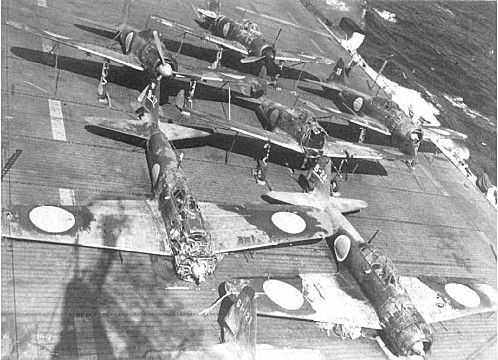
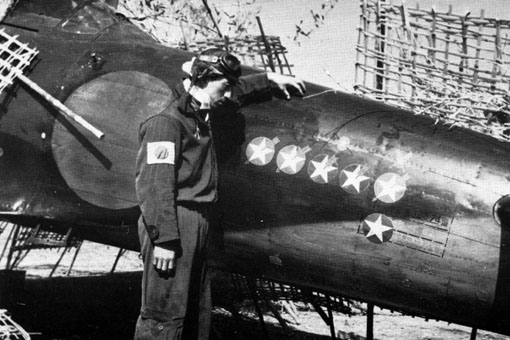
Oh boy, the question of IJN color schemes is an incredibly complicated one for such an esoteric subject. On a basic level, the IJN's fighter arm started the war using an all grey scheme, but transitioned around 1943 to a dark green over grey scheme. But "dark green" and "grey" are pretty neutral descriptors that do not tell much about the actual shades used. For the early war period, the IJN used a grey-green shade, sometimes haphazardly called ame-iro (candy color) or hairyokushoku (ash-green). What the exact shade of grey this was is still something of a mystery. Although early war IJN aircraft had excellent finish, the grey paint reacted very badly to ultraviolet sunlight and exposure. The wrecked A6Ms, like this one often had an almost off-white appearance. For aviation researchers and modelers in the 1960s and 70s, color photographs of wrecked IJN aircraft taken by Allied soldiers were often the only hard evidence for IJN colors available, so it began to be a given that IJN grey was some sort of light shade. The Harvard conversions used for the film Tora, Tora, Tora further helped to cement the idea of light grey, almost white A6Ms. The problem with this was that most Japanese written accounts of the planes describe the aircraft as much darker. Jiro Horikoshi, the designer of the A6M, describe the plane as a glossy hairyokushoku, for example. Moreover, surviving relics of A6M aircraft skin, such as these Pearl Harbor relics showed the grey to be much darker than the pale grey as seen in the Tora conversions.
While it is clear now that the very pale grey is inaccurate, there is still relatively little consensus as to the exact shade of grey used in the early war period. Ford Island Pacific Aviation Museum's A6M has a grey that is quite green. Texas Flying Legend's A6M is a bit darker. Plastic models of the A6M typically fall between these two standards. Adding to the confusion is that Mitsubishi-built A6Ms often had slightly different shades of grey than ones license-built by Nakajima.
As the Japan's air war became more defensive, the IJN in July 1943 decreed that A6M would receive a two-tone color scheme of dark green over grey. Of course many units in the field operating under increasing pressure from Allied air attacks, had already implemented their own field painting of A6Ms, such as this famous photo of Hiroyoshi Nishizawa's A6M. There is some speculation that the IJN field units also experimented with field camouflage of brown and green, as evidenced by these A6Ms captured on Saipan, but it is also possible that the apparent camouflage is just washing off dirt so the hinomaru (rising sun insignias) were clear for the photographer. As with the grey colors, the exact shade of green varied by manufacturer. This was also the period in which Japanese painting standards for their fighters declined precipitously, in some cases dispensing with primer altogether. IJN aircraft at postwar boneyards, such as Atsugi showed a degree of wear and tear exposing the metal underneath. How typical such shipping was though varied by unit though.
Even though the color red was a dangerous color for air combat, human eyes are drawn to red, the IJN roundels retained the hinomaru throughout the war, unlike the RAF. To about 1942, the hinomaru were plain red discs, but after this period, Nakajima-built aircraft began to superimpose the sun on a white circle and Mitsubishi soon followed suit. This as also the period in which the IJN began applying yellow IFF bands on the leading edge of their wings. Around 1944/45, the practice in the field was to paint over the conspicuous white outline with a darker green or blackish color, as seen in this famous photo of IJN ace Takeo Tanimizu's A6M. Aircraft assigned to Home Island defense, both of the IJN and IJA, had their hinomaru superimposed on white bands or squares to aid IFF for AA gunners. The practice dropped off as the Japanese lost air superiority over the Home Islands and camouflage on the ground became more important than evading friendly fire incidents. Training or test aircraft typically had an all-orange scheme applied, which later in the war saw a topcoat of dark green applied, but kept the orange undersides.
The one real consistency in IJN A6M markings were their use of blue-black cowlings and tail-codes for unit identification. The blue-black color was likely used because Japanese engines were notorious for oil leaks and other grime as well as for anti-glare purposes. Tail-code practices varied somewhat during the war, but the first portion of the code usually identified the plane's parent unit. Carrier-based A6Ms of the early war period used a alpha-numeric system that mirrored their assigned carrier division, thus code "AII" referred to the 1st Carrier Division's (A) second carrier (II). The reorganization of carrier air wings in 1943/44 led to a change in this system that mirrored USN carrier practice of assigned airwings rather than the aircraft being integral parts of the carriers' personnel. Flight leaders were distinguished by bands on the fuselage or tail.
The two best online sources for IJN color schemes are Aviation of Japan and j-aircraft.com. As the above indicates, not only were the IJN's somewhat haphazard painting standards to blame for this confusion, but also the language barrier posed a difficulty for researchers for those few surviving regulations that shine a light into this matter.