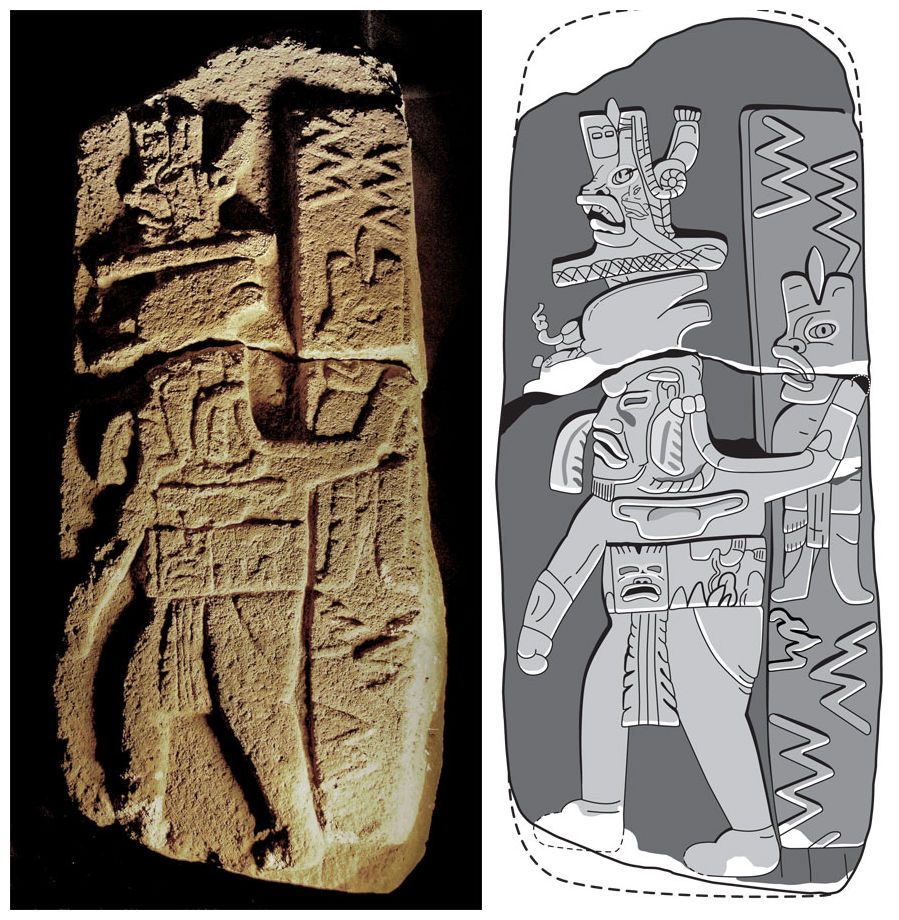
I admittedly know far more about later Mesoamerican history than Olmec history, but while I was trying to polish up on research I noticed only superficially that Olmec art seems to show two distinct 'sets' of ethnic type. One is very recognizably Mesoamerican in appearance, such as this mask or the portrait on this stone but others seem purely from a visual look at it to be a different physical type, like the infamous stone heads or this stone portrait.
I know there are conspiracy theories that circulated about supposed 'african' origins to the Olmecs and I don't want to seem as if I am supporting those at all but-I am curious why so much Olmec art seems to show different physical features than any other major Mesoamerican civilization that follows them. Is it a artistic convention unique to the Olmec? Was there a extinct ethnicity that formed the core of Olmec civilization that was subsumed by more standard Mesoamerican peoples later on?
Lastly, do other, later Mesoamerican peoples have similar facial features in their artwork or are these modern features that I simply haven't noticed?
I want to preface what I'm about to say by letting you know that we have a section in our FAQ titled Travel and contact across the Atlantic before Columbus that contain other answers regarding the Olmec-African connection.
That being said, the Olmec heads may look different from their other artwork not because they depict other people from within or outside of Olmec culture, but because of the medium they chose to create that art. The Olmec heads are all carved from large basalt boulders which required a considerable amount of effort to move them from their mountain location in the Sierra de los Tuxtlas down to the coastal areas of Tres Zapotes and San Lorenzo. These boulders are naturally occurring in the mountainous region from where they are collected, but they are not perfectly round or head shaped.
Instead, the Olmec chose boulders that were relatively head shaped on at least one side and it is that side they put the face on. These boulders are very minimally shaped and instead the artist worked with what they had. The decoration and features of the head were carved into the natural surface. Because of this imperfection in the boulders and the lack of further dressing the boulders, the image of the face must be stretched to fit the boulder resulting in features they look a bit distorted from what the people themselves may have actually looked like (Baudez 2012). Baudez does suggest other reasons for the look of the heads and his article is worth reading.
There are some Olmec heads that show evidence that they were reworked thrones which further constrained how the artist was able to depict the person on the stone (Porter 1989). The alcove in which a figure emerges in the throne came the shape of the inner ear for the San Lorenzo 2 monument, for example. Others, like the Cobata head, appear to be unfinished (Hammond 2001). The Cobata head, though, is unique in that it was found on the slopes of the Sierra de los Tuxtlas rather than at Tres Zapotes or San Lorenza which suggest that perhaps part or most of the carving was done before the head was transported to its final destination.
Unfortunately due to preservation conditions in Veracruz, no Olmec human remains have been recovered sufficiently to allow for genetic testing. But it is unlikely that Africans themselves travelled to the Americas prior to 1492.
Hammond, Norman. "The Cobata colossal head: an unfinished Olmec monument?." Antiquity 75.287 (2001): 21-22.
Porter, James B. "Olmec Colossal Heads as Recarved Thrones:" Mutilation," Revolution, and Recarving." Res: Anthropology and Aesthetics 17/18 (1989): 22-29.