After Latin/Latinate languages and the old Germanic languages, the biggest influence on modern English vocabulary seems to be greek. I understand pretty clearly how Latin came through old french during the normal conquests and melded with the Germanic old English of the Saxons, but how does Greek figure in? Was it third hand through the Normans? (Greek > Latin > Old French > English) This seems tenuous considering the thousands of pretty pure Greek words in English. Was it a product of classical education that was pretty common among the literate classes? Something else?
A good question, and I'm grateful that you outlined your understanding of etymology in Old English. Your conjecture is also fairly close. This is a huge topic, needing some background. The simple answer is that you're probably looking at the wrong timeframe, and the wrong stage of the language - I noticed you didn't capitalise "old" for "old English", and whilst it seem like a small point it's actually important to remember that Old English is its own language. It was traditionally studied, much as a foreign language was, by students of English Literature at British universities, and still is required first year material at some. The words are different (though often recognisable!), and the grammar, whilst providing a base for later forms, is also different. This is a Germanic tongue, in essentials. You are not going to insist that you can understand this (unless perhaps you are Frisian!), for example, but you might pick out words and see the relationship with the translation:
Da com of more under misthleopum Grendel gongan, Godes yrre bær;
Then came from the moor under the misty cliffs Grendel walking, God's wrath he bore
In Old English, words of Latin or Greek origin like 'wine' ('wynn' amongst other renderings) came through Germanic tribe contact with the Romans, and mostly even predated their arrival in Britain, as supported by cognates of these words in modern Germanic languages ('wein').
The next major stage of the language is known as Middle English. This is the language of Geoffrey Chaucer, and although tough, tougher than Shakespeare by a long way, it is manageable with a glossary:
Heere bigynneth the Millere his Tale Whilom ther was dwellynge at Oxenford A riche gnof, that gestes heeld to bord, And of his craft he was a carpenter. With hym ther was dwellynge a poure scoler, Hadde lerned art, but al his fantasye Was turned for to lerne astrologye,
Here begins The Miller's Tale Once there was dwelling at Oxford A wealthy peasant, who took in boarders, And by trade he was a carpenter. With him there was dwelling a poor scholar, Who had studied the Arts, but all his desire Was directed to learning astrology,
You'll note I haven't even had to change the order of the words and it reads more or less in modern format; I could just change word for word! You might also note that preference on word choice still demonstrates a preponderance of Old English, or Germanic-origin, words. I appreciate these short quotes provide a small data sample, but if you don't want to take my word for it, have a read of the rest of the Canterbury Tales - they're online.
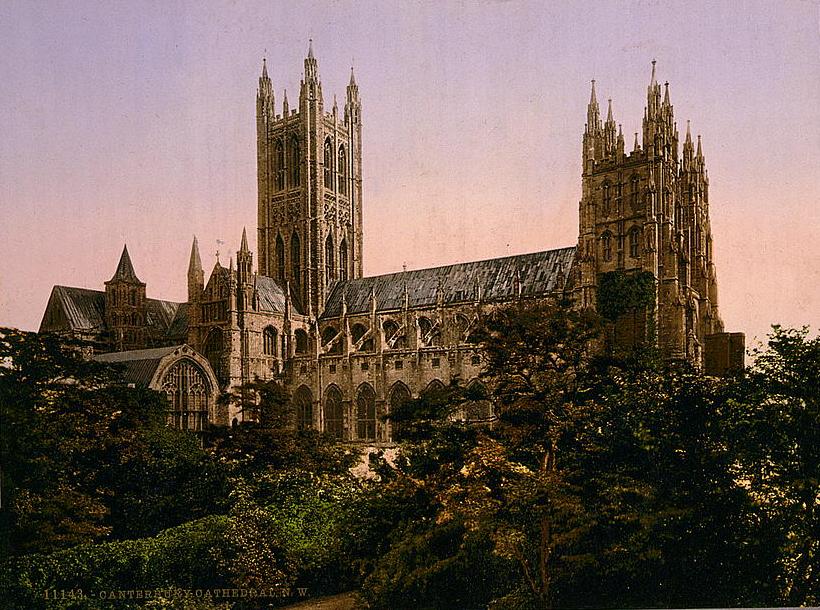
The large number of verbatim Latin and Greek words that appear in modern English, and indeed in other European languages, more or less owe their existence to the Renaissance. The Renaissance spans from, at its fullest reaches, parts of the 1300s through to parts of the 1700s as a useful period in history and art. The Renaissance was, in short, so named because it was a "rebirth" of classical (read: Greek and Latin) culture in Europe. To Renaissance thinkers, classical forms represented the peak of European achievement, and since the fall of those civilizations might be considered to be in decline. The resurrection of classical forms in homage (or pastiche) can be seen in architecture compared to the Gothic architecture that preceded it - the features to look out for are the columns, the pediment, the frieze etc.
This influence extended to language, where words of classical origin were increasingly seen as more elegant, particularly amongst students of philosophy - a discipline that included what we would nowadays call the natural sciences. So it was that English scientists used words like "vacuum" when "void" might have done; or inspiration was sought in Greek for the word "aether" to describe a concept that "air" would not explain. This is the simple explanation for much Greek, and indeed Latin, presence in our language when it appears more or less verbatim, and stems from the existing working knowledge Europeans had of Latin through the Middle Ages. The material was there at scholars' fingertips, ready to be used. This is also a period when technical texts were increasingly composed in English, when they might easily have been rendered in Latin - Newton in the late 1600s wrote his famous Principia in Latin. He was a bit of an eccentric, of course, but the fact that he could do so speaks to the continued usefulness of the language in intellectual circles.
The appearance of these words was not universally celebrated. David Crystal describes the fight over these words the 'Inkhorn Controversy', because the classical words were known as 'inkhorn' words. That is to say, they took more ink from your pot to write - because they were so bloody long! Generally, many of these words that have stuck in the language filled a lexical gap - a new concept that needed describing, and writers using the source of inspiration with which they were most familiar. Many others, however, failed to catch on, being superfluous at best, and pretentious at worst, belying the author's desire to elevate the perception of his learning; see "deruncinate" instead of "weed" (as in the verb, of weeding out your garden). Inkhorn protesters lamented the loss of purity in the English language, and many tried to insist (much like the modern Académie française does for the French language) on English-origin words to replace the newfangled ones: "speechcraft" instead of "grammar" or "linguistics", for example. You get an admixture here of arguments from utility (brevity and simplicity is best in language) and from moral principle (purity in language). There is a Tolkien-like charm to many of these forced Old English conjurings, but like many of the inkhorn words they were attempting to defeat, perhaps they failed to recognize the organic force of language. Most of the time language has an evolutionary force whose agency is too disparate to control, and attempts to wrangle it into submission require specific circumstances to be wholly successful.