Because I study armour and weapons, I will talk about the equipment of English soldiers and how it changed during the 15th century. I spoke about the arms and armour at Agincourt and the arms and armour of the Wars of the Roses in detail in previous answers, covering the first and third quarters of the century. So below I will sketch out the general trends.
In general, weapons remained much the same through the century. Men at arms (knights and those who fought as knights) mostly fought on foot and wielded the pollaxe at the century's beginning and end. For mounted warriors, the lance developed some - by the end of the century even the English were using a heavier lance that swelled around the hand grip - though note that around the time this was introduced some men at arms preferred a lighter lance, the 'lancegay'. Swords remained mostly the same, whether wielded by men at arms or archers (the vast majority of English armies) - they were mostly the acutely pointed shapes that Oakshotte referred to as 'type XV' and 'Type XVIII'. Falchions were also used.
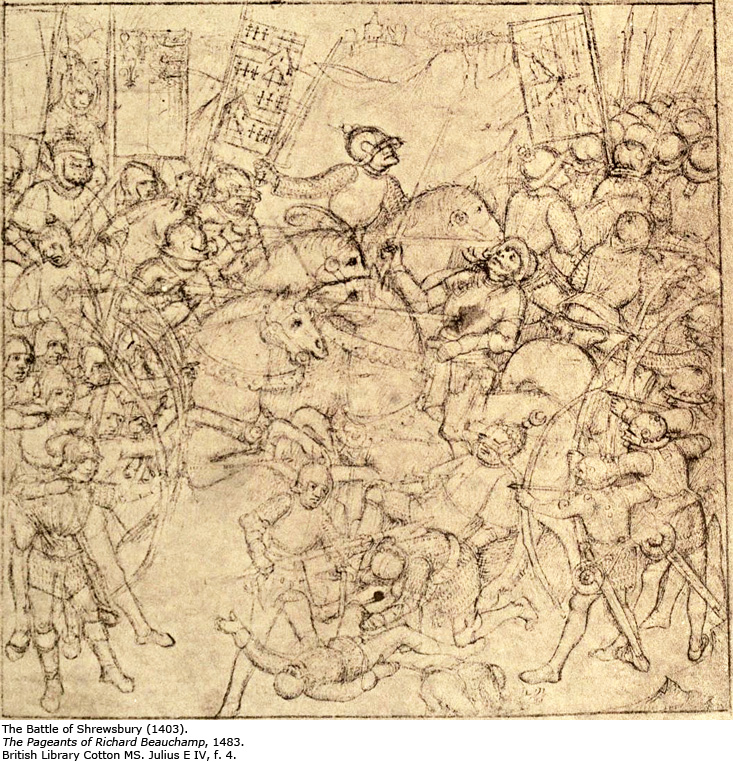
The weapons of archers also remained much the same, though there are some signs there were a bit better equipped later. In any case, by the 1480's they are both recorded and portrayed as being armed with swords and bucklers in addition to their bows, as you can see here. You also see infantryman (perhaps archers) wielding polearms, often bills but sometimes glaives and other styles of polearm. Bows remained much the same through the century.
For armour, the armour of men at arms changed a lot in style, as well as construction. This is a very detailed topic and too involved for me to touch on in this post - if you are interested in learning more, please ask. Suffice to say, in the beginning of the century full plate armour was finishing the last parts of its development (the backplate an defenses for the throat), so that by Agincourt a state-of-the-art armour would protect the entire body (save for gaps at the joints etc) in solid metal plates. This remained the case through the fifteenth century, though the style of armour (including silhouette, decoration, helmet type etc) and the construction would change. Entire helmet styles would be introduced and fall out of use, decorative schemes would be adopted and abandoned, and English armour would develop a number of peculiar adaptation for armoured fighting on foot, and then lose them again as it followed continental fashions more closely by century's end. To give an idea of how different armour looked, in 1400 a man at arms would might well look like this, in 1440 like this, and in 1475 like this.
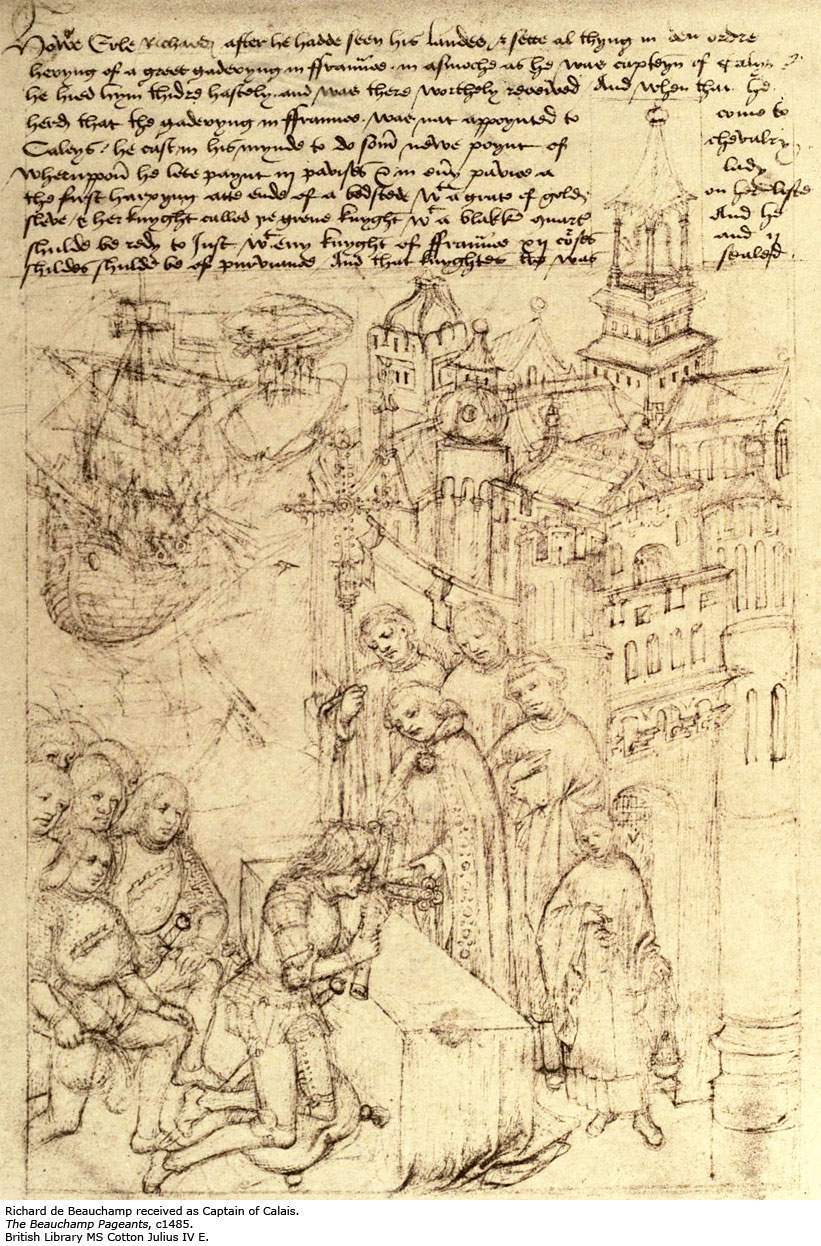
For infantry, armour change quite a bit more. In general, English infantry become better armoured as the century progresses, though for many archers for the entire century the defense remains a cloth jack (which was quite effective, if bulky). For the middle part of the century and until its end, many better-equipped archers wore a brigandine, a doublet like garment lined with metal plates. However as the century progressed plate armour became more common among common soldiers. 'Splints' or plate arm defenses are common in at least one inventory and in the last quarter of the century you see more and more breastplates made for infantryman depicted in art - just a decade or so before they were vastly outnumbered by brigandines. For example, in the Beauchamp Pageant from c. 1485 the men kneeling behind the earl are probably his retained archers, and they seem to be wearing breastplates. In the 16th century a full cuirass (breast and backplate, with skirt - the fauld in front an culet in the back) with splints defending the arms would become a kind of standard infantry armour in England and much of the rest of Europe, and was mass-produced and mass-ordered. Based on both art and surviving inventories, mail was often worn but mostly as a supplement to other armour in the form of skirts, collars, gussets (shoulder and underarm defenses) and sleeves, though mail shirts were still worn. This was largely true in the beginning of the century and certainly true at its end - it is likely that mail used as an independent device declined further, but note that Thom Richardson and the Royal Armouries notes a transition to supplemental mail in the later 14th century.
While hand guns were not adopted as enthusiastically by the English as by other armies (such as those of Burgundy, or the Hussites) guns were seen increasingly in inventories, and foreign merchenaries (if not others) fought with them in the later battles of the Wars of the Roses.
So the brief summary is that to the untrained eye not much changed. The basic 'load out' remained the same for both archers and men at arms remained similar. Armour style changed a lot, weapon styles changed somewhat less. Infantry became significantly better armored as time went on. Handguns were used, but did not transform English warfare.