I've been reading a lot of material on the colonization of the New World by the Europeans from the 15th to 18th century. I've always heard about the Greeks, Phoenicians and Carthaginians colonizing the Western Mediterranean prior to the rise of Rome. In particular, I wanted to know how or any materials on the colonization of southern Iberia by the Carthaginians; and if it was anything similar to the colonization of the Americas by the English, Spanish, Dutch, and French during the Age of Exploration
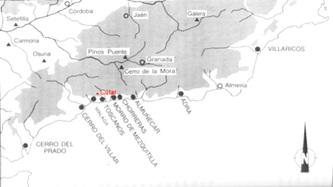
The Phoenician (not yet called Carthaginian) presence in southern Iberia was virtually unknown until the 1960s. In that decade, and led mostly by archaeologists such as Niemeyer and Schubart of the Deutsches Archäologisches Institut, there was a sort of Renaissance of interest in Phoenician things. A succession of sites in Andalusia were excavated and/or surveyed. This map is small and crappy, but it is the best I can find that shows the majority of those early sites. There was a long string of small enclaves west to east from Cadiz (Phoenician Gadir), Cerro del Prado, Toscanos, Morro de Mezquitilla, Chorreras, and eastward towards Villaricos. All of these were "settled" between the late 9th and late 7th centuries BCE, and we find similar sites in Sardinia, in western Sicily, and in North Africa (at Mogador, in Morocco, and all along the coast east to Utica and Carthage). There were also enclaves on Cyprus (like at Kition) and perhaps others elsewhere that have yet to be discovered.
Some argue that these early Phoenician settlements were founded for agricultural purposes. I strongly disagree with this -- in fact, in none of these places do we find any evidence of Phoenician agriculture, or, in fact, Phoenician penetration into the interior. The sites are all characterized by their physical setting: next to harbors or rivers, the inlets of which formed natural harbors; on hills or in otherwise isolated geography; and very small. I think they were, by and large, trading enclaves, Polyani's "ports of trade," and their purpose was commercial contact with the locals of the interior for the purpose of acquiring natural resources, especially metals. In several of these sites, the excavators found tripartite storehouses very much like the famous remains of one at Hazor, back in the Phoenician homeland. Picture, center. A lot of these small sites seem to have been little more than stop-overs along a much longer journey (say from the Levant to Cadiz). It is probably no coincidence that most of them are spaced out by about the length of a day's worth of sailing (though a few are closer).
If I'm right, the Phoenician "colonies" were quite different from their early Greek parallels (mostly in Sicily). The Greeks seemed to have been interested in agriculture in their "colonies" from the beginning, and therefore interfered with or occupied a larger "footprint" in the place they settled. They did trading too, but it seems that the Sicilian colonies were after more than trading relationships from a very early date. I don't know much about more modern colonization of the Americas, but I would suggest that the early American colonies (at Jamestown, say) were somewhere in the middle of these two archetypes -- partially interested in interface and resource extraction with the locals, partially interested in occupying adjacent land for agricultural purposes. A lot of this is up for debate, but I've done a lot of work on this topic and I'm probably right. :)
For a great introduction to the Phoenicians (including their early adventures in the Mediterranean), Markoe's book is excellent. For the nitty gritty of Phoenician Andalusia, check out this book, which has work from both Niemeyer and Schubart, among others. For a great introduction to Carthage, check out the translation of Lancel's book. All of these will give some colonial and post-colonial perspective, as well.