Repurposing from an old response I wrote about this:
Shark mouths on aircraft date at least as early as World War I, which is the first occurrence mentioned in my sources. While I think it is safe to say that the American Flying Tigers during World War II brought the style to the peak of prominence, the first recorded use was in fact German around 1916, found on a Roland C.II, flown by Ritter von Schliech, although it is a pretty lame rendering, compared to later versions, as it is really just a black line roughly comparable to a mouth. It seems to have been popular with the Roland C.II, and a number of the aircraft carried it, as well as a more robust, 'teethed' version on some as well (Thanks /u/Crabrubber for digging that up back with the old thread).
At roughly the same time, at least one British aircraft used the Sharkmouth design, one of the butt-ugly Maurice Farmans, serving with the Royal Naval Air Service in the Med. This is the 'teethed' style. It doesn't seem clear who the pilot was, but apparently he was the only one who did it to his aircraft, and it wasn't found on other machines from the Wing. A few examples can also be found here and there of French and American uses, but again, it wasn't that widespread.
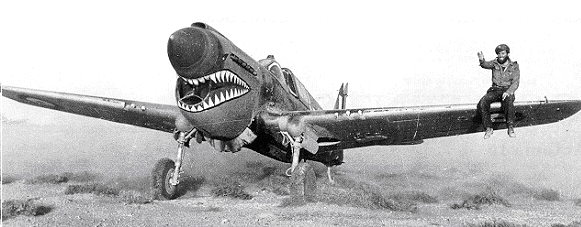
While there are examples here and there, the concept pretty much died out once the war ended, and it isn't until World War II that we see the "Sharkmouth" make its comeback.The Germans restarted it in 1939, with a few singular examples to be found on a Me 109 and a Ju 87. It really made a splash though with II/ZG 76, a unit of Me 110s, who put it on a number of aircraft. After fighting with the British over the Mediterranean, the Brits of Squadron 112 thought that the paint scheme was sufficiently badass to copy it themselves, putting it on their Curtiss P-40s. Their picture ended up being published in the Illustrated London News, a copy of which made its way to the far east and into the hands of the American Volunteer Group, aka the Flying Tigers, who also thought is was badass, and painted their P-40s in the same style, and because the world is all American-centric, basically getting remembered as the "Shark Mouth" unit, even if they were really doubly derivative...
Now, I'm not going to bother making a full list (if you are interested check out sources below), but suffice to say, the "Shark Mouth" looked really cool, and it got copied by a number of units by the end of the war - fighters, bombers, attack aircraft; American, British, Canadian, Aussies, French - everyone wanted in on it. And it remained that way after the war. It pretty consistently remained one of the "go-to badass" paint, schemes for aircraft, which numerous squadrons across many countries utilizing it. The use in Vietnam simply represented this long tradition, as do more recent examples.
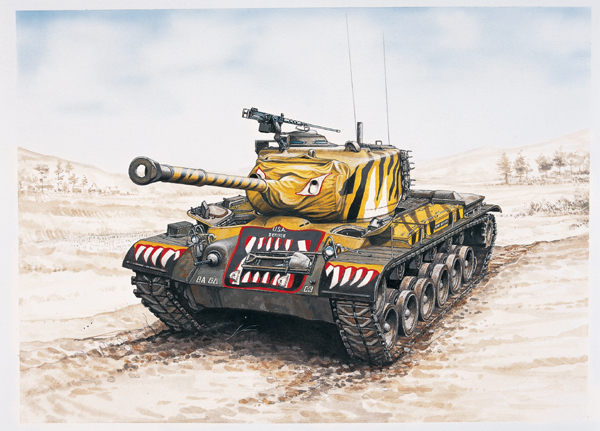
Side Note: It was also not uncommon to see on American tanks during the Korean War, the most famous being the M46s of the 6th Tank Battalion. Apparently the belief was that the design would scare the very superstitious North Korean/Chinese soldiers, although I've never seen anything to substantiate this belief, so it might really have just been an American superstition.
For a ton of photos and drawings, I would recommend you track down the following sources which I drew upon here:
"Sharkmouth 1916-1945" - Richard Ward, Osprey Publishing
"Sharkmouth 1945-1970" - Richard Ward, Osprey Publishing
Richard Ward's Sharkmouth 1916-1945, part of the Osprey Aircam Aviation Series, is a collection of photographs and profiles of aircraft adorned with various toothy decals. There are numerous examples from the First World War, the earliest probably being on German Roland C.II aircraft. The C.II was nicknamed Walfisch ("whale") due to its streamlined shape, they were first seen with crude plain black 'mouth' designs (so technically more 'whalemouth' than 'sharkmouth') that evolved into the more distinctive version with teeth. Sharkmouths are also seen on various other German types including heavy bombers; Allied examples include a Maurice Farman Fighting Bus of No. 2 Wing RNAS, a training B.E.2C of the RFC, a Sopwith Dolphin, and Nieuports of the United States Air Service. Precise dates are difficult to ascertain, but are around 1916-1918. Decorations were individual, rather than being squadron-wide markings.
The text mentions some Inter-War use of sharkmouths on civilian aircraft, but has no photographs. The design comes back to prominence on Luftwaffe aircraft at the start of World War II, on individual machines including a Bf 109 and Ju 87, but most notably with II/ZG 76, the second Gruppe of Zerstörergeschwader 76, a heavy fighter wing operating the Messerchmitt Bf 110. This entire unit wore the sharkmouth, hence its nickname of Haifischgruppe ("shark group"), and in 1940 and 1941 flew in the Battle of Britain and over Greece and Crete. In the latter regions they encountered No. 112 Squadron of the RAF, and when 112 Squadron re-equipped with Curtiss Tomahawks in North Africa they adopted the design ([IWM photograph CM 1339:] (http://www.iwm.org.uk/collections/item/object/205208811) "This photograph constituted the first public appearance of 112 Squadron's famous 'Sharkmouth' insignia, when published in October 1941.") The Tomahawk/P-40 is particularly well suited to the design, the large chin intake forming a natural part of the mouth.
Photographs of 112 Squadron Tomahawks reached the American Volunteer Group in Asia (possibly via the Illustrated London News). Better knows as the Flying Tigers, the AVG also flew P-40s and adopted the sharkmouth, becoming perhaps the unit most associated with the design with their aircraft being depicted in several books and films. Some of the AVG's "descendants" such as the 23rd Fighter Group also adopted the sharkmouth unit-wide, and variations of the design were found on any number of individual aircraft in air forces around the world over the rest of the war (the book includes B-17s, B-24s, P-38s, Spitfires, Bf 109s and Fw 190s, to list but a few).