When I think of the "roman alphabet", I picture something like this:
http://www.romeartlover.it/Iscrizi0.jpg
Clear block letters, easy to read, simple.
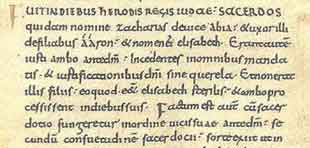
But a few hundred years later, the same alphabet is written like this:
https://upload.wikimedia.org/wikipedia/commons/4/46/Calligraphy.malmesbury.bible.arp.jpg
Letters squished together, extra serifs and calligraphic flourishes everywhere, very difficult to read.
How did this happen? Why didn't the scribes and clerics of the middle ages use the same simple Roman lettering? My guess would be that the Catholic Church wanted literacy to remain in the hands of the elite scribal class, but that's just a big fat guess. There is a tendency to blame the Catholic Church for everything bad in the middle ages.
Anyway, what gives?
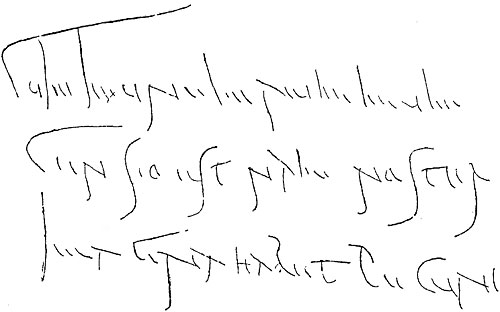
You're thinking of two very different kinds of texts. The one is epigraphical, on monumental inscriptions, and the other is the handwriting of a manuscript. Very, very different kinds of texts with very different kinds of writing on them. In fact, the medieval script that you're complaining about is vastly more legible than most ancient papyri and graffiti. A lot of those actually aren't too bad if you know how to read them, but neither is the Gothic script of the Malmesbury Bible that you've linked. Most manuscripts were written either in Latin cursive or (more rarely) in one of the capital styles that developed from monumental inscriptions, and they displayed pretty variable degrees of legibility. The script that we use today is based on the Humanist Script of the Renaissance, which revived the early medieval Carolingian Minuscule (which the Renaissance humanists incorrectly believed was the Roman script), which largely displaced and won out over the Merovingian Script that was developed from Roman cursive, in large part because the Carolingian script was easier to read and was less prone to having letters smoosh into each other. The later Gothic Script that appears in the 12th Century is a development of the Carolingian script. In fact, despite what you conjecture about the church trying to repress literacy, Gothic Script developed precisely because literacy was increasing in the later Middle Ages. The Carolingian Minuscule simply takes too long to write and consumes a rather large amount of space on the page, which makes it more difficult to produce large numbers of manuscripts in as little space as necessary, which is exactly what was demanded by this point. Gothic Script is also actually pretty easy to read. You need to be taught what the letters look like, but it's really not that hard, and has definite advantages--for example, even in really smooshed manuscripts or manuscripts that were written hastily it's always very easy to tell where word breaks are, which was a problem in older scripts, because in the Gothic Script word divisions are clearly indicated by not having the small vertical strokes at the line that join letters within a word