These days, nearly every elementary school student in the West has a pocket calculator. When slide rules were the dominant calculating device, at what age did people tend to get them? Was it just the STEM enthusiasts, or did everyone have them? Where did you buy them (were there slide rule stores?)? How much did they cost? Some slide rules can only do multiplication and division, while others can do trigonometry and exponents and squareroots and stuff; what capabilities did a typical slide rule have?
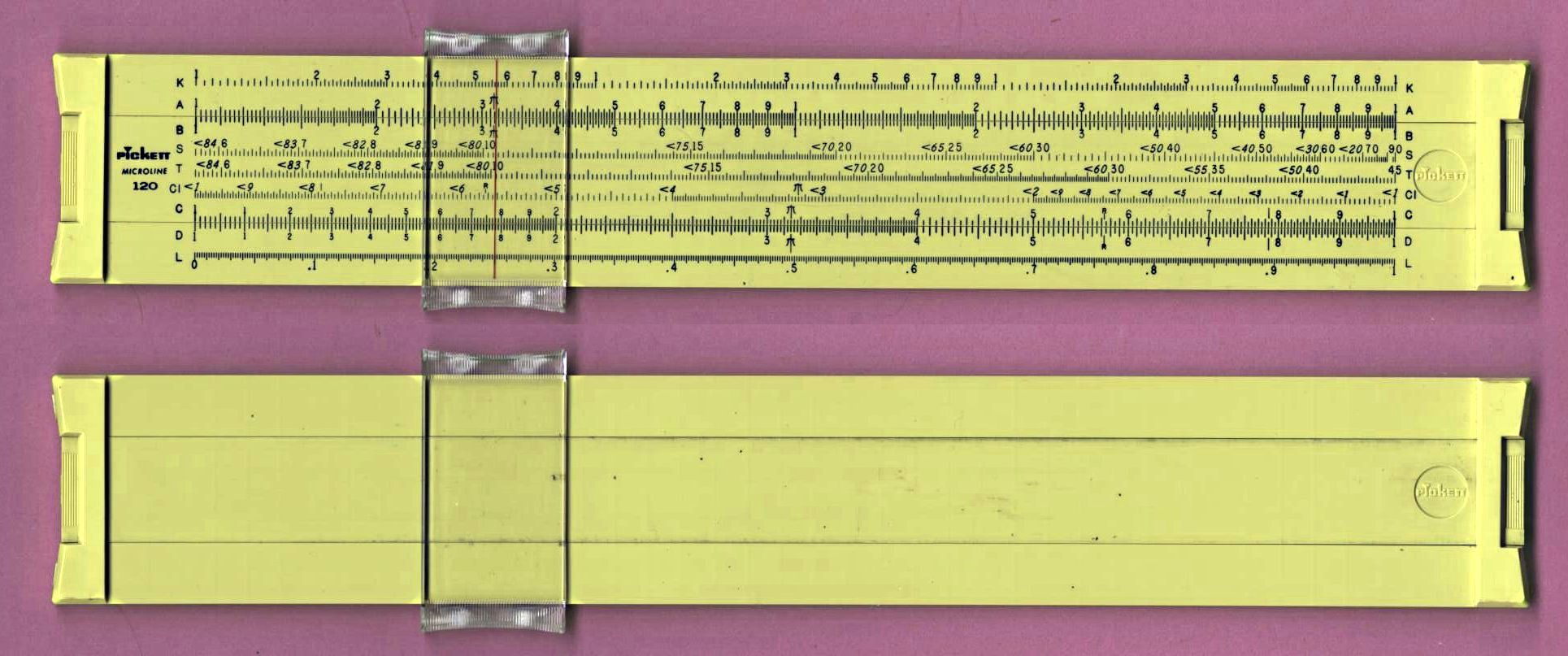
Oddly enough, I actually collect them. You would commonly begin learning them in high school, using a rule like this Pickett Microline 120-ES: http://sliderulemuseum.com/Pickett/Pickett_Microline_120-ES_DonatedByHuangCollection.jpg
These were very basic slide rules, capable of multiplication, division, logarithms, square and square roots, cubes and cube roots, and basic trig. They were made out of plastic and inexpensive.
Your classroom might have one of demonstration slide rules: http://sliderulemuseum.com/DemoSR.htm
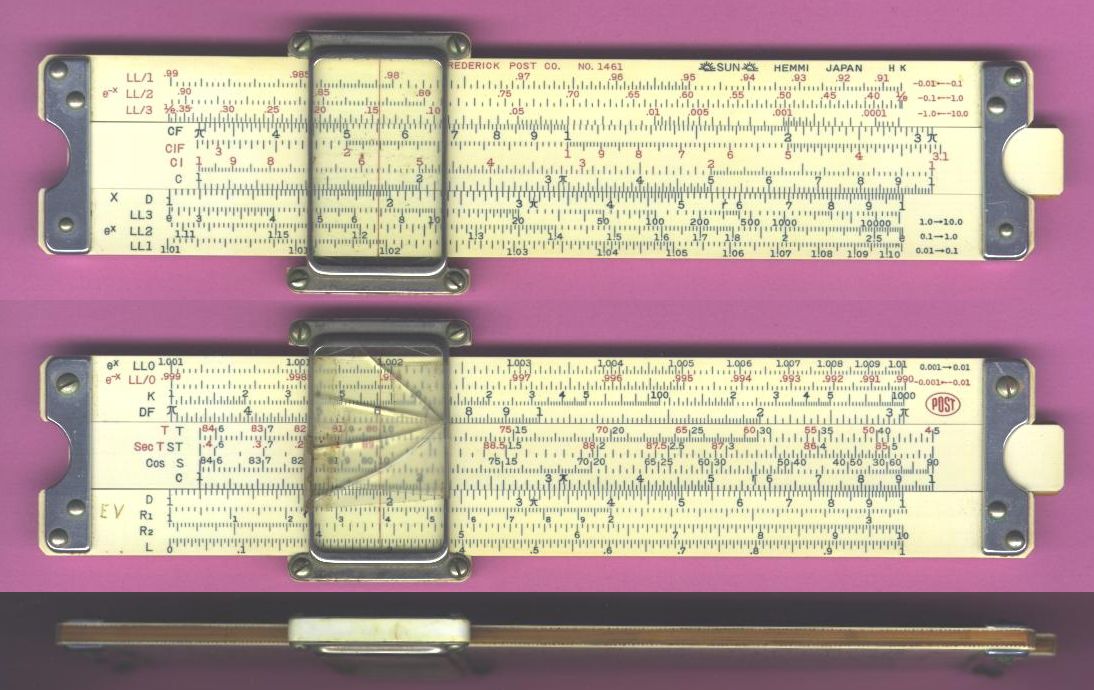
The teacher would use it to demonstrate various operations. If you went on to university, you move to more advanced rules that could things like natural logarithms and raising arbitrary numbers to arbitrary powers. These could be very expensive. My father, when he was in college, purchased a Post Versalog 1461. Similar to this one, but his is of later manufacture: http://sliderulemuseum.com/Post/Post_1461_Versalog_dcHK_DonatedByEnnVeskimets.jpg
Adjusted for inflation, the purchase price would be about $500 in today's money. And this is by no means the fanciest or most versatile one could buy.
For most in everyday life slide rules were not used. Arithmetic was done in one's head.