Its probably one of the most entertaining questions to discuss, and something that we have no way of finding a definite answer to without breaking a ridiculous amount of laws and spending a ridiculous amount of money to make these two big cats fight to the death.
Luckily, for those of us interested in an answer, the Romans had access to these big cats and a means of making them fight to the death in an arena.
Are there any historical records of the Romans forcing these cats to fight and, if so, which big cat generally won?
Martial writes in an epigram celebrating the opening of the Coliseum in AD 80, that:
"A tigress, wont to lick the hand of the fearless trainer, rare glory from Hyrcanian mountains, fiercely tore a wild lion with rabid tooth; a novelty, unknown in any times. She dared do no such thing while she lived in the high forests, but since she has been among us she has gained ferocity." (21)
So it looks like the tigers have it. I can think of no more examples offhand. Antoninus Pius is said to have shown 100 lions and tigers, though it is not explicitly said that he pitted them against each other (HA Ant. 10.8). In any event, the book to look at would be Jennison's Animals for Show and Pleasure in Ancient Rome. Rather old (1937), but pretty exhaustive in its treatment of literary sources.
My hunch would be such battles were rare, for a couple of reasons. First, both animals were quite expensive and extremely popular. While an emperor might have been able to slaughter lions by the dozen, the average game-funder might have found the expense harder to bear. So the was probably a tendency to kill lions and tigers only on really special occasions (like the games of AD 80, where 9,000 animals were killed over 100 days). Another poet, Statius, wrote of a lion killed in the arena unexpectedly that "the city fathers, groaned at your fate, as if you were a famous gladiator" (Stat. Silv. 2.5.25-26), which rather implies that lions could be shown in the arena multiple times and achieve a degree of fame. In The Martyrdom of St. Polycarp a magistrate informs a lynch-mob that he can't throw the good saint to the lions, because the games have ended and it wasn't permissible to exhibit the lions after the games (thus proving the lions were kept). And finally, every once in awhile we hear of lions or other great cats trained to be man-eaters. Claudius supposedly had a man-eating lion put down (Cass. Dio, 60.13), and Marcus Aurelius (unwillingly) bought one (Cass. Dio. 72.29). All this implies that there was rarely a need to waste a perfectly good lion when people were quite content to just watch the lion kill deer or Christians or what have you.
The man-eating lions bring up a second problem with lion vs. tiger fights: namely, that animals were terrified of the arena (it being a bright hot pit of sand surrounded by thousands of screaming humans) and unless they were specially trained they often didn't act with the sort of mad aggression the audience had come to see. One of the later emperors had 100 lions who refused to come out of their cages and so had to simply be shot with arrows (much to the crowd's displeasure). Famously, Pompey once presented elephants in games. When the elephants realized they could not escape from the hunters showering them with javelins, they merely stood around wailing piteously and waiting for death. The audience's sympathies came round to the elephants, and the whole thing became something of a debacle for Pompey. You might get animals to fight merely by chaining them together and poking them (this was standard practice for bulls vs. elephants or rhinos), but the best way to get animals to reliably preform was through training, which in the case of lions and tigers was an added expense to a pair of already expensive animals.
All this leads me to believe that such fights were extremely rare even in Rome, to say nothing of the provinces.
To say that the Romans had access to Tiger is true, but the extent to which this is true is less easy to ascertain. The species of Tiger that lived closest to the Roman Empire was the Caspian or Hyrcinian Tiger, Panthera Tigris virgata, a species which died out in the 1970s, and which, if you look at the distribution map, lived on the very edge of Roman reach. The Tiger is a solitary animal, and not easy to catch, which complicates matters of availability a bit. The animal itself, as well as the Bengal Tiger, was known to the wider Mediterranean world at least as far back as the time of Alexander's expedition into India, but hadn't appeared in Rome until the end of the 1st century BC.
Pliny tells us that:
idem Q. Tuberone Paulo Fabio Maximo cos. IIII non. Mai. theatri Marcelli dedicatione tigrim primus omnium Romae ostendit in cavea mansuefactam, Divus vero Claudius simul IIII.
'The same [Emperor Augustus] also was the first to publicly show a tamed Tiger in Rome on the occasion of the dedication of the Theatre of Marcellus, in the year of the consulship of Q. Tuber and Fabius Maximus (11 BC) on the 4th day before the Nones of May, and the divine emperor Claudius too (exhibited) four.' [Plin. n. h. VIII.65]
Sueton, in his life of Augustus, also relates that the Emperor exhibited a Tiger [Suet. Aug. XLIII.3], but doesn't comment on it. It was a rare event to have a tiger in Rome, and so it would have been even rarer to have them fight against lions, which were much more easily accessible since the Berber Lion was native to Roman North Africa. Vergil mentions 'Armenian Tigers' in his eclogae as being yoked to the cart of Hermes' son Daphnis, just like the Tiger is often associated with the dionysiac processions, for they association with India. They were known to the Roman world, but very exotic, and knowledge about them was not very deep. Aelian, in his treatise on the characteristics of animals, mentions that the second generation of a Tigers offspring will be dogs [Ael. NA VIII.1], which also resonates in the names of the dogs that devoured the hapless Aktaion, one of which is called Tigris in Ovid. On a whole, one doesn't get the picture that Romans knew a whole lot about Tigers, which is understandable.
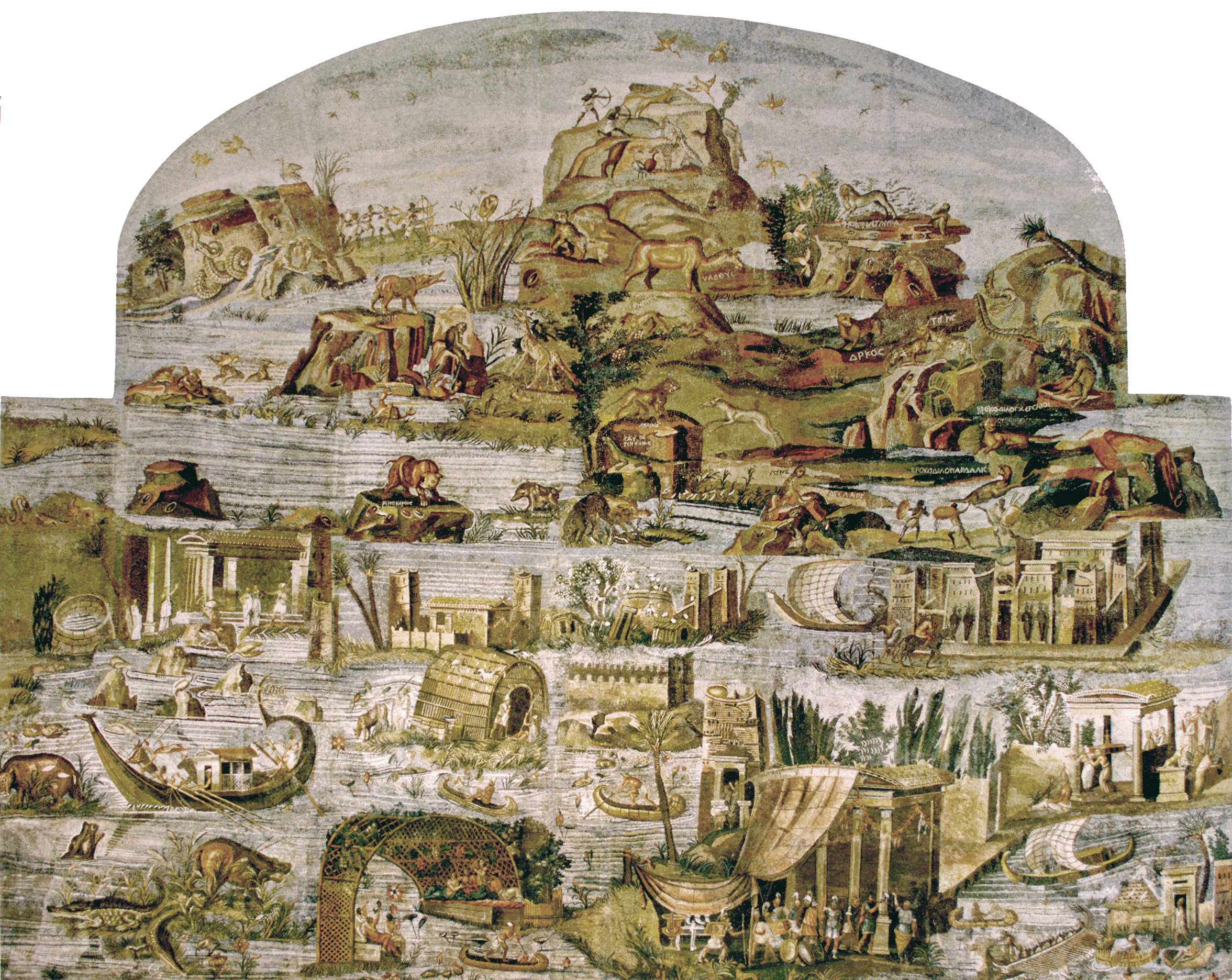
There is a further problem, since our ancient sources can often be ambiguous in what animal they talk about when they mention a 'tiger'. It seems that 'tiger' was also used as a label for the 'aethiopian Tiger', or Leopard. This is pretty apparent in the Nile River Mosaic from 1st century Palestrina. You can see two examples of an animal called 'ΤΙΓΡΙΣ' in the upper right corner, but they clearly are spotted cats, so 'aethiopian Tigers', or rather Leopards - which is pretty fitting considering the topic at hand, which is after all the river Nile. The Emperor Elagabalus from the early 3rd century is said to have celebrated his marriage to Iulia Cornelia Paula by importing a large number of tigers. Cassius Dio relates that, among other festivities,
various wild beasts were slain, including an elephant and fifty-one tigers — a larger number than had ever before been despatched at one time.
But these are commonly held to have been Leopards, since such a large number of Tigers would have been very hard to acquire, Dio might also be exaggerating a bit here.
In any case, the only example that I know of where a Roman author directly related something about a fight of Lion vs. Tiger is Martial, in his liber spectaculorum, or book of games, 18:
Lambere securi dextram consueta magistri / tigris, ab Hyrcano gloria rara iugo, / saeua ferum rabido lacerauit dente leonem: / res noua, non ullis cognita temporibus. / Ausa est tale nihil, siluis dum uixit in altis: / postquam inter nos est, plus feritatis habet.
"A tigress, rare glory of the Hyrcanian mountain chain,
accustomed to lick the right hand of her trainer,
tore to pieces with ferocious teeth the lion -
a new thing, never known to any times before.
A thing never attempted by her, as long as she lived in her high forests
since she is among us, she is more ferocious."
And it seems that at least in this instance, a tigress beat a lion in one of the Roman games. But in conclusion, it seems to have been a very rare occurrence to see a Tiger in Rome, much less see it fight a Lion.