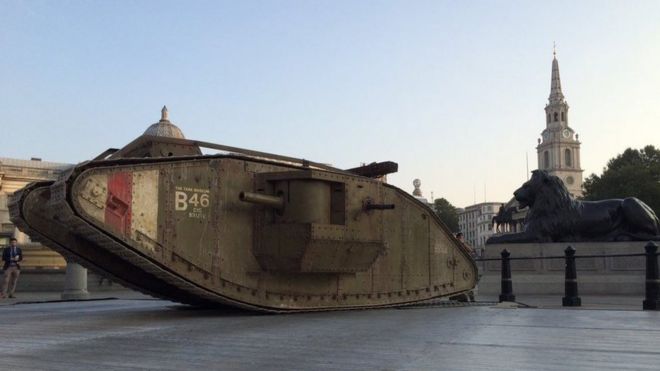
If you look at a picture of early tanks they look quite imposing, but I know they also had severe problems with mechanical failure. What did German soldiers under attack by tanks in WW1 (and German commanders receiving reports of them) think of them, especially when they were unknown weapons?
Tanks initially caused great concern in German units: 'tank fright' was a common reaction by infantry when first faced with tanks on the Somme in 1916. However, coordinating tanks with infantry and using them to best advantage was also difficult and as you are probably aware there were many problems with breakdowns, tanks becoming stuck in the landscape and so on.
The British next deployed tanks at the Battle of Arras in spring 1917. These tanks were Mk1s, the same as those initially used on the Somme, plus MkIIs, which were unarmoured training vehicles pressed into service for lack of numbers. Deployed at Bullecourt, they were a failure as there was no real planning, and the Australian infantry and the Tank Corps troops involved had no time to become familiar with one another. At Bullecourt the attack went in against a salient on fairly open ground, and the German defenders had little difficulty in defending themselves with artillery pieces and intense small arms fire.
The Germans had meanwhile developed an anti-tank rifle (thus inventing the 0.5 calibre round which Browning used for the M2 machine gun which sits atop so many Western vehicles even today) which was used at Bullecourt/Arras. And while panic was (and has been ever since) a common reaction to tanks by infantry who can't deal with them, the German army was satisfied that with the right tactics and some light artillery positioned forward, they could deal with these mechanical novelites. It is of course natural to scorn a weapon one's own side cannot possess.
Ironically, the British misuse of tanks served to reinforce the Germans in their thinking that the tank was a mechanical novelty of limited long-term value. Reading the literature, one is also tempted to believe that Prussian traditionalism preferred a tactical solution to the problem of trench warfare generally, while German industrial backwardness (hard to understand today, but an issue in the early 20th Century) and the blockade limited the prospects of the Germans developing their own successful tank.
At Cambrai in November 1917, the British used their tanks for a third time and this time in numbers, in a battle designed by the tank advocates (as opposed to the tanks being added to an existing plan in an ad hoc fashion). As is well known, the tanks, now improved MkIVs, smashed the German front line and drove forward. However, outrunning their supporting infantry, the tanks could not hold the ground taken as they lacked the visibility and crews suffered a lack of tactical awareness, so as well as many tanks being lost to breakdown, they were hunted and knocked out by German parties. Using new infiltration tactics, the Germans then re-took the ground lost.
This again seemed to vindicate the German high command's view that tanks were not essential and could be dealt with. Meanwhile, a specific anti-tank artillery piece of 37mm was developed and issued, ideal for concealment and maneuver by two men. The fighting at Cambrai also seemed to vindicate the idea that infantry trained to deal with tanks could do so, reducing the tendency to panic.
It was not until 1918 that the Allies began to really get the best out of their tanks, co-ordinating them with infantry who had trained for the role, and with objectives that were mindful of the tanks' weaknesses (such as their tendency to become scattered and depleted when used at long range). With German morale also suffering at this point in the war, attacks such as that at Amiens in August 1918 were devastating.
Sources:
A New Excalibur AJ Smithers
Tanks and Trenches David Fletcher.