If you're looking at something and you see a shield with a face on it, or a sword with a peculiar shape, what is the 'mental check-list' to understand what is fantasy and what was real arms and armour?
This is a great question!
I go into a lot of detail about interpreting art critically in this post. In general, it is very important to remember that artists aren't photojournalists recording the material of the culture of the past 'as it really was' but are trying to let their readers know who characters are by using conventions, or drawing from their imagination. Though these days people assume that artists portrayed the arms and armour of their own time, they often took care to make characters from other times or places 'look different'.
In particular, when portraying characters that are 'antique' - ancient or biblical - late medieval and renaissance artists often used a variety of anachronisms to show that 'these people lived long ago'. The most prominent of these are psedo-pteruges on the shoulders of figures in Classical or Biblical scenes. You also see odd skirts on occasion made in a similar fashion. You do not see these portrayed on contemporary figures, generally, and I have not seen them in other media, such as funerary effigies. In the linked image, the two guards in the foreground are wearing these kind of fantastical shoulder guards, the other guard is not. This shows that this event (Christ rising from his tomb) is not contemporary - it happened long ago and/or far away. Shields can be downright fantastical, and helmets may be based on what people thought classical helmets looked like (though this is more true of Italian art after 1400 than say, Flemish manuscript illumination).
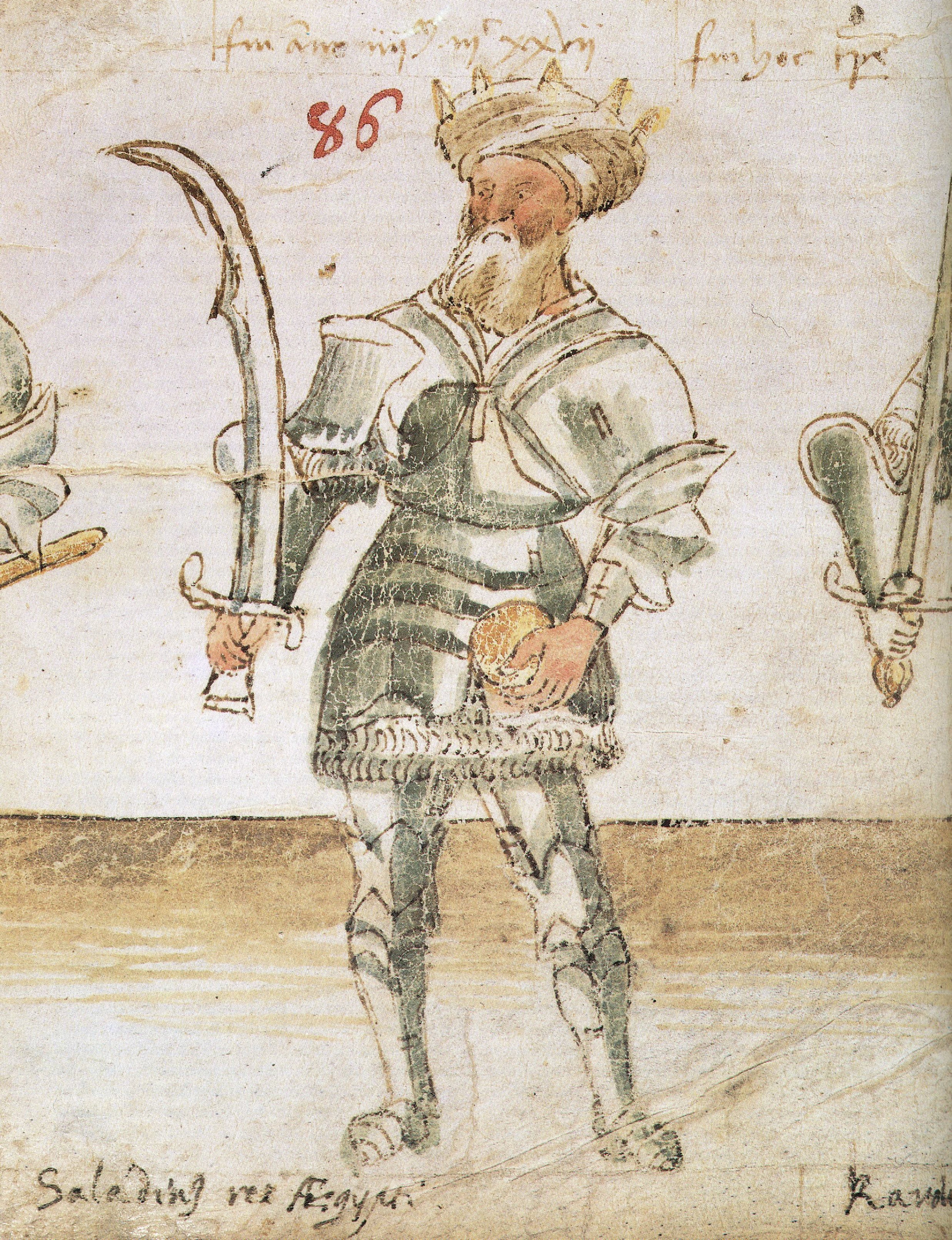
'Oriental' figures (both 'Saracens' or 'Turks'* and Jewish characters are often portrayed with stereotypical weapons or dress, such as wearing turbans. Often their clothing and equipment will be otherwise identical to a contemporary European. For instance, in the linked image above one of the sleeping guards has a turban. In this 15th century depiction of Saladin, the great 'Saracen' commander (he was Kurdish, not that European artists made that distinction) wears contemporary 15th century European armour, and wields a somewhat fantastical sword - very much like the western image of the 'scimitar'. These swords are often shown being wielded by 'oriental' soldiers in manuscripts - they may be based vaguely on genuine shamshir swords wielded by Turkish and Persian soldiers, but they seem more closely modeled on contemporary European falchions and messers.
In general, keep in mind if the event being depicted is contemporary. If it is not, the use of 'antique' or 'oriental' conventions is more likely. Always cross reference something odd with other art, preferably in other media depicting other events.
*Here I am using the period term to convey that this isn't an accurate portrayal of Turkish or Arab or Kurdish or Persian or Moorish dress, but instead a kind of stock character, the Turk or Saracen.