You mean Chinese characters I assume.
Proto-Indo European does not have a written script and neither do its immediate descendants. All of the European branches of it use scripts ultimately derived from Hieroglyphics, proto-Siniatic and Phoenecian scripts.
Brahmi is the first Indic script that did not conclusively derive from the aforementioned scripts. Some scholars say it is derived, some say it isn't. It is not the ancestor of Chinese Characters.[1]
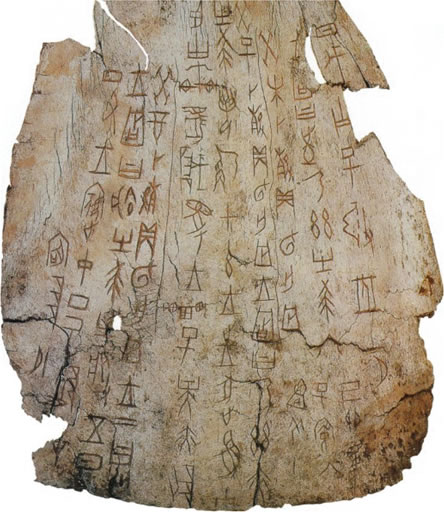
What is, is Oracle Bone Script, Like Chinese characters, Oracle bone script is a logographic system. The earliest script fragments record pyromancy divinations of the Shang Dynasty China. Occasionally, they find earlier Neolithic signs that push them back but these occur singly and are not conclusive evidence: http://news.bbc.co.uk/2/hi/asia-pacific/6669569.stm
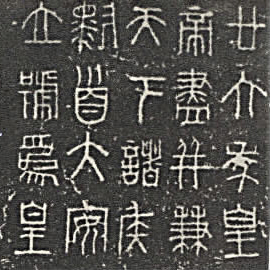
This evolved through various minor archaeological scripts into the Seal Script of Western Zhou to the Warring State of Qin periods. This is prominent because it was the first script to be standardized as formal, during the Warring State of Qin - it was used into the Han era as a decorative script.
During the Han dynasty, caoshu and xingshu developed, they become relevant when Simplified Chinese became a thing in the 1950s in Communist China. The modern Traditional Chinese style comes from kaishu in the Cao Wei Dynasty.
In the 1950s, Communist-run China took symbols from the caoshu and xingshu scripts along with some state-run simplification schemes to simplify Chinese characters for ease of writing and reading. This was not adopted by Taiwan, Japan, Korea, Hong Kong or Macao or any overseas Chinese territory, and is a controversy that has become rooted in Chinese nationalism and well as anti-communist rhetoric for something really simple and misunderstood.
Koreans and Japanese obtained Chinese characters, (Hanja, Kanji respectively) from interactions with China in the 2nd-4th centuries BCE to CE and the 1st Century CE respectively. Hanja is increasingly not used, officially being not sanctioned in North Korea ( but still taught ) and being taught on a limited scale in South Korea. Korea uses the independently developed Hangul alphabet as a replacement for Hanja. Hangul was first developed in the 15th century Joseon dynasty by Sejong the Great.
Kanji is still used in Japan alongside the Kanji-derived Hiragana and Katakana, which are used for small words and foreign words respectively, they are both syllabaries with 52 characters making up the 52 syllables in Japanese ( Yeah, Japanese is that simple. ) Additionally, Japan simplified Kanji during the occupation of Japan by the US in series of orthographic reforms - the characters they came up with do not resemble Simplified Chinese characters at all.
Vietnam, for the record, used to use Chinese characters too for a long period of history. They called them Chu Nom, and they were made up by taking the definition, getting a Chinese character that meant that, and them using a Chinese character that made the sound of the word in Vietnamese. As you can imagine this was ridiculously complicated and thus when the French took over Vietnam, this was phased out rather quickly in favour of a modified Latin vocabulary. I do personally love the charm of Chu Nom, but I recognize it's difficulty of use.
Sources
[1]Hunter, G.R., The script of Harappa and Mohenjodaro and its connection with other scripts 1934
Qiu Xingui, Chinese Writing, 2000
Charles E. Tuttle Co., A Guide to Reading & Writing Japanese, 1961 Edition
Keith Weller Taylor The Birth of Vietnam 1976