Ever since the 60s/70s, the Chinese government has not allowed any of the Emperor mausoleums found to be excavated. This include the tombs of the Ming, Tang and Qin dynasties, including the crown jewel: the mausoleum of the first emperor, due to concerns about preservations and past failures at excavations (such as the catastrophy at the Dinling mausoleum). There have many discussion, for an example see:
http://www.chinaheritagequarterly.org/articles.php?searchterm=008_qianling.inc&issue=008
My question to this sub is, do you agree with the Chinese government's policy to not excavate any of these imperial sites? Is this a policy followed by other countries as well? Or do you think this policy is too cautious and excavation should commence? If not, at what point should they be excavated, if ever? How far are we from that point?
And how much do you think these excavations will impact our understanding of Chinese history?
That's a very hard question to answer and honestly - I am Not quite sure if I am qualified for it. Especially not for the imperial tombs in china.
What I can answer is what happens if things get done too fast, without a clear preservation plan and without a clear idea of what you want to achieve.
I am from Vienna and I studied art history there - and my dad was an archeologist at the Vienna city museum.
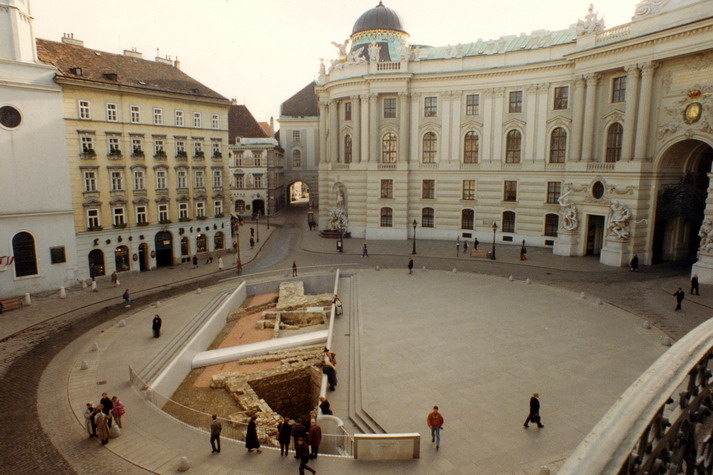
During his job he oversaw the excavation of Michaeler Platz (Michaeler square) if you have ever been in Vienna you can't really miss it since it's right in front of the Hofburg.
This is what it looks like : http://www.hollein.com/var/ezwebin_site/storage/images/projekte/michaelerplatz-archaeologiefeld/350_michaelerplatz_02.jpg/5436-1-ger-DE/350_MICHAELERPLATZ_02.jpg_projectimage.jpg
So the square has quite an interesting history , with buildings from roman times , the Middle Ages and the old imperial theater being located there - and when a new subway line was built they excavated part of the square in the course of the construction.
They found some frescos on the medical buildings - the city wanted to have them displayed in Situ - my dad wanted to cover it up completely or at least transfer the Freskos to a safe spot.
Politically the city won - and the result is that the frescos are basically gone and the ruins are falling more and more into ruin every year since they are exposed to the weather year round.
And the can't really cover it up and keep it visible since this would destroy the sight of the Hofburg from The Kohlmarkt which is a famous view of the Hofburg itself.
So basically even on a very small excavation, in a very rich city, preservation was not done as it should have been done and the buildings are falling apart more and more.
And I think that this is one of the lessons the Chinese learned from a lot of similar projects in Europe - that you need a perfect plan, a perfect idea of what to do and goals and to have the means (both in money and technology) to achieve those goals.
And as long as they are not 100% sure that they can conserve whatever they find in the tomb they won't dig it up - the risk is basically to high for them.