Did they return to Morocco? Were they allowed to practice their religion? Did they face any discrimination?
On page 92 of Anthony Beevor's Battle for Spain, an important note is made that Franco made the regulares honorary christians. On page 401 he depicts the victory parade where regulares took part.
In Preston's Spanish Civil War, the regularles were noted multiple times as being extremely loyal to Franco, ruthless toward both members of the Republican Army and civilians in republican territory, especially on their march to Madrid from Morocco during the early stage of the war. Which is corroborated by Beevor.
The irony of using the conquered from reconquista for Franco's reconquista of the left is one of my favorite ironies of the war (along with Franco denouncing the republicans for having 40 to 60k foreign volunteers during the war while he had the Italians and the german's condor legion).
Anyways back to the point. Preston's book is a biased perception (but still really good) and a great read if you are sympathetic to the republican cause. The republican atrocities are somewhat glossed over and excused by "the disorder of the republic" while the nationalist's were analyzed and described in detail. Preston is biased enough that for me the omission of any maltreatment of the regulares, the repression of their culture or religion by Franco, indicates that they had a privileged status after the war.
The answers to all three questions vary if you look at the situation before or after the independence of Morocco, in 1956.
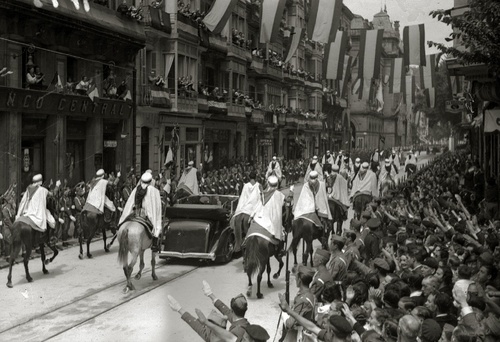
Initially the Moroccan Regulars were part of the occupation army and got their share of the spoils, so hardly discriminated. They got newly built Muslim cemeteries and mosques in Spanish (Peninsular) soil and were paid their salary and pensions like any veteran on the victorious side. The highest ranking Moroccan, Mohamed ben Mizzian (or Meziane) was made commander general of Ceuta in 1939 (a first ever since the Portuguese conquest in the 15th century, for a Muslim), and in 1953 he was made Captain General of Galicia, though we could take the honor of this promotion with a grain of salt as it fits with Franco's well established tendency to put people in places where they couldn't gather support and become a threat to his own power. In this case, he was taking an experienced Moroccan general as far from Morocco or Moroccans as he could, placing him in probably the most Catholic-significant region of Spain, the end of the Way of St. James. Franco also surrounded himself with his own "Moorish Guard", which became a symbol of early Francoism. You can see them here escorting Franco's car during a parade in Madrid.
The change comes in 1956, when France concedes independence to the French protectorate of Morocco and Morocco's king, obviously, demands the evacuation of the Spanish protectorate. Franco ignores the petition for about a month but is finally forced to relent. After that, all Moroccans in Spain are considered Moroccan citizens and are deported or invited to leave for Morocco. The Moorish Guard is dissolved and Ben Mizzian, destined to the Canary Islands in 1955, accepts the offer of Muhammad V to organize and lead the post-independence Moroccan army. Ironically, his first mission will be to brutally crush a rebellion in the former Spanish protectorate where he himself came from, in 1958. Even the Muslim inhabitants of Ceuta and Melilla ceased to be Spanish but in this case they were allowed to stay, since many had been there for centuries. They became stateless with the option to become Moroccan citizens if they wanted to, until the 1980s when they were restored the Spanish nationality.
In 1956 the Moroccan civil war veterans also lost their military pensions. They've demanded their return in recent times but the matter is universally ignored by politicians in Spain and kind of a taboo. Nobody wants to speak about paying some foreigner for killing and raping Spaniards in their wonder years.