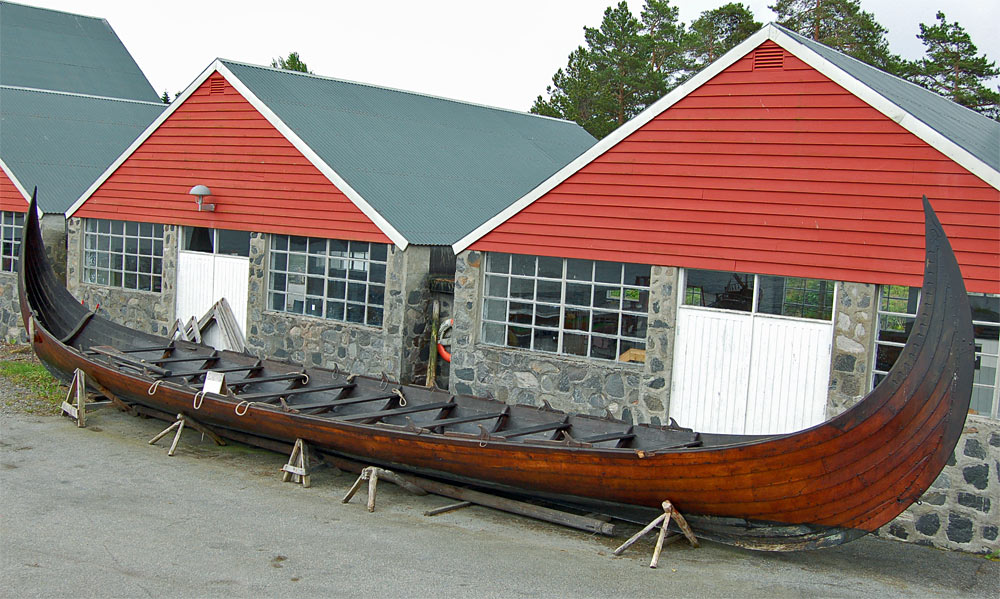
The Vikings (As people know them), or the Norse peoples if you prefer, were all known and respected for the ships they built and what their ships were capable of performing. They respected and venerated their ships extremely much too.
But where did they learn how to build their ships, because I know there are different types, including the longship and compared to the rest of Europe, what kind of ships were they using and how big was the difference/advantage in this regard?
Lastly, a somewhat related question, considering that they as a people had quite decent capabilities of travelling across water, how well did the traders and people in a larger town know about other larger towns in the area of Scandinavia and Northern Europe? (Let's say Kattegatt in Norway and Birka in Sweden) Where there networks of traders, or perhaps a family had ties to a different wealthy family through marriage or pacts?
Thank you all. :)
In the time before the viking age the sail was not yet common in Scandinavia. The ships were rowed, such as the Hjortspring boat from 300 or so BC.
A bit younger an more similar boat is the Nydam boat from about 315. It's the oldest known "Clinker-built" ship. This is a technique developed in the germanic cultures, typical for Longships, German cogs, and traditional nordic boats up to 1900. This ship had no sail, and no keel to support a mast.
Kvalsundskipet from about 690 had a keel, but no trace of a sail yet. Over the next century sails seems to have become common, and in about 790 the viking age starts. The ships keep evolving of course, and you can still recognise much of the older ships in a modern Norwegian fembøring.
Also:
Let's say Kattegatt in Norway
Kattegat is not some city! It's a medieval or newer Dutch name for a small sea between Denmark and Sweden. "Vikings" get that so wrong it hurts to watch.
As for the question: There were close contacts. People traded and raided and colonized between America, the Caspian sea and Italy. Knowing of other places in the nordic nations was no problem.
Take Ohthere of Hålogaland's account given in England for example:
He said that the land of the Norwegians is very long and narrow. All of it that can be used for grazing or ploughing lies along the coast and even that is in some places very rocky. Wild mountains lie to the east, above and alongside the cultivated land. In these mountains live the Finnas. The cultivated land is broadest in the south, and the further north it goes the narrower it becomes. In the south it is perhaps sixty miles broad or a little broader; and in the middle, thirty or broader; and to the north, he said, where it is narrowest, it might be three miles across to the mountains. The mountains beyond are in some places of a width that takes two weeks to cross, in others of a width that can be crossed in six days.
Beyond the mountains Sweden borders the southern part of the land as far as the north, and the country of the Cwenas borders the land in the north. Sometimes the Cwenas make raids on the Norwegians across the mountains, and sometimes the Norwegians make raids on them. There are very large fresh-water lakes throughout these mountains, and the Cwenas carry their boats overland onto the lakes and from there make raids on the Norwegians. They have very small, very light boats.
Ohthere said that the district where he lived is called Halgoland. He said no-one lived to the north of him. In the south part of Norway there is a trading-town which is called Sciringes heal. He said that a man could scarcely sail there in a month, assuming he made camp at night, and each day had a favourable wind. He would sail by the coast the whole way. To starboard is first of all Iraland and then those islands which are between Iraland and this land, and then this land until he comes to Sciringes heal, and Norway is on the port side the whole way. To the south of Sciringes heal a great sea penetrates the land; it is too wide to see across. Jutland is on the far side and after that Sillende. This sea flows into the land for many hundred miles.
From Sciringes heal he said that he sailed in five days to the trading-town called Hedeby, which is situated among Wends, Saxons and Angles and belongs to the Danes. When he sailed there from Sciringes heal he had Denmark to port and the open sea to starboard for three days. Then two days before he arrived at Hedeby he had Jutland and Sillende and many islands to starboard. The Angles lived in these districts before they came to this land. On the port side he had, for two days, those islands which belong to Denmark.