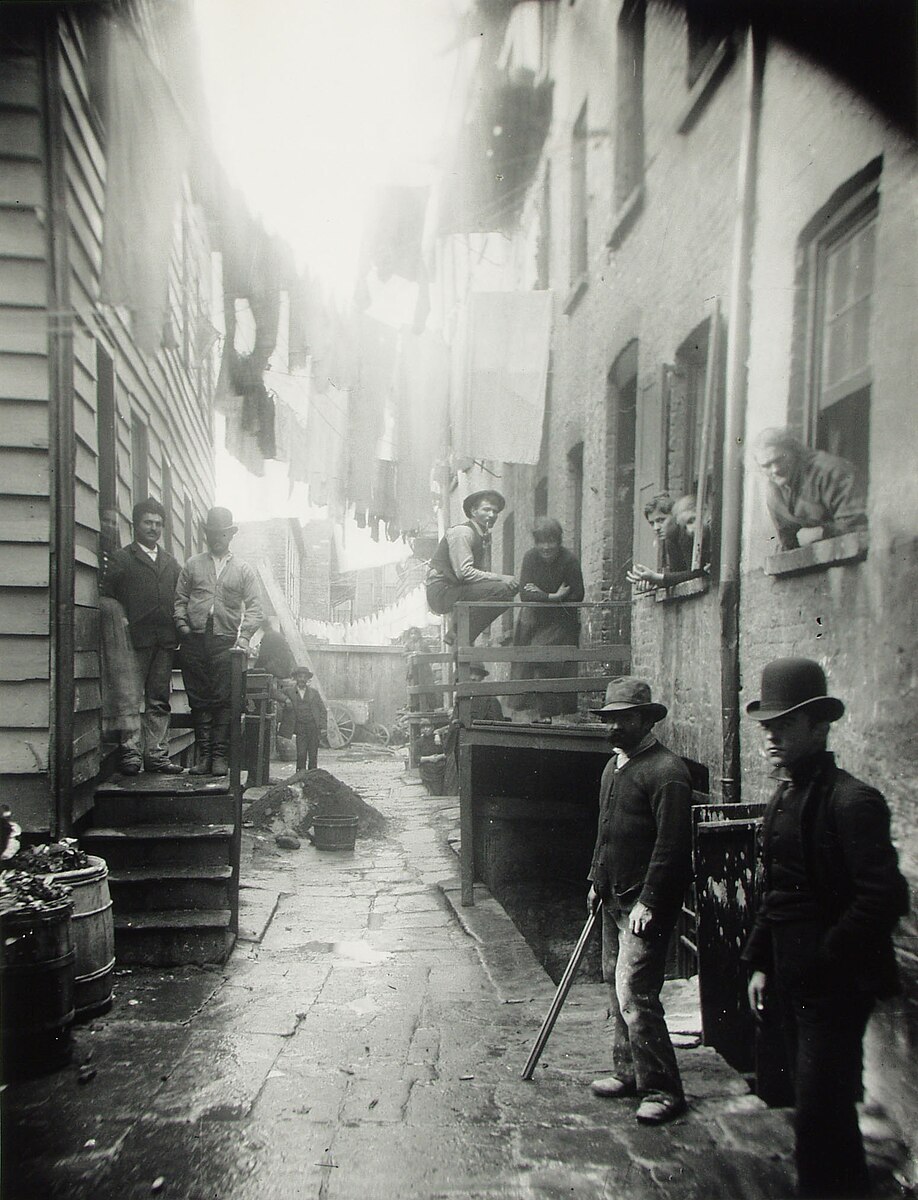
I think a lot of it has to do with urban planning. Most of the "Downtown" area of NYC sprang up piecemeal over the course of the 17th and 18th centuries. There are a lot of these narrow little alleyways downtown.
You can see much of this in the photography of Jacob Riis, a documentary photographer who frequently shot some of tenements and the less-than-savory neighborhoods of NYC in the late 19th century. His famous photograph of Bandit's Roost especially is a great example of the NYC alleyway you are thinking of. Take a look through his photography, and especially the book he published, "How the Other Half Lives" for some more examples of other scenes in NYC alleyways from the period, almost all of which were taken in the Downtown area (Bandit's Roost was actually located in the notorious Five-Points, popularized in Gangs of New York; the neighborhood is now Chinatown).
The Commissioners' Plan of 1811 provided the original design for the grid plan now seen in Manhattan above Houston Street, which maximizes the use of space, perhaps because of the rising cost of real estate. Most of the buildings in this area of NYC are "cheek by jowl" - they are directly next to one another, sometimes even sharing walls - which doesn't allow much space for alleys.
Bandit's Roost was actually demolished as a result of the popularity of Riis' photography; a park was put in its place. People in NYC seemed to believe that alleyways invited "unsavory" activity, and actively sought to get rid of them.
What's an alley? In my mind what an alley is can be found in Manhattan.
You may consider crossposting this to /r/AskNYC, there's a lot of NYC-specific knowledge in there
I did a lot of digging into this a year ago, trying to answer the question why was Chicago platted with alleys in 1830 when Manhattan was planned without any in 1811.
There's a frustrating lack of research resources on alleys. The few things ever written either focus on the alley dwellings of Washington City, or fail—as the Wikipedia entry does—to distinguish between minor streets and service lanes.
Poring through the plats reproduced in John W. Reps's book The Making of Urban America, I concluded that the big difference was what kind of houselot purchasers the platters/planners expected—and whether they would be expected to have their own horses. So in tight coastal mercantile cities like New York or Baltimore, it was not expected that the purchasers of houselots would be "country folk" with their own horses to be stabled, fed, and mucked in the rear of the house. When the 1811 Commissioners Plan was drawn, they already knew something about what kind of city New York was. Meanwhile, in sprawling "new town" plans such as Philadelphia or Washington City, the expectation was apparently that big houses would be on generous lots with gardens, and have side drives to their own stables. As these cities became more populated, however, the original blocks proved too large for the urban middle class, and minor streets were cut through the big blocks, as seen on Society Hill.
It looks like the first use of alleys comes in Oglethorpe's 1733 plan for Savannah. The 1740 plan for nearby Neu Ebenezer, Georgia, to be settled by Protestants from Salzburg, shows kleine Gaßlin: small back lanes in an explicit hierarchy of streets. Eight decades later, as new towns were platted in the Ohio Valley and the Old Northwest, the expectation seems to have been that many houselot purchasers would have their own horses, to tend to business in the surrounding countryside. By the time of Chicago’s platting in the 1830s, the use of alleys seems to be so expected that the state legislature merely prescribes that the canal commission should subdivide the townsite into “town lots, streets, and alleys” such that the lots will easily sell.
I was unclear. I live in Alexandria, LA. The tanks were supposedly staged about 10 miles outside of town on land that later became an LSU satellite campus. My neighborhood is supposedly where the bigwigs lived at the time.
I am now unsure how much of that story I have investigated on my own, however. I'm going to do some checking tonight.