Currently reading the new definite edition of Heinrich Gerlach's The Forsaken Army which is now called Durchbruch bei Stalingrad. The Romanian troops are only mentioned in passing as poorly equipped and unorganized and I know that some Germans like to blame them for the encirclement of the 6th Army.
Yes, there exist several harrowing firsthand accounts of the Italian experience on the easter front, the most famous being written Italian poet Mario Rigoni Stern, called "The Sergeant in the Snow" (it. Il Sergente Nella Neve) recalling his experiences as a Sergeant Major on the eastern front.
Up until the battle of Stalingrad, the Italian presence in Russia was limited to the "Italian Expeditionary Corps in Russia" (it. Corpo di Spedizione Italiano in Russia) numbering some 62,000 deployed in Ukraine as part of the German 11th Army in the summer of 1941.
With the 1942 stalemate on the Russian front, in the summer of that year the Italian Expeditionary Corps was expanded to 229,000 men to constitute the Italian 8th Army, also called Italian Army in Russia (it. Armata Italiana in Russia) attached to the Germany Army Group B engaged on the lower Don River, and consequentially the siege of Stalingrad.
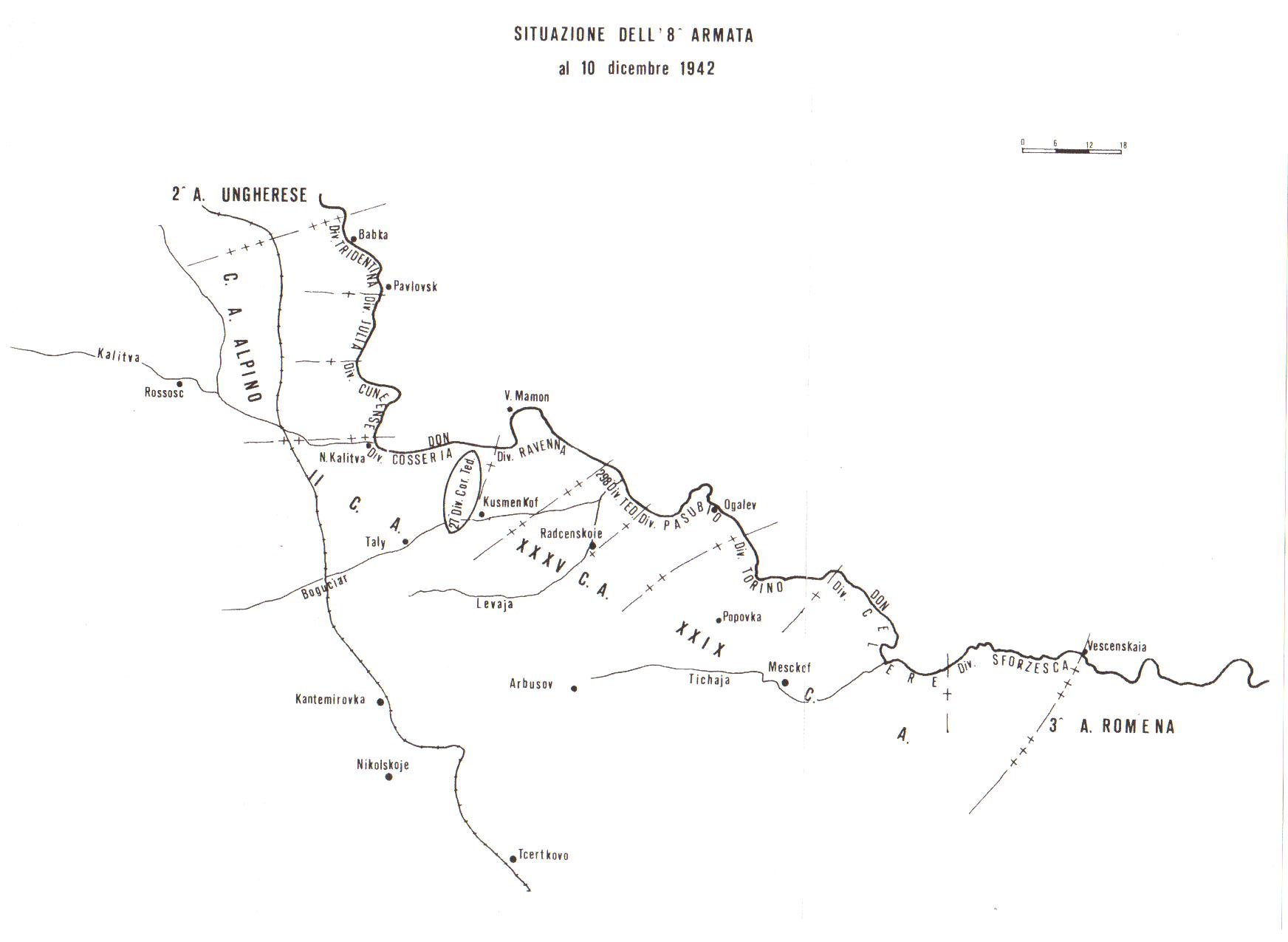
In the winter of 1942 Italian 8th army was placed on the left flank of the German Army engaged in Stalingrad, between the Hungarian 2nd Army and the German 6th Army, later substituted by the 3d Romanian Army. The left flank of the Italian 8th Army was constituted by the Alpine Corps made up of the "Tridentina," "Julia," and "Cuneense" divisions originally destined for the caucasus but redirected on the Don following the protracted fighting at Stalingrad, while the center was constituted by the II Corps with the "Cosseria" and "Ravenna" divisions, centered on the town and bridge of Verchnij Mamon on the Don. The right flank was made up of the "Pasubio," "Torino," and "Sforza" regiments which had suffered heavy casualties in august (especially the "Sforza" which had held off the Soviet attempt to establish a bridgehead at Serafimovič) and were consequentially reinforced by the 298th and 62nd Infantry Divisions of the Germany army. The German 294th Infantry, 22nd Armor and the Italian "Celere" (which had also suffered many casualties in the summer) guarded the rear. This image roughly sketches the Italian positions along the Don.
Morale was not the best amongst the Italian troops, especially amongst the Alpine divisions, perplexed at finding themselves deployed in the steppes. A severe lack of motorized transports meant that even the freshest troops had marched as much as 500 kilometers on foot before reaching the front, and the Italian high command was well aware that their army was lacking vehicles, artillery, and antitank guns.
On November 19th in 1942 the Soviets began their counteroffensive, breaking the Axis line by annihilating the Romanian 3d army just north of Stalingrad, between the German sixth army and the Italians. By December 16th, the Soviets also broke through the center of the Italian line, manned by the "Ravenna" division, and by December 19th were some forty miles behind the Don River, consequentially encircling and in great part annihilating the Italian army in Russia save the Alpine regiments, which held their positions on the Don until January 19th, 1943, when the Soviets broke through the Hungarian 2nd army just to the north of the Italian army, which then had no choice but attempt a full retreat in order to avoid encirclement. Needless to say, encirclement was inevitable.
This is where The Sergeant in the Snow picks up its narrative. The Italian retreat was by no means easy; the Tridentina division marched at the head of the column, while the Julia and Vicenza guarded the left flank, but miscommunication led to the latter two divisions being isolated and completely picked off by the Red Army as the Tridentina adjusted its course to some twenty miles to the north, hoping to find the Russians less entrenched at Nikolaevka. Indeed the two hundred kilometers or so that the Italian army marched in retreat before the encirclement was broken at Nikolaevka is described in almost every narrative as utterly chaotic;
Orders are no longer effective, only the most energetic and esteemed officers are obeyed in any way, but the troops are seized by the psychosis of defeat, they seek shelter in izbas that are overcrowded, but warm. The streets in cities are literally blocked by carts, quadrupeds, and german motorized vehicles that can't get through. Violent arguments break out between Italians and Germans, the latter don't hide their disapproval for their impotent ally, reduced to exhaustion, while the Italians can't ignore that the Germans have abandoned to death or certain capture thousands of con-nationals on the frozen steppe [...] In the mess, with the march gravely impeded by the cold and the equipment, principally shoes which do not hold out at 30 degrees below zero (men wrap their feet in hay and rags to avoid freezing) general Nasci welcomed a small item of good news: what is left of the German 24th corps will transfer under his command with everything it was able to save: four tanks, two self-propelled artillery and some cannons. It's a help he couldn't even hope for, as he prepared for the great retreat towards west. Now he must organize the columns, with the wounded and frozen on sleighs. The orders are to destroy all archives, abandon all that is not necessary and begin the march.
(translated by me from Enzo Biagi's "La Seconda Guerra Mondiale")
The only Italian division to break out of Nikolaevka in any recognizable shape was the Tridentina. However, its travails would not end there. En route to Italy, the vast majority of its men would be interned by the Germans and employed as forced labor in German factories by the summer of 1943, when Italy pulled out of the war.