I'm specifically interested in Texas and the southwest but any responses are welcome
I've written about this subject in the Southwest before, here and here, that you may be interested in. The second half of this post is also entirely about Hohokam canal irrigation.
Because the climate in the U.S. Southwest is not conducive to agriculture in most places - because of the lack of rainfall and groundwater - the farming cultures of the Southwest developed an extensive array of farming techniques to succeed in an unfavorable environment. This was especially necessary given that the primary subsistence crop - maize - was originally a subtropical plant. Extensive breeding of maize into hardier, arid-adapted forms was necessary to support large populations via maize agriculture in the Southwest.
In terms of chronology, domesticated maize was introduced into the Southwest as early as 2000BC if not sooner. Early agricultural communities begin popping up in the Tucson Basin and in Sonora at Trincheras sites (like Cerro Juanaquena) around 1500-1000BC, but you don't see a widespread transition to fully agricultural subsistence across the Southwest until around AD500.
This not coincidentally coincides with the introduction of beans into the Southwest from Mesoamerica. The famous "three sisters" trinity of crops - maize, beans, and squash - were the staple of agricultural societies in Mesoamerica, and likewise made up the core of agricultural diets in the Southwest (and in the Eastern Woodlands of the U.S.). The three together make up a complete protein, and in particular, iron-rich beans make up for the biggest nutritional deficiency in a corn-based diet. There are archaeological examples of severe anemia in native populations in northern Florida due to the imposition of a strictly-corn-diet on native people by the Spanish. Beans are absolutely crucial to living a purely agricultural lifestyle - earlier agriculturalists combined small-scale agriculture with hunting and gathering activities to supplement.
However, even after the introduction of beans, foraging activities were an important part of life in Southwestern agricultural societies. Despite the very clever agricultural technologies invented by Southwestern people to adapt to dry-land farming, agriculture was still a risk, especially for societies coming close to the carrying capacity of the environment. A general lack of rainfall can be compensated for by these agricultural techniques (that I'll mention below), but an additional challenge of the environment is high annual variability in rainfall - i.e. the amount of rainfall, and consequently snowmelt and other runoff, is variable from year-to-year. Because of that, foraging can be used to spread risk, rather than relying completely only agriculture (even with advanced agricultural techniques). Even if the foraging yields are bad due to low rainfall in a particular year, utilizing foraging and agriculture together is a better usage of land area, and consequently water resources.
The agricultural techniques developed to mitigate water scarcity in an arid environment include massive canal systems (such as those developed by the Hohokam in the Phoenix and Tucson basins of southern Arizona), as well as farming techniques still practiced today by many Pueblo groups. For instance, utilizing talus slopes composed of loose gravel and sands (like these in Chaco Canyon) to catch and absorb moisture and runoff. A similar technique is used at Hopi pueblo for "dune farming", where sand dunes can act in a similar way to trap moisture. These dry-farming techniques are highly effective at utilizing marginal areas. I've seen archaeological and modern examples of using gravel "mulch" spread on farming plots to retain moisture in a similar fashion.
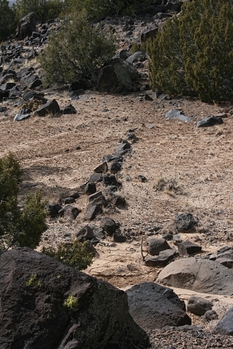
Direct water control was also practice beyond irrigation canals, with various check dams and terraces capturing runoff through washes and down slopes, either creating small reservoirs or making sure that water from flash flooding (common in the desert) lingers on a patch of land long enough to penetrate the soil and help germinate crops. Something like this: that flat, raised area behind the terrace would have been the small farm plot.
That's just a quick sketch of agriculture in the prehistoric Southwest - there are more details (particularly about canal irrigation) in the posts I linked to at the top.