This article claims as many as one in every 250 people in the US at the time worked on the Manhattan Project. I've always thought of the Manhattan Project as a group of physicists and mathematicians working secretly, so I was pretty surprised by these numbers. Why were so many people used in this project? What did they all do?
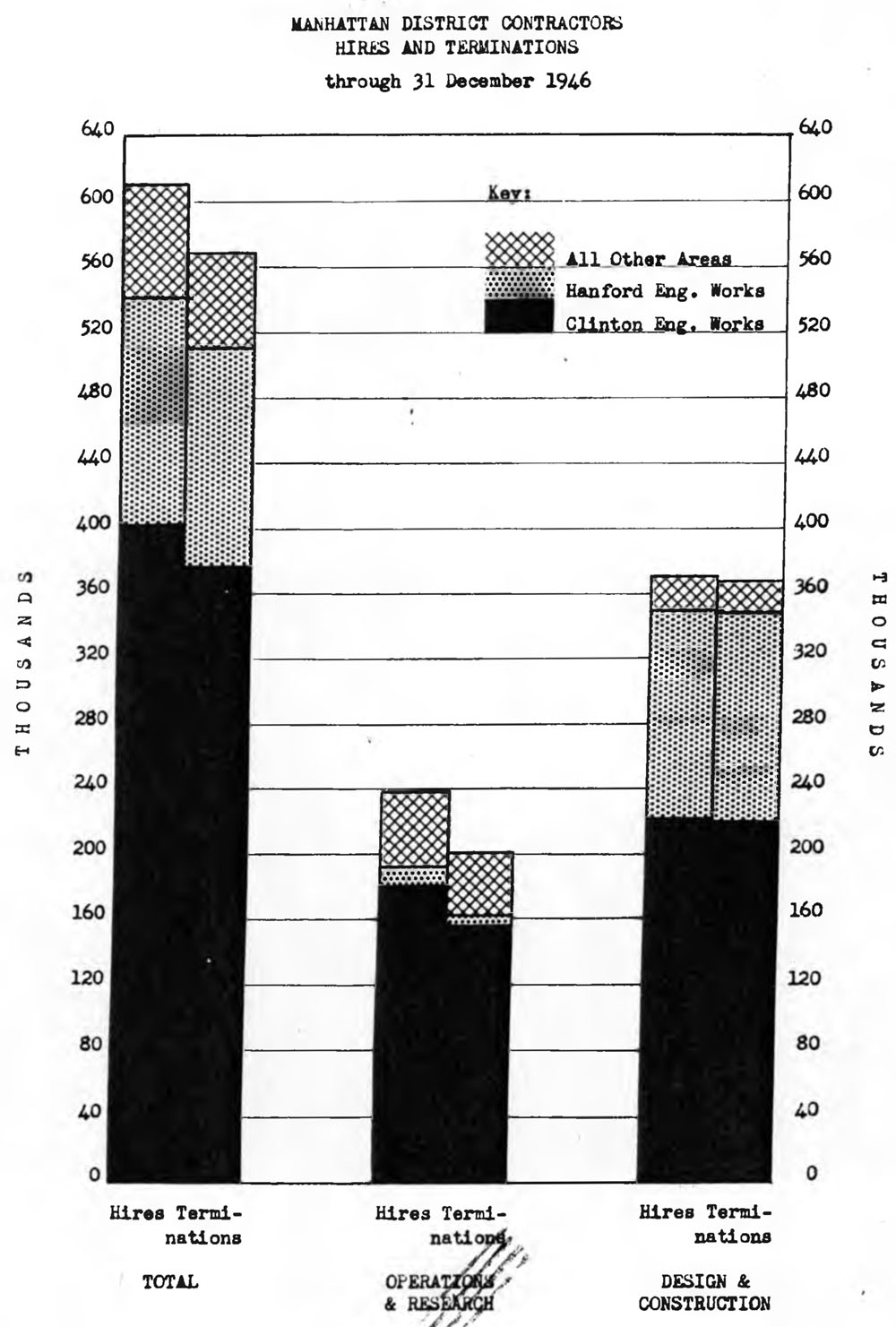
This table of totals here speaks volumes if you know how to interpret it:
67% of the labor was at the Oak Ridge site ("Clinton" here) for enriching uranium. Of that labor, 45% was devoted to "operations and research" and 55% "design and construction"
23% of the labor was at the Hanford site for producing plutonium. Of that labor, some 90% was "design and construction," the rest was "operations and research."
All other parts of the project make up the remaining 10%, and some 80% of that was "operations as research," the rest being "design and construction."
You also have to take into account that both Oak Ridge and Hanford had massive turnover rates. People were quitting/transferring at rates of 10-20% a month at those sites. So there was a constant need for replenishment on top of any growth.
So what does that tell us about what it takes to make a bomb during World War II? Yes, there were several thousand scientists working on the project — the people who usually get the credit for making it. They were clustered in a few laboratories (Los Alamos, Chicago's Met Lab, Berkeley's Rad Lab, and a few smaller labs), doing hard work. But the vast majority of the effort was about industrial construction and operation of the sites that produced the fissile material (enriched uranium and plutonium) that were used as the fuels of the bomb. At Hanford this meant constructing three industrial-sized nuclear reactors and the facilities necessary to strip plutonium from spent nuclear fuel. At Oak Ridge this meant a massive complex, including the largest factory in the world under one roof at the time (the K-25 plant), to enrich uranium using three separate methods (thermal diffusion, gaseous diffusion, and electromagnetic separation).
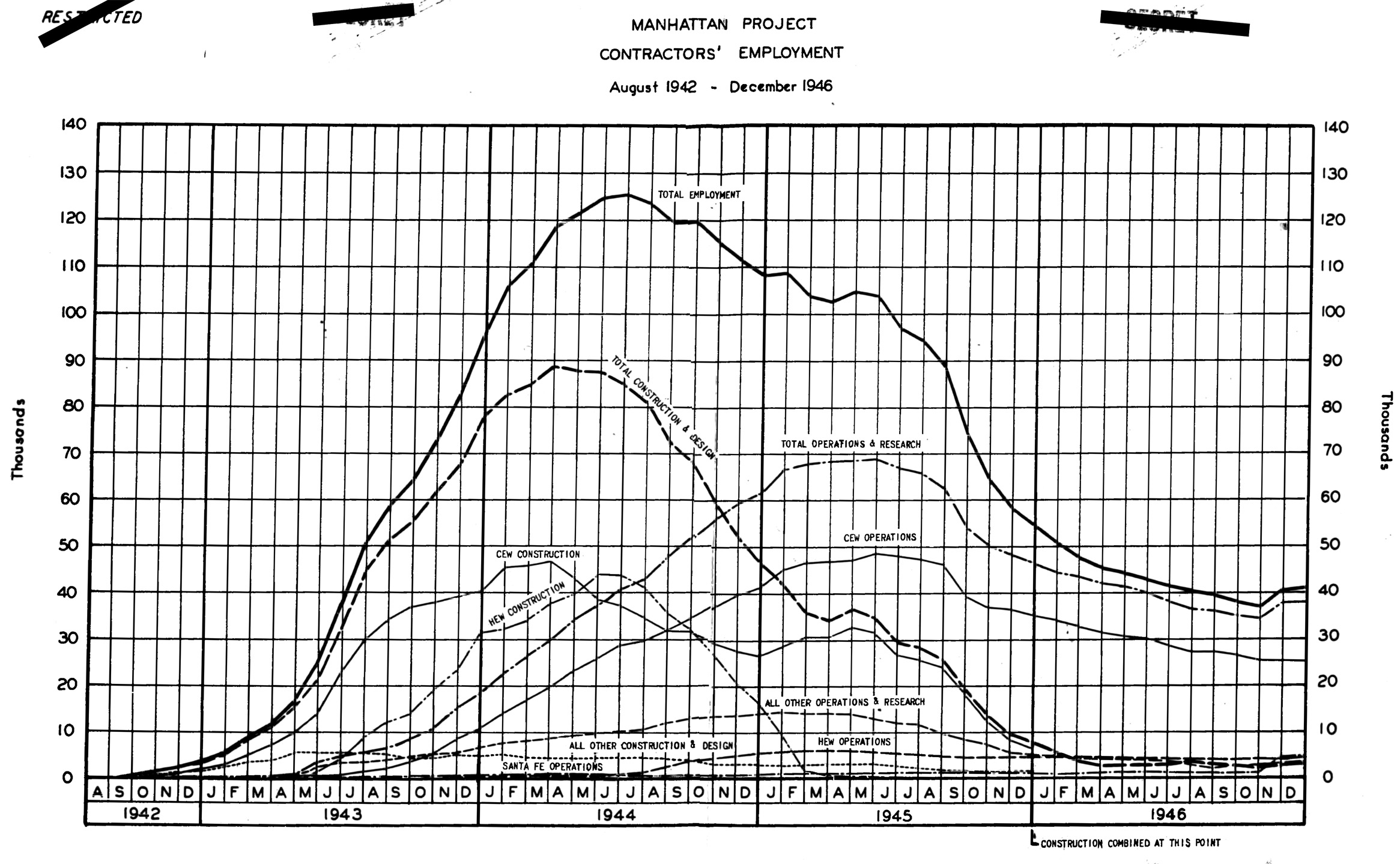
If you look at the labor shifts over time you can see this quite clearly. There was a massive amount of labor being employed in 1943-1944, almost entirely construction. Then, once the sites were built, there were fairly large amounts of labor, especially at Oak Ridge ("CEW" here, versus Hanford as "HEW"), devoted to running them. The scientific labs, which fall under "Santa Fe" (Los Alamos) and "all other" headings, barely show up on the graph.
These labor figures map very well onto the cost figures of the Manhattan Project: 63% of the expense of the project went to Oak Ridge, 21% to Hanford, and a mere 8% went to Los Alamos and other research aspects.
What do this tell us? For one thing, that our perception of the Manhattan Project and the atomic bomb as being solely about scientific research is dead wrong. It is about scientific research coupled with industrial development (under military auspices — specifically that of the US Corps of Engineers, who are in charge with engineering and development projects).
Knowing this explains many important things, such as why other countries didn't build the bomb (it wasn't easy, and it wasn't just about scientific theory), and even informs questions like, "why were those people who made it so keen on using it?" (among other considerations, they were trying to prove their money's worth). It also raises new questions, like "how did they keep it all secret?" (most of those buildings and even operators had no idea what they were working on — they were only told the bare minimum they needed to know to get the job done). And so on.
If you are curious about the work done inside the "secret city" of Oak Ridge during the war, the largest of the installations, Denise Kiernan's The Girls of Atomic City: The Untold Story of the Women Who Helped Win World War II (Touchstone, 2013) is a good popular account. I am also fond of Stan Norris's biography of General Leslie Groves, the engineer who oversaw the entire project, because it focuses on the industrial/engineering/organizational sides of the story more than the "science" side that usually (and erroneously) gets all the credit: Racing for the Bomb: General Leslie R. Groves, the Manhattan Project's Indispensable Man (Steerforth, 2003).
Pinging /u/restricteddata, the author of the linked blog article